The modern marketer has a peculiar problem. The audience is speaking all the time, in public, at industrial volume. Some of it is praise. Some is fury. Some is a person waiting for a train and developing an opinion about a logo. Some of it is a machine wearing a person's syntax. David Low has spent a quarter-century getting progressively closer to that noisy room. First he made the messages. Then he built an agency around connecting them. Then he marketed software that listened to the answers. Now, as chief marketing officer of Cyabra, he works on the question beneath the answer: who, exactly, is doing the talking?
It is an unusually tidy arc for a career that crossed Madison Avenue, startup software, consumer intelligence and defense-oriented AI. Low has worked on the MasterCard Priceless platform, Microsoft's Xbox introduction, Nokia and Verizon Wireless. He co-founded a New York agency and helped grow it to 70 people. He later became CMO of Kerauno and Talkwalker, advised BigBear.ai, shaped the market launch of Moonvalley AI, and joined Cyabra in June 2026.
The technologies keep changing. His favorite question barely does: what helps a person make the next good decision?
Before the dashboard, the big idea
Low studied communication at Boston University from 1990 to 1994. There is one biographical detail that feels more useful than a line of course titles. He captained the university's lacrosse team in 1992, 1993 and 1994. Three seasons is long enough for leadership to stop being an honor and become a recurring Tuesday afternoon obligation.
He entered advertising and held senior roles at BBDO, Grey and McCann Erickson. Those were institutions built for the era when a few large brands could buy a great deal of the public's attention at once. The assignments on Low's record have the heft of that period: MasterCard, Microsoft, Nokia, Verizon. A product launch such as Xbox demanded more than an attractive advertisement. It needed a place in culture, a promise that could travel, and coordination across the innumerable rooms of a large agency.
Those rooms created the problem Low and Scott Elser set out to solve when they co-founded Launchpad Advertising. Big agencies had expertise, but their disciplines could become silos. Small specialist shops could move quickly, but often saw only their slice. Launchpad organized itself around what it called “Interaction,” a view of communications across the entire route from brand to purchase. Low's compact phrase for it was “brand-to-buy.”
Launchpad appeared on the Inc. 500 in 2012. At the time of the announcement it had 35 employees near Union Square and clients ranging from startups to Fortune 200 companies. It later grew to 70. Awards and headcount are pleasant facts. The more revealing detail is the operating argument: clients did not experience their businesses as separate boxes marked digital, retail, CRM and television, so the agency should not behave that way either.
A jar of peanut butter in the strategy room
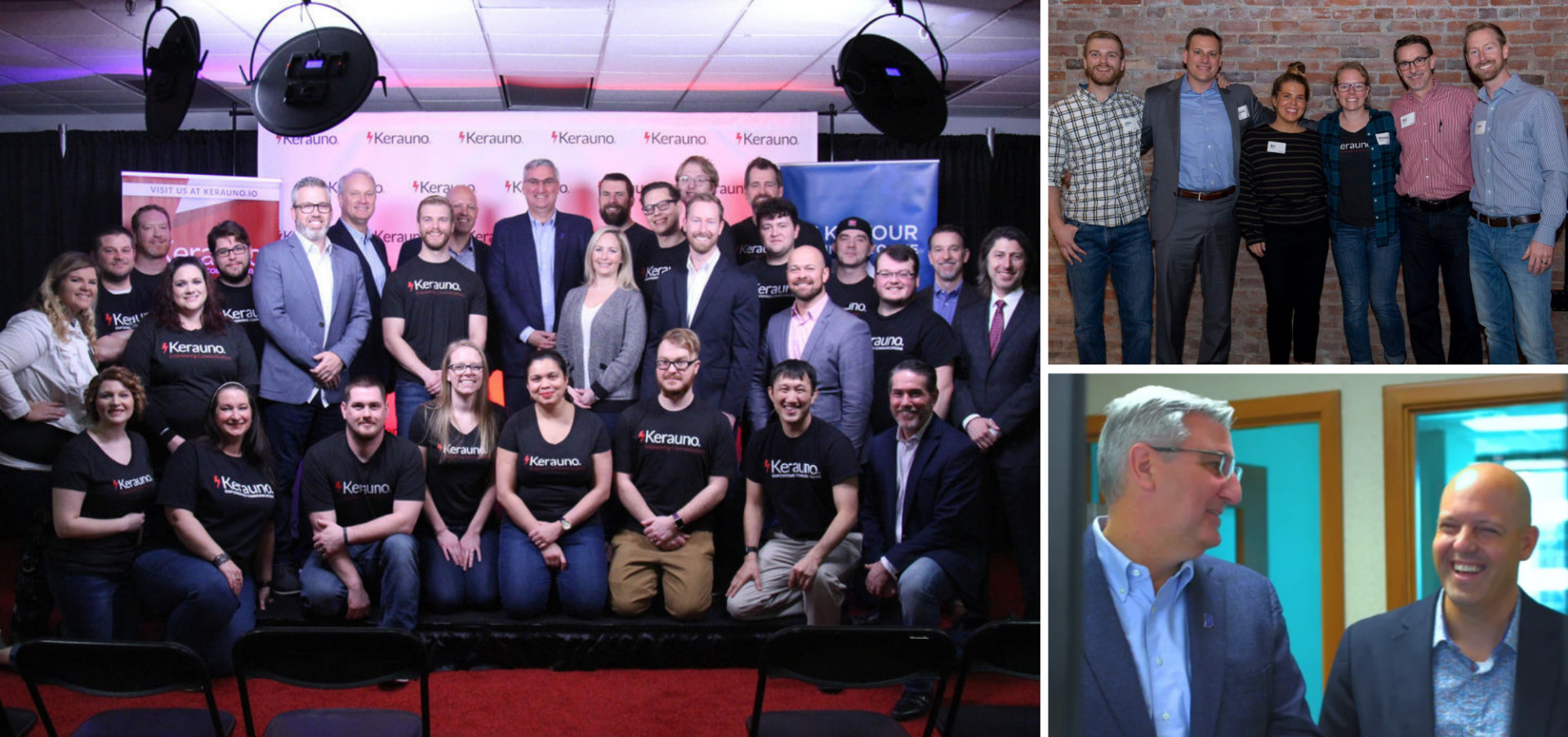
By 2019, Low was applying that instinct inside a communications-software company in Indianapolis. Kerauno connected workflows, systems, devices and people. The company was growing quickly, with nearly 100 employees at the time, and the abundance of possible markets created its own danger.
Low called it the “peanut butter problem.” An ambitious young business spreads itself across too many opportunities. Every surface receives a thin coating; no customer gets enough substance. The metaphor is funny enough to survive a planning meeting and precise enough to be useful after one. Kerauno concentrated on smaller companies with roughly 25 to 500 employees while larger competitors moved upstream.
His public account of the Kerauno period says he built a marketing team and technology stack during 224 percent year-over-year revenue growth, and oversaw the sale of the company's largest business unit. Yet the way he explained the product was resolutely human. Software companies, he argued, too often optimized systems and forgot the communication moving between people. “Technology gets leapfrogged pretty quickly,” he said, “so it's important to understand who we are at our core.”
Four turns toward the signal
When listening became a machine job
Low joined Talkwalker in 2022 as vice president of marketing for the Americas and rose to global CMO that December. Social listening presented a larger version of the integration problem. A major brand could attract millions of mentions across networks, blogs and news. Reading them was impossible. Counting them was insufficient. The useful work lived between the two.
His division of labor for AI was crisp. Let machines perform the heavy sorting. Give people more time to decide what the patterns mean. “Less number crunching, more results,” he said. This was neither a hymn to automation nor a defense of manual drudgery. It was a job description.
He was equally unsentimental about shiny trends. Asked whether marketers needed metaverse-specific content, Low returned the question to audience behavior. If customers were there, the channel deserved attention. If a brand merely wanted a fashionable accessory, it did not. The stance rhymes with the peanut butter warning: strategy is the courtesy of choosing.
At Talkwalker, Low led a global team spread from New York to Luxembourg and Singapore. The company's own listening platform became a shared source of truth for campaign and brand decisions. He argued that predictive analytics could help marketers move from reacting to conversations toward anticipating their direction. Cyabra later credited his marketing transformation with helping position Talkwalker for its acquisition by Hootsuite.
The crowd acquires a mask
Social listening rests on an old democratic comfort: enough individual voices, gathered together, reveal something true. The premise becomes shaky when coordinated accounts can imitate enthusiasm, outrage or investor conviction. A metric may be calculated perfectly while the behavior beneath it is staged.
That is the commercial story Low took on when he became Cyabra's CMO in June 2026. The company analyzes manipulated content, coordinated behavior and inauthentic actors for enterprises and governments. His mandate is to expand demand across both groups and help establish “narrative intelligence” as a category. It is a marketing assignment with a pleasing degree of difficulty: explain why an organization should question the apparent public mood without teaching it to distrust the public.
Low frames the moment as another technological hinge. He has said he wants to build inside the category because online manipulation now reaches beyond digital feeds into reputation, markets and public decisions. Cyabra's recent research, which he has highlighted publicly, examined networks posing as traders and alert accounts rather than behaving like obvious spam. The disguise is more convincing because it borrows the language of the genuine article.
His planned September 2026 talk in New York carries a marketer's title for the problem: “There's Finally a Name for What's Hijacking Your Brand Narrative.” His proposed SXSW 2027 panel is blunter still: “Truth Has a Visibility Problem.” Both titles understand that accuracy alone does not win a contest for attention. Truth must also be findable, legible and timely.
The people behind the machinery
Low's decision to join Cyabra did not turn, at least in his telling, on the fashionable menace of bots. It turned on the team. CEO Dan Brahmy said the company considered hundreds of applications and met candidates across several geographies. During two months of conversations, Low kept returning to the people. In the appointment announcement, he called them genuine, mission-driven and committed to one another. “At the end of the day, great people make it worth it,” he said.
The remark fits his earlier view of company culture. People are the lifeblood of companies, he has said, and technology should make their work more consequential. Public recommendations describe him as direct, insistent on clarity and unusually self-directed. One creative partner praised the way he challenges work while staying invested in the partnership. A former client executive characterized him as someone who can take a complex assignment and run with it.
This gives his career a warmer logic than the sequence of acronyms suggests. P&Ls, SaaS, AI, CMO: the alphabet soup is only useful when somebody gets fed. Low's work has moved from persuading an audience, to listening to it, to checking whether it exists in the form the numbers imply. Through each stage, he has argued for focus, clearer action and a human being at the end of the system.
The coming years will produce more data about what everyone appears to think. They will also produce better imitations of everyone. Low's new task is to help organizations tell the difference without losing their nerve or their curiosity. It is the old advertising problem in sharper clothes: earn attention, understand the audience, and do not spread the strategy so thinly that you can see the bread.