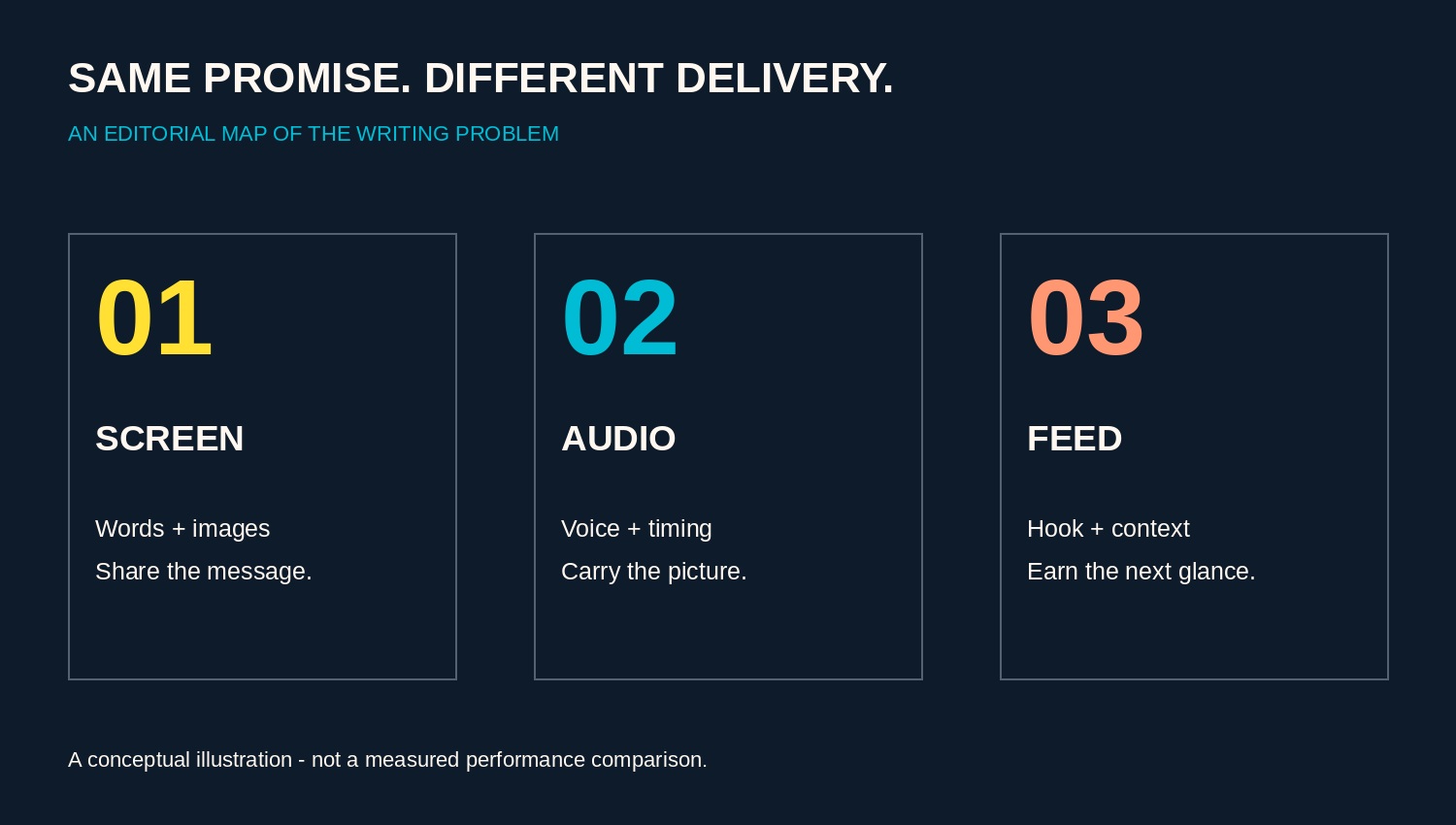
Imagine a commercial with the sound turned off. A face, an object, a reaction: the pictures can carry part of the argument. Now imagine the same message arriving through headphones. Every useful detail has to find another way in. For a writer, that change is an assignment in itself. It is also a useful way into Copywriting, the advertising practice associated with Caroline Casey, whose listed specialties put comedy, television, and podcast scripts within the same small circle.
- The work: commercial scripts, brand and campaign writing, creative consulting, product copy, and social content.
- The distinction: comedy sits alongside writing for both screen and audio.
- The useful takeaway: test the message in the medium where the audience will encounter it.
The company’s public description presents a writing service with several entry points. A marketing team might need a campaign concept. An agency might need a script. A product business might need descriptions that tell a customer what they are looking at. The interesting question is how these assignments relate. Read as positioning, the offer suggests that voice is something to work on across formats, rather than a paragraph that lives inside a brand document.
The ear is a different editor
Copywriting lists both television and podcast commercial writing. That pairing matters because it invites a practical test. Put a script on a page and the reader can go back. Put it in someone’s mouth and the listener receives the sentence at the speaker’s pace. A clause that looks tidy can become a small obstacle when it has to be heard once.
This is an editorial reading of the service mix, rather than a claim about Casey’s private process. But it gives a prospective client something concrete to evaluate. Ask for writing in the format you intend to use. Read the audio copy aloud. With screen work, ask which information belongs in the picture and which information needs words. A portfolio is more useful when the assignment is clear.
The joke needs a destination
Comedy is another of the practice’s stated specialties. In a commercial context, that is an intriguing ingredient. A joke creates an expectation and then rearranges it. A selling message has a destination: some understanding, preference, or action the advertiser wants to encourage. Put them together and the commissioning question becomes wonderfully specific. Does the funny part help the audience get there?
Consider a hypothetical product ad built around an elaborate misunderstanding. The scene might be amusing enough to retell. Yet if the product could be exchanged for anything else without changing the scene, the brand has bought a rather expensive guest appearance. A useful review asks what the audience remembers after the laugh. This is a way to assess the work, not a claim about any particular campaign in Casey’s portfolio.
Read the audio copy aloud. Ask what the picture can say. Give the joke a job.
An editorial checklist for commissioning the work
One promise, several assignments
The company’s client list names NBC, TruTV, Saatchi, the NFL, Walmart, Procter & Gamble, L’Oréal, Bounty, Tide, thredUP, Red Door At Work, and Sierra Trading Post. Treat that as a list of claimed client experience, rather than evidence that every name represents a current account or the same kind of assignment. It places entertainment, agencies, sport, and consumer products within the practice’s stated experience.
Its services also include branding strategy, integrated campaigns, creative app consulting, product descriptions, and social media writing and management. Those are different purchasing decisions. A campaign can require a central idea and several expressions of it. A product description must help someone understand a particular item. Social management adds the question of what happens after an individual post goes live.
For a buyer, the breadth is useful only if it becomes a precise brief. The phrase “brand voice” can conceal several disagreements: who is speaking, how familiar they should sound, and what the customer already knows. A commissioning team can resolve some of those disagreements before hiring. Choose an audience. Choose a promise. Then decide how that promise should behave in each setting.
Buy the assignment, not the adjective
Copywriting belongs in the market for professional creative services. The relevant alternatives are other independent writers, specialist studios, agency creative departments, and in-house teams. The comparison should begin with the work. Someone looking for a script has a different problem from someone building a continuous publishing operation. A broad service description is an invitation to discuss scope, not a specification by itself.
That distinction also makes cost a more useful conversation. A prospective client should define deliverables, versions, revision rounds, approval responsibilities, and whether production support is needed before comparing proposals. A fee for one finished script and a fee for ongoing social management purchase different obligations. The same discipline applies to deadlines: identify who can approve the work and when they will be available.
The fit becomes weaker when a client needs a complete production operation but has only commissioned words. Establish who owns design, recording, editing, and distribution. Equally, a comedy brief needs permission to make choices: a team that cannot agree on tone may struggle to approve the result. These are questions about the assignment’s conditions, rather than judgments about the practice’s capacity.
A brief you can steal
Here is a practical exercise suggested by the practice’s combination of formats. Write the customer’s question in one sentence. Write the product’s answer in another. Add the evidence that makes the answer believable. Finally, name the action you want the audience to take. These are editorial recommendations anyone can use; they are not a reconstruction of the company’s working method.
Now adapt that little brief three ways: something to see, something to hear, something to encounter while scrolling. Notice what has to change. If an audio version depends on an unseen demonstration, the explanation needs work. If a humorous version obscures the answer, simplify it. If every format sounds identical, ask whether consistency has become repetition. Copywriting’s service mix makes that exercise worth trying. The words have several stages to perform on. They need to know which one they are standing on.