The neatest thing about Maurice Herrera’s favorite piece of marketing jargon is that it refuses to stay in the marketing department. “Stratecution” sounds like something cooked up during a long meeting and kept alive by a PowerPoint template. In Herrera’s hands, it became a brisk test of whether ideas could survive contact with Monday morning. Strategy and execution, he liked to say, rise or fall together. One supplies direction. The other supplies proof.
That proposition followed him through a career of unlikely neighbors: cereal and soup, gum and candy, weight management and home carbonation, rental cars and universities. The products changed. The central question did not. Why should a person choose this, and what must an organization do to deserve the choice?
Herrera eventually put the question in even less ceremonial language while chairing a marketing roundtable at Avis Budget Group: “What has marketing done for revenue lately?” It is hard to hide behind mood boards after that. His version of brand building asks for emotional precision, operational discipline and a number at the end.
A Brooklyn education
The personal story begins in East New York, Brooklyn. Herrera attended New York City public schools and remembers teachers who saw potential in him. His parents had come to the United States at age 30 with, as he later wrote, little more than grit and faith in hard work. They stretched to pay for a private high school. It was one of several acts of confidence that Herrera would later identify as decisive.
Binghamton University followed. He studied mathematics and economics, played basketball “for a minute,” found opportunities to lead and met the woman he would marry. The comic timing in that basketball aside says something about his public manner: polished, earnest, but alert to the danger of sounding polished and earnest for too long.
He graduated in 1991, then earned an MBA from the University of Michigan’s Ross School of Business in 1997. Ross set him on a path into brand management. Years later, he returned for the school’s first CMO Forum, joining other alumni to discuss how marketers could handle disruption without losing the plot.
The early résumé reads like a tour through the pantry: General Mills, Campbell Soup, PepsiCo and Kraft, later Mondelez. By 2012, Herrera was at Perfetti Van Melle, leading marketing for Mentos and Airheads. When Mentos returned to American television in 2013, his explanation carried the seed of his later work. Great brand building, he argued, integrates a brand into a belief consumers already cherish.
This was a more demanding standard than mere recognition. A famous mint could buy attention. Herrera wanted the audience to understand what the attention belonged to. He would make the same point years later at Avis: targeting and channel selection were receiving plenty of attention, while strategic creativity was receiving too little. Content had to lead back to brand value or it was simply expensive weather.
One craft, four kinds of choice
Habit and shelf attention
Trust and personal relevance
Convenience and loyalty
Education and career possibility
The difficult product
After a period as chief marketing officer at Materne North America, maker of GoGo squeeZ, Herrera joined Weight Watchers in 2014. The assignment expanded the aperture. He oversaw advertising, digital, social media, customer relationship marketing and public relations. Colleagues later credited him as a key leader during the company’s turnaround and return to multi-year growth.
Herrera’s own writing from that period dwelled on authenticity, a word brands use so often that it risks becoming decorative. Weight Watchers could not treat the lives of its members as a media placement. The work required a tone that recognized struggle without turning the customer into a problem to be solved. It asked for empathy with commercial consequences.
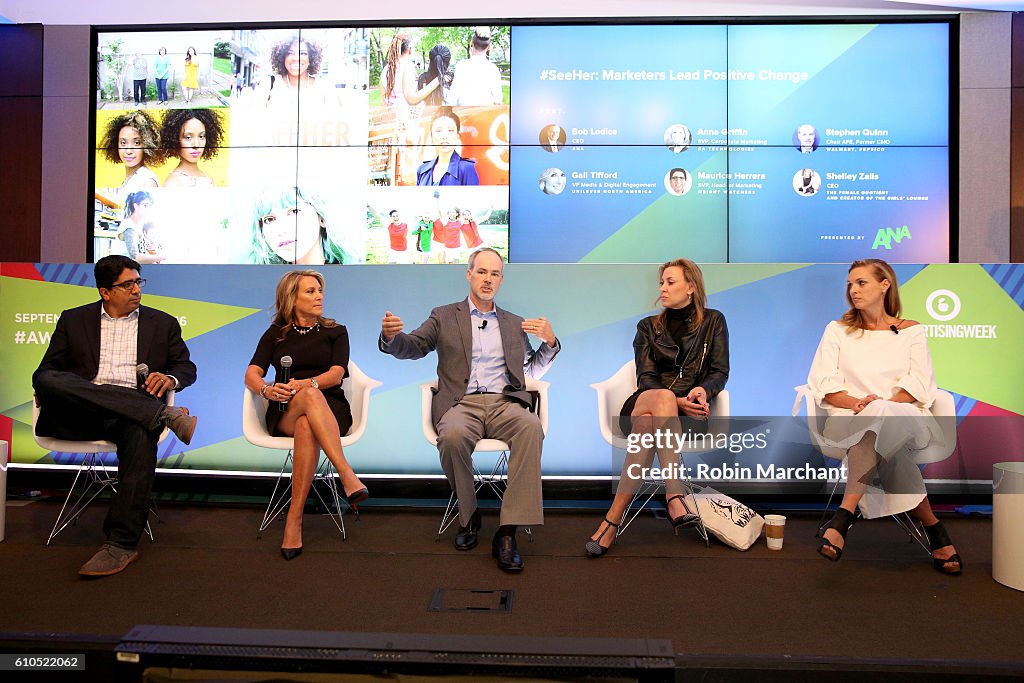
In 2016 he appeared at Advertising Week New York on a panel about marketers leading positive change. Two years later came a short stop at SodaStream as head of U.S. marketing. Four months after arriving, he left for Avis Budget Group. The SodaStream chapter was brief enough to look like a footnote, though it illustrates a durable career fact: good operators sometimes encounter the right next assignment before the current one has settled into the org chart.
At Avis, where he served as chief marketing officer for the Americas, Herrera confronted what one industry gathering called the “purchase cyclone.” Customers moved among screens, devices and outside influences. Data was fragmented. Attribution was contested. The marketer’s job involved both the famous promise of “We try harder” and the prosaic mechanics of making a reservation easier.
Set a clear objective. Invite feedback before certainty hardens. Work in an agile rhythm. Keep creative content tied to the value of the brand. Then ask what moved.
A product made of futures
In October 2021, Herrera left Avis for Adtalem Global Education. CEO Steve Beard’s recruiting pitch offered a mission-led organization, a marketing function with room to change its operating model, and a culture built around collaboration, empowerment and competition. Herrera’s remembered reply was efficient: “Sign me up.”
The move made personal sense. Herrera has said that two forces changed his own trajectory: education that fostered meritocracy and people who strengthened his self-esteem. At Adtalem, marketing was attached to the possibility of a new career. Its five institutions prepared nurses, physicians, veterinarians, social workers, psychologists and other professionals. Herrera described the work as a privilege because the product was both an educational experience and the life that could follow it.
His team rebuilt the enterprise marketing model around three ideas: student-centric, data-driven and impact-focused. The institutional brands needed distinct reasons to be chosen. The shared organization needed better data accountability, improved web experiences and a clearer relationship between spending and enrollment. A university portfolio cannot be marketed like a family pack of gum, but the old discipline still applied. Choice had to be earned and measured.
By the company’s 2023 Investor Day, Herrera could describe a substantial pivot. By the 2026 gathering, the numbers had started to narrate the work: inquiries up almost 20 percent over the preceding several years, cost per acquisition down 16 percent, and marketing dollars broadly maintained. He also described localized marketing, shared capabilities across institutions and early use of content tools that could quadruple campaign output.
The numbers matter because Herrera’s career-long argument had reached its natural arena. Strategic creativity drew the map; systems, data and teams covered the distance. Even the use of new tools was presented as leverage for a process, not a magic trick.
The name at the end of the work
Adtalem had spent four years concentrating the company on healthcare education. The corporate identity lagged behind the strategic reality. In February 2026, it became Covista, with the promise “The Talent to Transform Healthcare.” Herrera co-led the rebrand.
He described brands as devices that force clarity. They declare what an organization uniquely brings to a market and why someone should hire it. Covista had to express the scale of five schools without dissolving their individual reputations. It also had to make the parent company intelligible to students, employers and investors. The answer was a single purpose carried by a portfolio of distinct institutions.
Herrera said the work involved deep listening, hard choices and alignment among strategy, identity and culture. The order is revealing. A name appears near the end of that list. Rebrands are often photographed as unveiling moments, but the useful labor happens earlier, in rooms where people decide what the company will stop pretending to be.
The unveiling gave Herrera a scene worthy of the journey. Covista rang the bell at the New York Stock Exchange. Standing on the floor, he thought about parents who arrived with faith in work, teachers in Brooklyn who noticed him, Binghamton, Michigan, his wife and children, and the long line of bosses, mentors and colleagues between a public-school classroom and Wall Street.
The reflection avoided the tidy mythology of individual ascent. Herrera named the boosters. Education had created opportunity, but people had helped him believe he belonged inside it. For an executive who had spent his career studying why people choose, the more intimate revelation concerned those who had first chosen him.
A handoff, not an erasure
Two months after the rebrand, Covista announced an organizational change. Marketing would join digital and innovation under Michael Betz, whose role expanded to chief growth and innovation officer. Herrera would step down. The company credited him with building and scaling the marketing organization, strengthening its institutional brands and co-leading the enterprise rebrand.
Executive departures tempt an easy ending, but Herrera’s Covista chapter is more interesting as a handoff. He left an identity designed to describe the strategy, institutional brands with sharper positions and a marketing engine able to show its arithmetic. The next structure combined those capabilities with digital and innovation. Organizations change their boxes; useful work survives the diagram.
Herrera’s next role had not been publicly announced by late August 2026. The completed record already offers a portable lesson. Listen until the choice is clear. Make the choice visible. Build the system that can deliver it. Measure what happened. And whenever a grand marketing claim begins to float toward the ceiling, ask the blunt question that brings everyone back to the room: what did it do?