Dan Brahmy has a fairly elaborate answer to a simple question about life outside work. Family features. So do music and FIFA. Pasta makes repeated appearances. Asked how he unwinds, the co-founder and CEO of Cyabra managed to return to it several times, as though a single mention might leave the wrong impression. For someone whose working life involves synthetic identities, coordinated manipulation, and manufactured public opinion, a dependable plate of carbohydrates seems a reasonable arrangement.
The joke sits alongside a much less comfortable question that has occupied him for years. When a crowd appears online, how much do we really know about the people in it? A swelling argument can look like public opinion long before anyone checks who started it, who keeps it moving, or whether its most enthusiastic participants exist. Brahmy has built a company around inspecting that crowd. He has also had to learn that identifying a problem and persuading somebody to buy a solution are separate jobs.
Before the bots, there were customers
Born in Paris, Brahmy moved to Israel with his family at 14. After high school, he served as a shooting and indoor-combat instructor in the Israel Defense Forces. His later professional path passed through account management, online advertising, sales, and strategy. It is a useful background for a founder whose job involves explaining an unfamiliar risk to people with familiar budgets.
He began studying at IDC in 2012, working at a financial-software business alongside his studies. In summer 2014, he joined Google in Dublin as an SMB sales intern. His first startup experience came with Spark, a business selling to government customers, where he joined his economics professor as a minority co-founder and led sales and business development. Municipalities and state institutions were part of that education. Deloitte Digital followed. In 2015, he completed the degree now listed in his executive biography as a B.A. in Marketing from Reichman University, formerly IDC.
These are jobs in which a promising idea eventually encounters someone who must decide whether to pay for it. That practical encounter would become a recurring theme. Brahmy could understand the appeal of a technical achievement. He would learn to ask whether the customer understood its purpose, and whether the proposed solution fitted a problem pressing enough to change a buying decision.
A friend with an unsettling proposition
Brahmy has described his arrival at Cyabra as a fortunate encounter with people he trusted. Yossef Daar, whom he already knew, brought experience in information warfare. Ido Shraga brought a technical background in business intelligence and cyber engineering. Brahmy credits his co-founders openly: “I’m here because I deeply admire my co-founders.” The sentiment is unusually direct in a business culture that can make the founder sound like a solo expedition.
The early idea developed in meetings at fellow early co-founder Sendi Frangi’s apartment in Givat Shaul. There was pizza, and the conversations ran late. The question was how knowledge of false identities could be put to work detecting them. Current company records date Cyabra’s founding to July 2017. The present founding leadership comprises Brahmy as CEO, Daar as chief product officer, and Shraga as chief technology officer.
By July 2018, the business had 12 employees working from The Bridge’s offices on Rothschild Boulevard in Tel Aviv. It had attracted investment from TAU Ventures and joined Coca-Cola’s accelerator program. The surroundings were ordinary startup territory: meetings, prospective customers, a small team. The subject matter was stranger. Here was a company asking clients to consider that some of the people addressing them online might be a performance.
“I’m here because I deeply admire my co-founders.”
Dan Brahmy, 2025
Read the room. Then count the actors.
Brahmy’s explanation of the original premise begins with the author. Cyabra would investigate the identity behind a message and the way the message travelled. A fact checker can examine a claim; Brahmy wanted to give customers information about the accounts carrying it and the patterns connecting them. The distinction matters because an apparently persuasive conversation may have been arranged before its audience arrived.
Early descriptions of the platform included checks on when profiles were created, their shared connections, previous posts, keywords, and sentiment. The aim was to connect individual clues into an account of coordinated behavior. No single loud opinion establishes manipulation. The interesting question is whether the apparent crowd contains connected actors behaving in ways that deserve closer inspection.
For Brahmy, the downstream effects matter. A small group can influence a much larger audience if its activity gets repeated, reported, and treated as evidence of what people think. The size of the initiating network alone tells an incomplete story. His recurring concern is the passage from an artificial signal to an ordinary person’s decision.
An explanatory map of the questions behind Cyabra’s approach.
This also explains the breadth of his audience. Governments worry about organized influence. Companies worry about reputations and decisions made under pressure. Both have reason to understand whether the activity in front of them represents an authentic audience. Brahmy’s challenge has been to make that inquiry feel necessary before a crisis supplies its own expensive demonstration.
The customer-discovery confession
In 2020, Brahmy identified customer discovery as his favorite part of the CEO’s job. Financials came last. “My favorite hat is customer discovery.” There is a pleasing lack of ceremony in the admission. A chief executive may have to wear every hat, but that does not oblige him to enjoy the entire wardrobe.
His advice to first-time founders was correspondingly practical. Talk to prospective stakeholders. Work in small iterations. Keep listening until the product becomes indispensable. He emphasized perseverance and resilience, while warning against building first and simply expecting customers to appear. It was advice from someone who had already tried a startup and regarded mistakes as part of his preparation.
Then came the less flattering account of his own execution. In a video shared publicly in 2025, Brahmy said Cyabra had spent four years concentrating on building technology without getting enough market feedback. He acknowledged the technical advantage that effort produced, while admitting the commercial problem. His company had been trying to prove itself by building. Customers still needed to help determine what should be built.
That admission gives the career story some friction. Customer discovery can be a founder’s favorite activity and still receive too little attention. A mission can be convincing to the team and remain difficult to explain outside it. Brahmy’s public willingness to describe that gap makes his later emphasis on listening more substantial than a tidy piece of entrepreneurial advice.
A bigger room, with more scrutiny
Cyabra’s work brought it into prominent company. Elon Musk hired the business to assess spam and fake accounts around his acquisition of Twitter. In January 2024, former U.S. secretary of state and CIA director Mike Pompeo joined its board. Cyabra also announced a $5.7 million extension to its Series A funding, led by OurCrowd. The business of identifying doubtful identities was acquiring some conspicuous, readily identifiable connections.
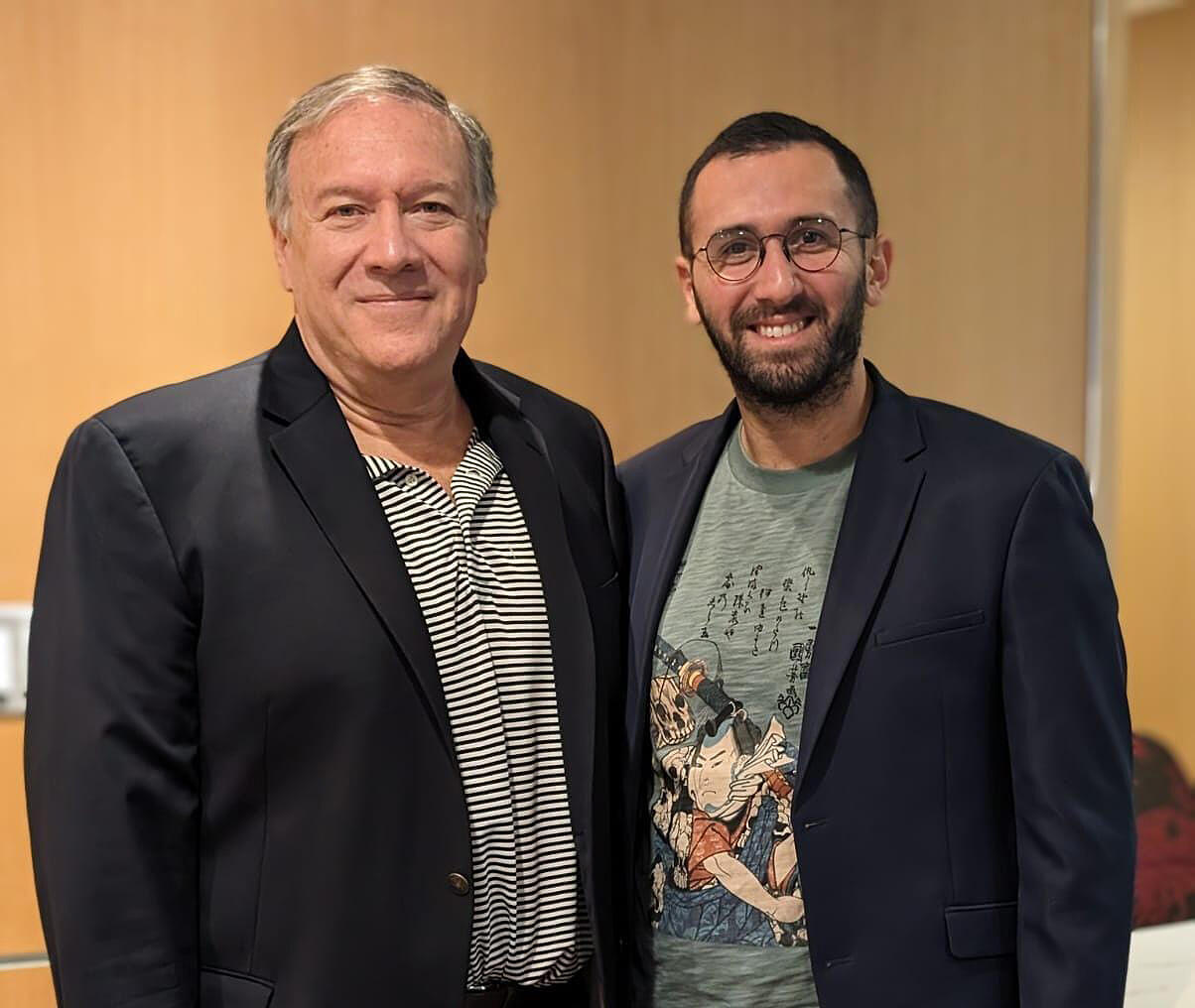
In July 2024, Brahmy announced the plan to take Cyabra public through a merger. The actual listing came later: on March 27, 2026, Cyabra began trading on Nasdaq as CYAB following its combination with Trailblazer. The gap between announcement and completion belongs in the story. A public-market ambition is a plan; a completed listing is an event.
The new setting also makes the business easier to examine. For the first quarter of 2026, Cyabra reported approximately $1.4 million in revenue, up 12 percent year over year, and a GAAP net loss of $10.8 million. That loss included share-based compensation and one-time combination expenses. Revenue growth and transaction costs now sit beside the mission in public view. Brahmy remains CEO and a director, with the additional obligations that accompany those roles at a listed company.
More home turfs, the same question
Expansion has had a domestic geography, too. Brahmy announced his family’s move to New Jersey, closer to New York City, in a personal post. He described a life spanning France, Israel, his Argentine wife Debi, and their two children. He admitted being afraid of leaving friends, family, and his co-founders. His eventual description of the move was an addition to the family’s home territory. Growth had acquired boxes to pack.
His public manner allows for that mixture of ambition and everyday attachment. The pasta, football video games, hip-hop, and salsa belong beside the executive biography. They provide a little scale. Someone who spends working hours questioning the authenticity of digital conversations also wants time with his family and a good game of football on a screen.
The work continues to move between public institutions and corporate audiences. In 2026, he appeared with Orchestra CEO Jonathan Rosen at the Meltwater Summit to discuss how brands should assess online pressure before responding. On October 13, Cyabra announced a national security advisory council chaired by Pompeo. The constituencies differ, but Brahmy keeps returning to the need to understand the activity before choosing a response.
That is the thread connecting the salesman, the co-founder, and the public-company CEO. He has needed to persuade customers to inspect an online crowd, and to let those customers inspect his assumptions in return. The internet supplies plenty of apparent certainty. Brahmy’s business begins with a pause, a closer look at the participants, and a question about how they all arrived together.