The Profile
The Man Who Thinks Clearly About Things You'd Rather Not Think About
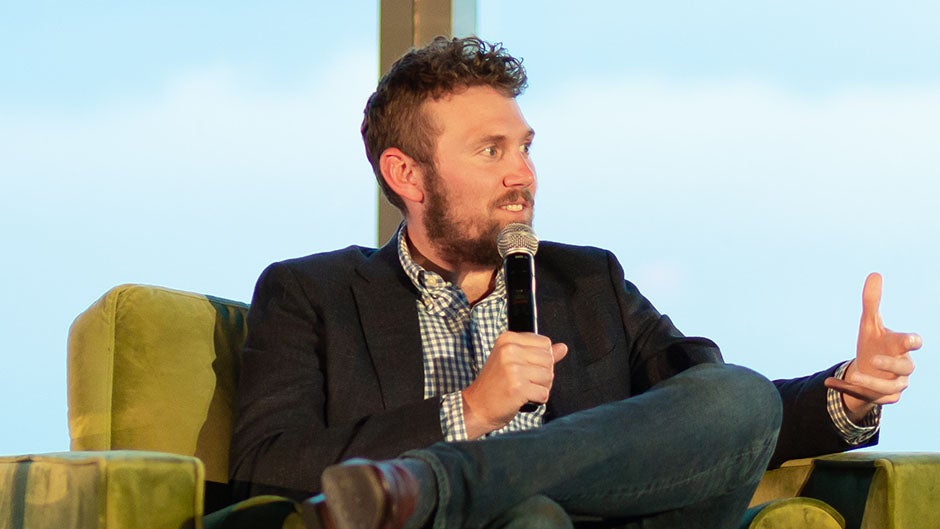
Charlie Warzel is a staff writer at The Atlantic and the author of Galaxy Brain, a newsletter that arrives three times a week with the unsettling reliability of a conscience. He writes about technology, media, and the internet - which is to say, he writes about power, attention, and the thousand small ways we lie to ourselves about both.
His base of operations is Lummi Island, Washington - a small, ferry-dependent patch of land near Bellingham. This is not an accident. Warzel left Brooklyn, then Missoula, then the gravitational pull of major media markets, and chose a place where you have to mean it when you want to go anywhere. It lends his work a certain quality: he is embedded in the digital world by profession, not by proximity, and the distance gives him a view that most tech journalists can't quite find.
The newsletter is called Galaxy Brain for a reason. It's named for the rhetorical phenomenon where a chain of plausible-sounding logic leads somewhere absurd - a trap Warzel is specifically and deliberately trying not to fall into. Each edition is, in its own way, an attempt to think clearly when clarity is structurally discouraged.
Highlighting uncertainty and resisting easy narratives is how you protect journalism's credibility.
- Charlie Warzel, on his approach to reporting
He covers AI hype cycles without joining them. He documents Twitter's transformation without performing outrage about it. He writes about misinformation as a systemic problem, not a villain story. This is harder than it sounds - the media environment rewards the villain story, and Warzel knows it, which is why he keeps writing the other kind.
Galaxy Brain is The Atlantic's flagship newsletter, and it operates as a hybrid: part long-form essay, part reader-driven investigation (he calls these "Rabbit Holes"), part community experiment via Sidechannel, a Discord server shared with seven other tech and media newsletter writers. The podcast version has landed on Spotify and YouTube. The newsletter has grown into something that resembles a publication-within-a-publication.
Career Stops
2010-2012
NBC / Adweek
Early TV & trade press work
2012-2019
BuzzFeed News
Senior Tech Writer, Missoula MT
2019-2022
New York Times
Opinion Writer-at-Large, Privacy Project
2021
Out of Office
Book co-authored w/ Anne Helen Petersen
2022-Now
The Atlantic
Staff Writer + Galaxy Brain newsletter
Seven Years in the Trenches: The BuzzFeed Chapter
In 2012, when Warzel joined BuzzFeed News as a senior technology writer, the platform still had something to prove. He would spend seven years there, based in Missoula, Montana - which is not where senior technology writers typically operated from. He was doing remote work before remote work had a hashtag.
The BuzzFeed years produced some of his sharpest work. His landmark piece "A Honeypot For Assholes": Inside Twitter's 10-Year Failure To Stop Harassment became essential reading - not because it named villains, but because it mapped a structural failure with clinical precision. Twitter had the data, the tools, and the awareness. It chose, again and again, not to act. Warzel documented the choices, not the excuses.
He also traveled to Sweden using only Bitcoin for an experimental piece about the future of money - and had an RFID microchip implanted in his own hand for another. This was journalism that cost something, sometimes literally in body integrity. He got the Mirror Award in 2019 for his reporting on Facebook's privacy struggles.
The Microchip Experiment
In one of his most unusual pieces of experimental journalism, Warzel had an RFID chip implanted in his hand to explore what the future of money and biometric technology might feel like from the inside. This is not a thing cautious journalists do.
By the time he left BuzzFeed in 2019, he had spent years embedded in the worst parts of the internet's ecosystem - disinformation networks, extremist communities, platform failures - without losing his ability to explain them to people who had never visited those places. That is rarer than it sounds.
The Privacy Project and "One Nation Tracked"
At the New York Times, Warzel led the Privacy Project and co-authored One Nation Tracked - a seven-part investigative series built on an enormous dataset of smartphone location pings. The series demonstrated, in concrete and granular detail, that the data broker industry was tracking Americans everywhere and selling it to anyone willing to pay. No hacking required. Just capitalism doing what it does.
The series was a Livingston Award finalist for National Reporting in 2020. More importantly, it changed how a lot of readers understood their phones - not as devices they control, but as surveillance infrastructure they carry voluntarily.
What we're witnessing online is a group of people desperate to protect the dark, fictitious world they've built. Rather than deal with the realities of a warming planet, they'd rather malign and threaten meteorologists.
- Charlie Warzel, on online disinformation after hurricanes, 2024
His NYT tenure also produced extensive coverage of QAnon - coverage that was notable for what it refused to do. Where much of the press treated conspiracy theories as spectacle, Warzel kept asking: who does this serve, how does it spread, what happens when it reaches people who have the power to act on it? He warned explicitly that breathless QAnon coverage could amplify dangerous beliefs by framing fringe as central. He was right.
His Opinion Writer-at-Large role gave him room to range across media, politics, and technology - and he used it. He wrote about the attention economy as a structural feature, not a bug. He wrote about how platforms convert attention into influence. He built a beat that was really about power, examined through the lens of tech.
OUT
OF
OFFICE
Out of Office: The Big Problem and Bigger Promise of Working from Home
Co-authored with Anne Helen Petersen • December 2021 • Knopf
Written during the pandemic but thinking past it, Out of Office argued that remote and hybrid work wasn't just a logistical adjustment - it was an opportunity to permanently reshape the relationship between workers and institutions. The book pushed for trust, fairness, flexibility, and inclusivity rather than surveillance tools and mandated presence. It arrived early enough that the return-to-office debates of 2022-2024 read like the argument it had anticipated.
Galaxy Brain: Thinking Out Loud in Public
When Warzel joined The Atlantic in 2022, he brought Galaxy Brain with him - moving it from Substack into the publication's infrastructure. It became The Atlantic's flagship newsletter. That framing matters: this is not a side project. It is the main event.
The newsletter publishes three times a week. The format is deliberately varied: long essays, shorter dispatches, reader-submitted rabbit holes (investigations that readers contribute sources and leads to), mailbag issues. There's a companion podcast. There's a Discord community - Sidechannel - shared with seven other tech and media newsletter writers.
The name is the whole argument. Galaxy Brain is the thing Warzel is specifically trying not to do. The newsletter exists as an ongoing demonstration that you can engage seriously with complex, fast-moving stories without disappearing into your own logic. You can think big without thinking yourself into nonsense.
AI & Hype Cycles
His 2025 Atlantic piece "AI Is a Mass-Delusion Event" argued that the problem with AI discourse is the polarization between utopia and catastrophe - both positions that benefit from drama, neither from accuracy.
Social Media & Power
His 2023 piece "Twitter Is a Far-Right Social Network" drew on platform data and behavioral patterns rather than anecdotes - and got picked up by CNN, which was probably not Elon Musk's favorite day.
Disinformation
Warzel argues the internet functions as a "justification machine," not a brainwashing engine. People seek out content that confirms what they want to believe - the platform delivers. The framing changes what solutions are possible.
Privacy & Surveillance
From the NYT Privacy Project to ongoing coverage at The Atlantic, Warzel has spent years documenting how personal data moves through systems people don't know exist and can't meaningfully opt out of.
The subscriber model at The Atlantic ties Galaxy Brain readers to a free digital subscription for the publication - creating a bundle that benefits both sides. Warzel also offers free subscriptions to those who can't afford them. This is not the approach of someone who thinks the newsletter is purely a business.
An Island, a Partner, Two Dogs Named Steve and Peggy
Warzel grew up in Bryn Mawr, Pennsylvania - a suburb of Philadelphia with good schools and not much internet mythology. He graduated from The Shipley School in 2006, crediting it as the place where he learned to write and think. Hamilton College followed, where he studied political science and landed an internship at NBC News before finishing his degree.
He has been remote his entire career. Missoula during the BuzzFeed years. Brooklyn for a period. Now Lummi Island, Washington - a place that requires a ferry to reach and has a population of roughly a thousand people. He lives there with his partner Anne Helen Petersen, a culture critic and journalist with her own newsletter (Culture Study on Substack), with whom he co-authored Out of Office. They have two dogs: Steve and Peggy.
The island is not incidental to the work. Being geographically removed from the media industry while writing about it gives Warzel a perspective that's hard to manufacture. He is not at the dinner parties. He is not in the green rooms. He is on a ferry, reading something, thinking about the attention economy.
⚓
Lives on Lummi Island, Washington - population ~1,000. Ferry required to leave.
🐶
Two dogs named Steve and Peggy. Both presumably unbothered by the attention economy.
⚡
Had an RFID chip implanted in his hand for a journalism experiment on the future of money. That's a commitment.
₿
Traveled to Sweden using only Bitcoin for a story. This was when Bitcoin was still mostly associated with idealism.
The partnership with Petersen has also shaped how Warzel thinks about remote work not as a productivity hack but as a labor and equity issue. Out of Office is as much about power dynamics in the workplace as it is about commutes, and that framing came from a collaboration between two journalists who had both been doing this for years before it was fashionable.
How He Actually Thinks
Warzel is not a neutral observer - he doesn't pretend to be. But his approach is not advocacy either. It is, more precisely, a refusal to let the story be simpler than it is. When AI companies claim world-historical significance for their products, he asks what evidence supports that. When critics say AI is obviously useless, he asks what evidence supports that too. He is allergic to the rhetorical move of treating a complex system as if it has one cause and one cure.
He describes journalism as a public version of essay-writing: drawing connections, constructing arguments, pushing back on conventional wisdom while keeping empathy in view. At Shipley School, he learned to write. At NBC, he learned the mechanics of production. At BuzzFeed, he learned digital media's operating logic from the inside. At the Times, he learned to report at scale. At The Atlantic, he synthesizes all of it.
The Galaxy Brain Problem
The newsletter is named for the cognitive trap it's designed to avoid: the chain of internally consistent reasoning that leads to a conclusion nobody sane would endorse. Warzel's editorial position is that this is an occupational hazard of thinking seriously about the internet, and the best defense is naming it.
His criticism of Twitter - before and after the Musk acquisition - has been consistent, patient, and data-driven. He was documenting the platform's harassment failures in 2016. He wrote "Twitter Is a Far-Right Social Network" in 2023. The through-line is not outrage but observation: the platform's choices have structural consequences, and those consequences are worth tracking across a decade.
His AI coverage follows the same pattern. "AI Is a Mass-Delusion Event" is not a dismissal of AI technology; it is an argument that the discourse around it has become untethered from evidence in ways that drive bad policy and misallocated capital. The problem, in Warzel's framing, is not AI itself - it is the way we talk about it, and the way that talking shapes what we do.
◆
In an era when tech journalism often means either boosterism or apocalypticism, Warzel keeps finding the third option: careful, evidence-driven analysis that takes seriously both the real capabilities of technology and the very human tendency to lie to ourselves about what we've built.
That's not a comfortable beat. It doesn't generate viral takes in either direction. It requires readers who are willing to sit with ambiguity. Apparently, enough of them exist - because the newsletter keeps showing up, three times a week, from an island on the other side of a ferry.