A reputation crisis used to arrive with a newspaper headline, a television segment or a recall notice. Now it can begin with twenty accounts that look like twenty people, behave like one operator and recruit thousands of real users before lunch. The awkward question for a communications chief is no longer simply, “What are people saying?” It is, “Is this crowd actually a crowd?”
Cyabra sells an answer. Its software examines public posts, the accounts behind them and the way those accounts move together. It looks for fake profiles, coordinated campaigns, synthetic images and video, impersonators, sentiment shifts and the narratives joining all of it. The output is not supposed to be another dashboard full of angry red charts. The useful output is a choice: ignore the noise, keep watching it or respond with evidence.
That last step is the company’s hard-won insight. Cyabra began as a detector. It wants to become an operating layer for narrative intelligence, a still-young category that sits somewhere between social listening, threat intelligence, crisis communications and open-source investigation. The distinction matters because counting a pile-on and understanding who built it are different jobs.
The people who knew how a fake profile behaves
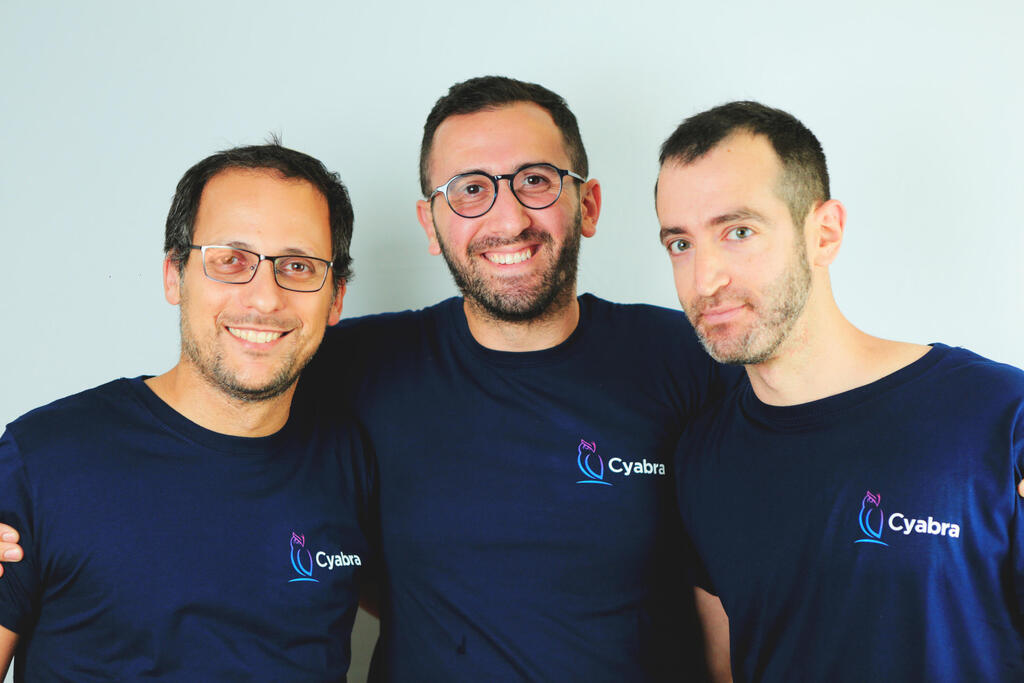
Dan Brahmy, Yossef Daar and Ido Shraga co-founded Cyabra in 2017. Brahmy had worked in strategy at Deloitte Digital. Daar’s background included business intelligence and Israeli military intelligence. Shraga had worked as a technology leader in business intelligence and in cyber engineering roles in the Israel Defense Forces. Early reporting described late-night planning sessions over pizza, with the founders discussing how to use their knowledge of digital identities on defense instead of offense.
That expertise produced a technically ambitious premise. A false profile does not become suspicious only when it publishes a lie. It leaves behavioral clues from the moment it is made: its connections, cadence, reuse of material, location signals and synchronization with other accounts. Cyabra says its models inspect hundreds of such parameters, returning an authenticity judgment with a confidence score.
But knowing the machinery of manipulation did not automatically produce the right product. Brahmy has described the company’s first four years as a familiar technical-founder error: building and building, with too little market feedback. The team was trying to prove it had the best detection technology. Customers were trying to decide what to do at 9:17 on a Monday morning when a hashtag suddenly turned radioactive.
“Staying closely tuned to customer feedback is what kept us building the right product.”Dan Brahmy, co-founder and CEO
What changed their minds was not a better benchmark. It was the buyer. A communications team does not purchase an authenticity score for its own sake. It buys earlier warning, fewer false alarms, a clearer escalation path and documentation strong enough to support a platform report or a measured public response. The company’s product spread outward from detection into alerts, mapping, visual analysis and mitigation.
The product learned to answer a more expensive question
Cyabra now organizes the problem around three things: actors, behavior and content. An account may look plausible in isolation. Its behavior may look less plausible when it posts the same message at the same minute as fifty peers. The content becomes more revealing when an image recurs across accounts, languages and platforms. Joining those layers is the product’s central claim.
Actors
Real person, bot, sock puppet, impersonator or uncertain account.
Behavior
Timing, coordination, amplification, geography and network patterns.
Content
Narratives, sentiment, images, claims and synthetic-media signals.
Its platform includes authenticity and behavior analysis, coordinated-campaign detection, multilingual narrative and sentiment analysis, image analysis, deepfake detection and impersonation monitoring. Narrative Alerts watches for emerging manipulation. News Claims Analysis follows claims as they move from online networks into traditional coverage. A Coordinated Activity Detection agent, launched in 2026, automates part of an analyst’s investigation and returns a verdict with supporting evidence.
The evidence layer may be the least glamorous and most practical piece. An alert says something odd is happening. A mitigation package maps accounts and content to platform policies, giving the customer material for takedown requests or internal escalation. The software is trying to shorten the distance between “this looks fake” and “here is what we can responsibly do about it.”
Social listening counts the crowd. Cyabra checks its pulse.
The cleanest way to place Cyabra in the market is beside a social-listening tool. Listening platforms are good at mentions, reach, themes and sentiment. Cyabra argues that those measures become dangerous when manipulated engagement is counted as ordinary opinion. Its pitch is to identify the source and structure of the conversation: which accounts are genuine, which are coordinated and whether synthetic content is helping the story travel.
That position puts it against narrative-analysis companies including Logically, Blackbird.AI, Alethea, VineSight and Pyrra, as well as in-house analysts. Cyabra says its difference is breadth: it connects a narrative to bots, behavior and generative content. Some rivals have more resources or broader offerings.
WarnerMedia provides the tidy case study. Around the 2020 release of Wonder Woman 1984, the company used Cyabra to identify fake profiles discussing the film, report suspect accounts and separate real influencers from manufactured chatter. The same basic machinery has been used by public agencies monitoring foreign influence and by brands looking for impersonation, boycott manipulation or a synthetic swell of outrage.
The buyers now range from communications and reputation teams to defense ministries, election bodies, law enforcement, intelligence agencies and research institutes. PepsiCo has spoken publicly about using Cyabra for reputation work. The U.S. State Department and WarnerMedia appear in company case studies. In 2024, Cyabra said it had worked with 19 governments on election protection over the preceding year.
$1.9 million quarter, $3.4 million loss
Cyabra’s economics look like young enterprise software, not a finished utility. It sells mostly non-refundable SaaS subscriptions lasting from several months to three years. Government customers can buy two- or three-year on-premises licenses. A buyer that wants a limited investigation can purchase a managed report. Public list pricing is not disclosed, though recent announcements show annual and multi-year contracts in the six figures.
ARR is a point-in-time annualized measure, not recognized revenue. Q2 2026 revenue was $1.9 million, up 39% year over year.
The cost is visible too. Cyabra reported a $3.4 million net loss for the second quarter of 2026 on $1.9 million of revenue. Across the first half, the loss was $14.2 million, swollen by stock compensation and a one-time business-combination expense. The company had $800,000 in cash at June 30, then completed a $6 million private placement in July. Its accumulated deficit stood at $61.6 million.
Those numbers do not invalidate the product, but they clarify the assignment. Cyabra must turn episodic danger into recurring spend while managing long government procurement cycles and renewals. Its 2025 revenue grew 37%, yet year-end ARR was flat because several large renewals and expansions slipped into early 2026. By June, ARR had reached $8.1 million, up 29% from a year earlier. The business can grow quickly and still be lumpy.
The buyer is usually already in trouble
Disinformation software has a timing problem. The easiest moment to justify it is during a crisis, exactly when procurement is slow. Cyabra’s alerts, subscriptions and partner channels try to get inside the workflow before the alarm. Carahsoft helps with U.S. public-sector procurement; Onclusive combines media monitoring with Cyabra’s authenticity analysis.
The commercial announcements illustrate where budgets exist. In 2026 the company disclosed a contract worth more than $500,000 with an international research institute, more than $500,000 in combined annual revenue from two European national-security agencies, a multi-year six-figure APAC intelligence agreement and a six-figure annual deal with an interactive-entertainment company. It also announced work with large consumer and food-and-beverage brands without naming them.
The value proposition is not merely catching a lie. It is avoiding the cost of treating manufactured sentiment as a representative sample. A company can overreact, reward the instigator and amplify a marginal campaign. Or it can underreact while an orchestrated network recruits authentic users. Cyabra is useful when the response cost is high, the signal is ambiguous and the organization has someone empowered to act on evidence.
The copyable part is the response ladder
A smaller organization cannot reproduce Cyabra’s models overnight. It can copy the operating logic: start with the decision, separate reach from authenticity and preserve enough evidence to explain the call later.
Define the expensive decision
Write down what would trigger a reply, a takedown request, an executive alert or deliberate silence.
Test the actors, not only the words
Look for creation patterns, synchronized posting, repeated assets, impossible locations and the same accounts appearing across narratives.
Measure manufactured reach separately
Do not let a suspicious cluster stand in for the whole audience. Show organic and inauthentic engagement side by side.
Keep an evidence packet
Record URLs, timestamps, network relationships and policy violations before content disappears or the story changes.
A signal, not an oracle
Cyabra’s approach is strongest on observable public activity with enough volume and history to reveal patterns. It is less useful for private groups, encrypted channels, tiny conversations or attacks that never repeat a behavior. Social-platform API changes can reduce access, alter fields or impose rate limits. The company has to keep rebuilding connectors as the networks change their rules.
An authenticity score is also not a truth score. A real person can spread a false claim. A pseudonymous activist can coordinate for legitimate reasons. A bot can post accurate information. Cyabra says its account models are classification systems validated against labeled “golden” datasets, which helps avoid the invention problem associated with generative models. Classification can still be uncertain or wrong when behavior falls outside the training data.
The tool works when someone owns the next move.
Without a response policy, platform contacts, an analyst or a communications lead who can interpret the evidence, even a correct alert becomes expensive decoration.
The sensible use is proportional. Treat the platform as an evidence engine, combine it with human review and ask whether the conclusion survives outside the model. The goal is not to declare every anonymous account malicious. It is to stop a manufactured minority from masquerading as public consensus.
The bet after the ticker symbol
Cyabra combined with Trailblazer Merger Corporation I in March 2026 and began trading on Nasdaq as CYAB. By August it had 58 full-time and two part-time employees. The listing gives everyone a quarterly view of the distance between category ambition and operating reality.
The company’s rebrand earlier in 2026 made that ambition explicit. Detection-first language gave way to “restoring trust and authenticity” and to narrative intelligence as infrastructure. Gartner included Cyabra as a Market Shaper in its first 2026 quadrant for narrative-intelligence startups. The recognition is useful, but the harder proof will be renewal behavior: whether customers keep paying after the election, launch or outrage cycle ends.
Cyabra’s most credible advantage may be that it has already changed its mind once. The founders began by believing the detector was the product. Customers taught them that the decision was the product. Now the company has to make that decision layer routine enough to live in budgets, calm enough to recommend silence and rigorous enough to earn trust while selling software about trust. Finding the bots was the technical trick. Building a durable business around what happens next is the test.