A robot demonstration is a civilised occasion. The room has been arranged. The network behaves. The furniture stays where it was put. David Lane’s version of the story becomes interesting when somebody moves a chair. In his 2026 address to Edinburgh graduates, the robotics researcher described the machine’s sudden fascination with the doorway. A small disturbance, and the performance acquires a plot.
Lane has spent decades working around that moment: the point where the arrangement ends and the world gets a vote. His career includes a North Sea diving job, underwater robotics research, the founding leadership of SeeByte and the creation of institutions intended to help other people turn experiments into working technology.
For a biography involving autonomous machines, there are a gratifying number of human complications. Customers must buy things. Colleagues must build them. An invention needs somewhere to go after the university. And an intelligent machine, however ingenious, still needs permission to do something consequential.
A diver before the doctorate
In 1979, Lane worked offshore in the North Sea as a diver and maintainer for British Oceanics. He was still on the way to his electrical and electronic engineering degree at Heriot-Watt University, which he completed in 1980. A development engineering job at Ferranti followed, from 1980 to 1982. The underwater world was already part of his working life before it became the subject of his doctorate.
His PhD, completed at Heriot-Watt in 1986, concerned underwater robotics. He later described the thesis as an investigation of autonomous robot architecture and the connection between perception and action. Put plainly, the machine had to connect what it could discover about its surroundings with what it should do next. That connection would keep finding new settings throughout his career.
Lane has also traced his interest in underwater technology to diving, the space race and Thunderbirds. It is a pleasing combination: practical experience, public ambition and television’s cheerful confidence that a sufficiently elaborate vehicle could resolve an awkward afternoon. His subsequent work concerned the software and sensing that might make actual vehicles useful.
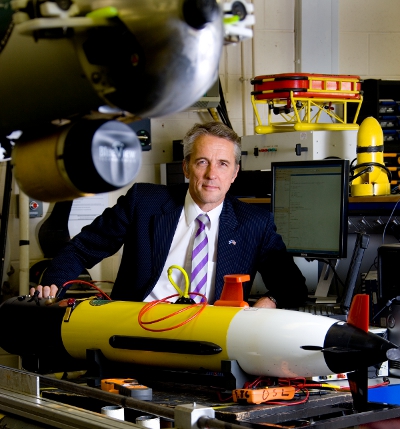
By 1995 he was directing Heriot-Watt’s Ocean Systems Laboratory. A professorial chair followed in 1998. The laboratory’s work brought together control, sensing and autonomy, with applications in offshore inspection and underwater operations. There was plenty to occupy a researcher. Lane also took on the question of how the work could become a business.
When the research acquired customers
SeeByte’s founding team came together in 2001. Lane served as its founding CEO until 2010, helping commercialise a research portfolio developed over roughly two decades. The company sold software for unmanned maritime systems into offshore energy and defence markets. Edinburgh was one base; San Diego became another.
The distinction matters because an underwater vehicle contains several different engineering problems. Motion is one. Understanding sensor information is another. Deciding how to carry out a task adds a further layer. SeeByte’s business placed software at the centre of that arrangement, carrying university work into equipment and operations beyond the laboratory.
In 2009, during Lane’s leadership, the company secured its first eight-figure US-dollar export contract with the US Navy. An order of that size gave the research a rather different audience from a conference presentation. A customer was committing money to work that had to become operationally useful. The crossing from experiment to product had acquired contractual terms.
The business also travelled. In written evidence to Parliament, Lane recorded exports accounting for 75 percent of SeeByte’s business across three continents. Geography had become part of the engineering story: a Scottish research group’s work was finding customers well beyond Scotland.
Forty people on the other side of the exit
Lane remained on SeeByte’s board after handing over the chief executive role. His board involvement continued until 2013, when Battelle acquired the company. That sequence gives the founding chapter a clear ending: he helped establish the business, led its early commercial development and stayed involved through the sale.
One detail in his parliamentary evidence is particularly human. More than 40 employee-shareholders benefited at the exit. An acquisition can be described through the names of the buyer and the company being bought. This one also had a constituency of people who had helped build what was being sold.
The detail belongs beside the export figures. It adds another measure of what the venture produced. There were customers overseas, a business with a life beyond its founder’s CEO tenure, and employees participating in the outcome. These are different consequences of the same long effort to carry research into industry.
A place for the next difficult crossing
Lane’s later work expanded the institutional side of that effort. He co-created the Edinburgh Centre for Robotics and the National Robotarium, linking Heriot-Watt and the University of Edinburgh. These provided a setting for research, training and the passage from technical ideas to applications.
His research leadership also included the £40 million ORCA Hub, focused on offshore robotics. The questions remained close to the practical difficulties of machines operating away from carefully managed surroundings. A programme can support many researchers and collaborators; it still has to contend with the distance between what a machine demonstrates and what an operation requires.
Policy became another part of his work. Lane led the 2014 UK RAS2020 robotics and autonomous systems strategy, and served as a director of euRobotics, helping shape the European research partnership. In 2016 he received a CBE for services to engineering. He was named Scottish Knowledge Exchange Champion of the Year in 2019.
- LaboratorySense, interpret, act
- BusinessBuild, sell, deliver
- InstitutionTrain, connect, support
An editorial map of his work, rather than a sequence of exclusive roles.
There is a quieter record in other people’s careers. The Italian roboticist Gianmarco Veruggio named Lane among his early overseas mentors. Kelvin Hamilton, who co-founded SeeByte, described Lane as his PhD supervisor and mentor. Those connections make the institutional language more tangible. A research environment is also made of people who teach one another how to approach a difficult problem.
The lawn is part of the story, too
The businesses around Lane now include machines with rather different working days. In February 2024, Kingdom Technologies announced his arrival on its board alongside a funding round. The Glasgow company develops robotic mowers. Its early customer activity included sports fields in Florida. A career that began around underwater vehicles had found room for grass.
Lane welcomed the team’s energy and its opportunity to grow. The connection fits his continuing work as an investor and company director, alongside his academic roles. The Royal Society of Edinburgh lists non-executive directorships at Kingdom Technologies and Robotical; Consequential Robotics identifies him as executive chairman.
Robotical brings another setting into view: education, through its programmable Marty robot. The customer, environment and task differ from those of a maritime software company. The recurring challenge of turning robotics into something useful remains recognisable. His roles put him near that challenge from several directions.
Who said the robot could do that?
Lane’s recent writing widens the frame again. His 2026 essay series explores autonomy becoming infrastructure: independently owned systems coordinating across organisations, despite different technologies, plans and objectives. A single capable machine is only part of this proposed future. The arrangements between machines deserve engineering attention too.
In September’s The Right to Act, he examined how an autonomous participant obtains legitimate permission to act. Discovering a route, resource or tool does not settle the question of authority. His proposed architecture connects predicted consequences with rights and constraints, then places limits close to the point where an action becomes possible.
“A permission that cannot stop anything is only an opinion.”
David Lane, The Right to Act, 2026
The next essay, Nothing Holds Still, published on 9 October, considers what happens after systems have coordinated and conditions change. A delay or lost resource can disturb commitments elsewhere. Lane proposes a continuity mechanism that carries relevant changes across the affected dependencies, allowing the necessary participants to respond.
These are architectural proposals, with imagined situations used to explore them. They reveal where his attention has moved: from a robot linking perception to action, towards organisations agreeing how autonomous action can be coordinated and sustained. The questions have grown to include whose assumptions matter and who needs to hear when they fail.
A workshop outside the door
In July 2026, Lane received an honorary Doctor of Science from the University of Edinburgh. His response to the occasion made room for admiration, gratitude and a thought about his parents. He said he looked like his father, who would have been proud, and remembered his mother too. The public record briefly becomes a family picture.
His address to the graduates brought him back to the untidy conditions beyond the demonstration. He encouraged them to begin before they knew everything, reconsider a first answer and persist when projects stalled. The values he chose were practical ones: curiosity, confidence, resilience and kindness.
He also had a line for the predictions that make young people’s futures sound already cancelled: “Pessimism is cheap, and it has an excellent press office.” There is a little mischief in that sentence, and some generosity. A researcher familiar with failed plans was giving the next group permission to have plans of their own.
Lane offered them a workshop as an image of the world ahead: demanding, messy and ready for their work. It suits the career that preceded the speech. The North Sea, a research laboratory, a software company and a national robotics institution each supplied a different bench. There was always something left to make work.