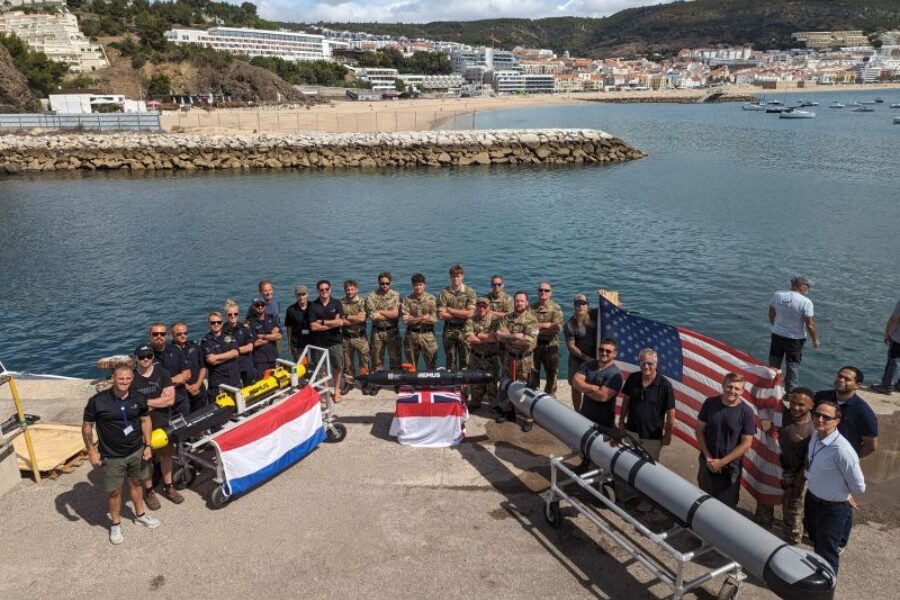
The photograph has all the ingredients of a naval group portrait: uniforms, national flags, a sunny Portuguese waterfront. The less conventional guests are the long underwater vehicles lined up beside their handlers. They belong to different fleets. Getting them to work on the same assignment is the point.
At the REPMUS exercise in 2023, operational units from the United States, Britain and the Netherlands ran a collaborative mission using SeeByte’s Neptune software. Their vehicles searched, classified and mapped, then responded to targets detected during the mission. In the company’s account of the exercise, the achievement was a shared sequence of work across national teams.
SeeByte occupies an easily overlooked part of maritime robotics. It supplies the software that helps operators plan missions, coordinate machines and interpret what their sensors collect. The vehicle gets the photograph. The software helps decide what happens next.
The fleet has a coordination problem
The company says more than 25 navies use its solutions. Its central proposition is straightforward: operators should be able to manage different platforms and sensors through a common interface. A fleet assembled from several suppliers should still function as a fleet. That matters when equipment, crews and national procedures have developed separately.
Mine countermeasures give the proposition a concrete purpose. SeeByte’s MCM Toolbox combines command and control, autonomy and target recognition so robots can enter a mine-threat area while ships and people remain outside it. The system can be organised for use from land or a ship, with components selected for the job. Its customers are buying a way to plan, execute and examine hazardous work.
This places SeeByte between hardware manufacturers and naval operators. Its expertise is in the connections: sensor information, mission objectives, vehicle behaviour and the human decision at the other end. The useful question for a buyer is whether those pieces work together with the fleet already owned.
use SeeByte solutions, according to the company. A measure of reach, not a count of vehicles or licenses.
Three jobs beneath one screen
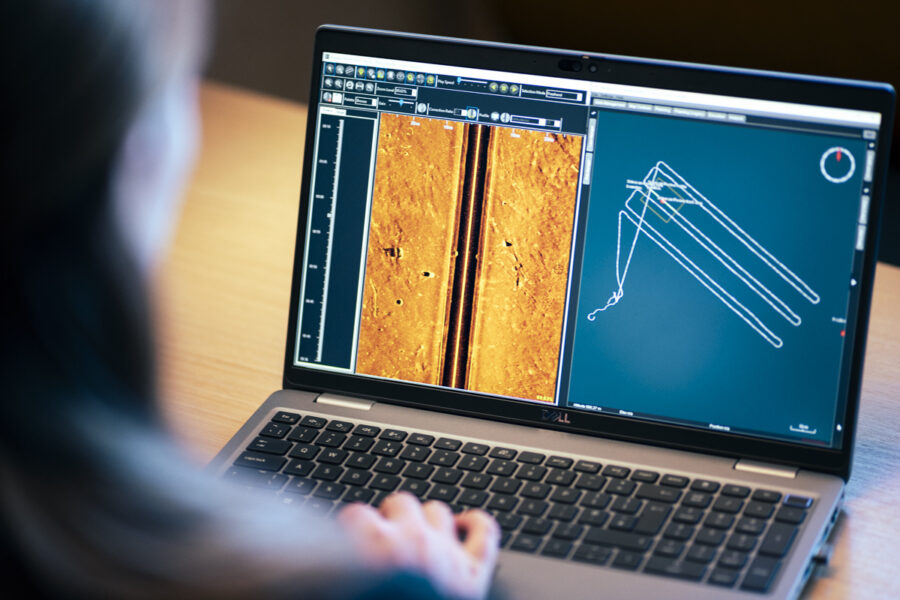
SeeTrack is the operator-facing command-and-control product. It brings together planning, monitoring and analysis, including sonar review and reporting. The aim is continuity: an operator learns a way of working that can survive a change of vehicle or payload.
Neptune supplies collaborative autonomy. Objectives are assigned with vehicle capabilities in mind, and onboard software can adapt execution as circumstances change. Its design distributes control rather than depending on a constant stream of instructions from one central point. Information is shared when communications permit.
The third component, Automatic Target Recognition, assists with detection and classification in sonar data. It can help analysts after a mission or run aboard a vehicle. Embedded recognition can feed a new inspection task into the squad’s work while the mission continues. These are distinct responsibilities: organise the work, carry it out and help interpret the evidence.
A rival picked up the phone
SeeByte’s market has overlapping competitors, and some become collaborators. Greensea Systems, now part of Greensea IQ, had competed with SeeByte in remotely operated vehicle software. In 2022, the companies announced a joint autonomy project supported by the U.S. Defense Innovation Unit. The agreement was valued at $1.2 million, with a potential value of $4.2 million. Those were project figures shared across a collaboration.
Greensea’s Ben Kinnaman described recognising that SeeByte’s target-recognition capability could complement his company’s robotics platform. “I picked up the phone and asked SeeByte if they’d be interested,” he said. The customer’s timetable made combining their capabilities attractive. A competitive relationship became a route to delivery.
For another engineering business, the repeatable lesson is quite specific: identify the missing capability, find who already has it and define a joint customer problem. Cooperation here had a product boundary and a procurement opportunity. It was more concrete than a promise to work together someday.
“I picked up the phone and asked SeeByte if they’d be interested”
BEN KINNAMAN / GREENSEA CEO / 2022
£2.4 million now is different from £50 million later
In May 2024, SeeByte announced a three-year UK contract covering software, support and development for the Ministry of Defence’s Mine Hunting Capability programme and related work. The base award was £2.4 million. Extension options and future tasking could take the full arrangement to a maximum of £50 million.
The distinction matters. A ceiling describes room for subsequent orders; it does not mean that the supplier has received the whole amount. The arrangement continued services first procured in March 2022 and included support for systems already in use. The commercial story is sustained engineering and maintenance alongside software supply.
SeeByte’s licensing model also looks more like specialist operational software than an everyday web subscription. Its published terms allow time-based or perpetual licenses tied to the installed hardware. Training and integration belong in the purchasing conversation. For a navy, maintaining a working capability means keeping the people and the software ready together.
Three-year initial term. Up to two extra years. Future tasking determines how much of the ceiling is used.
Open doors, proprietary keys
SeeByte sells choice of hardware through commercially maintained open architecture. Its software development kits let third parties integrate vehicles, sensors or algorithms. But open interfaces do not make the underlying product open source. Customers still license the software, and compatibility can become part of their dependence on it.
A UK procurement justification published in 2024 makes that tension unusually explicit. It said Royal Navy systems needed to interoperate with allied systems using SeeByte, and that third-party software would create significant interoperability problems. SeeByte’s ownership of the relevant rights was part of the rationale for awarding the work to it. From a business perspective, an installed network of compatible users can reinforce the supplier’s position.
Alternatives depend on the task. Greensea IQ offers subsea navigation, control and autonomy technology; EIVA’s supervised ROV autonomy addresses inspection work. A buyer comparing them must start with the mission and existing equipment. They overlap with parts of SeeByte’s offering without automatically replacing an allied naval workflow.
A bigger cylinder is a different problem
The sharpest corrective to loose talk about underwater AI appears in SeeByte’s own ATR documentation. A recogniser needs tuning for a target’s shape and size: a 15-centimetre cylinder and a 30-centimetre cylinder count separately. It also depends on the sonar and configuration used for tuning.
SeeByte says a well-tuned algorithm can require two to three thousand target views, depending on geometry and acceptable false alarms. That makes training data an operational input. Move to another sonar setup or target size and recognition performance cannot simply be assumed. The product’s value rests on the fit between training and the actual sensing conditions.
Vehicle failure presents a different limit. Neptune can be configured to redistribute unfinished objectives when one asset fails, but the company notes that completing the mission may then take longer. A rehearsal is a preparation tool; actual paths can diverge as environmental conditions or vehicle faults intervene. Autonomy still has to account for the equipment available.
The university work that learned to travel
SeeByte’s origins run through Heriot-Watt University’s underwater robotics research. David Lane formed the founding team in 2001 and served as CEO until 2010. Co-founder Yvan Petillot was chief technical officer until 2010. In March 2026, SeeByte marked its twenty-fifth anniversary, dating its beginnings to 2001.
A university research-impact account traces the commercial foundations through sonar interpretation, mapping, vehicle control and multi-vehicle planning. It records £11 million in revenue associated with 15 technology licenses over its reported 2008-2014 period. Those are historical technology-transfer figures, but they give substance to the university connection: research became products that customers paid to use.
The early commercial work extended to offshore inspection, including a programme with Subsea7. In October 2013, Bluefin Robotics acquired SeeByte, retaining the brand, staff and offices. Bluefin was then owned by Battelle. The acquisition announcement described customers in both military and oil-and-gas markets, showing the range of applications beneath today’s naval emphasis.
The work keeps moving toward the operator
The recent record follows the same coordination problem into more practical settings. At REPMUS 2024, SeeByte reported four operational vehicles from three nations working through a collaborative mission, with contacts passed onward to task a VideoRay Defender. In September 2025, it demonstrated digital mine-warfare tasking signals across a U.S., British and Dutch Neptune squad, addressing the manual interpretation of orders.
There is a less theatrical example, too. In May 2025, the company reported Royal Navy quayside surveys using Neptune and a REMUS 300 underwater vehicle on deployed operations. The operators had received SeeByte training before deployment. Here the product story is a particular team applying the software to a particular piece of water.
Commercial relationships broadened alongside those uses. A September 2024 agreement with Kraken Robotics connected maritime software and sonar expertise. In November 2025, BlueZone Group became its exclusive Australian representative, covering local government, defense and industry engagement. Both arrangements put partners between the software and the customer’s operating environment.
Inside the company, SeeByte describes a culture of flexible working, skill development and support for well-being. Its August 2026 appointment of Jennifer Urquhart as chief operating officer added responsibility for operational delivery alongside CEO Chris Haworth. These are ordinary organisational concerns with unusual end users. The work is convincing operators that a shared mission will remain manageable when the robots leave the quay.