A boat is an awkward place to put a technology thesis. It pitches. It takes on spray. Its cargo changes how far it can travel. And before anyone can congratulate the software, somebody must construct a hull. Saronic Technologies, founded in Austin in 2022, has followed that inconvenience all the way to a rather large purchase of waterfront ambition.
- Saronic builds autonomous vessels and the software that directs them.
- The U.S. Navy is a confirmed buyer; offshore commercial work is being explored.
- Its next constraint is manufacturing: Louisiana expansion, then Port Alpha in Texas.
The company’s trajectory suggests a useful question for anyone building something difficult: where does the real bottleneck live? An autonomous vessel needs perception and navigation. A useful fleet also needs production capacity, trained operators and customers willing to put the equipment to work. Saronic is attempting to make those pieces develop together.
The boat comes before the algorithm
The operating founders bring a revealing mix of experience. Chief executive Dino Mavrookas spent eleven years as a Navy SEAL before working in private equity. Chief commercial officer Rob Lehman brings Marine Corps service and defense-industry experience. Chief technology officer Vibhav Altekar was an early Anduril engineer. Chief operating officer Doug Lambert worked on maritime robotics at Liquid Robotics and Terradepth.
That combination helps explain the business. Saronic develops hulls, hardware, autonomy and control software in-house. It wants vessels designed around unmanned missions from the beginning, with the production process considered alongside the equipment. Mavrookas described the principle in a 2025 announcement: “we design our vessels for autonomy from the keel up”.

“We design our vessels for autonomy from the keel up.”Dino Mavrookas, co-founder and CEO
For a naval customer, the appeal is practical. An unmanned platform can carry sensors or supplies into a mission without requiring a crew aboard that particular hull. Saronic’s place in the market is the hybrid fleet: autonomous vessels working with crewed ships, extending what commanders can observe and move.
Three hulls, many jobs
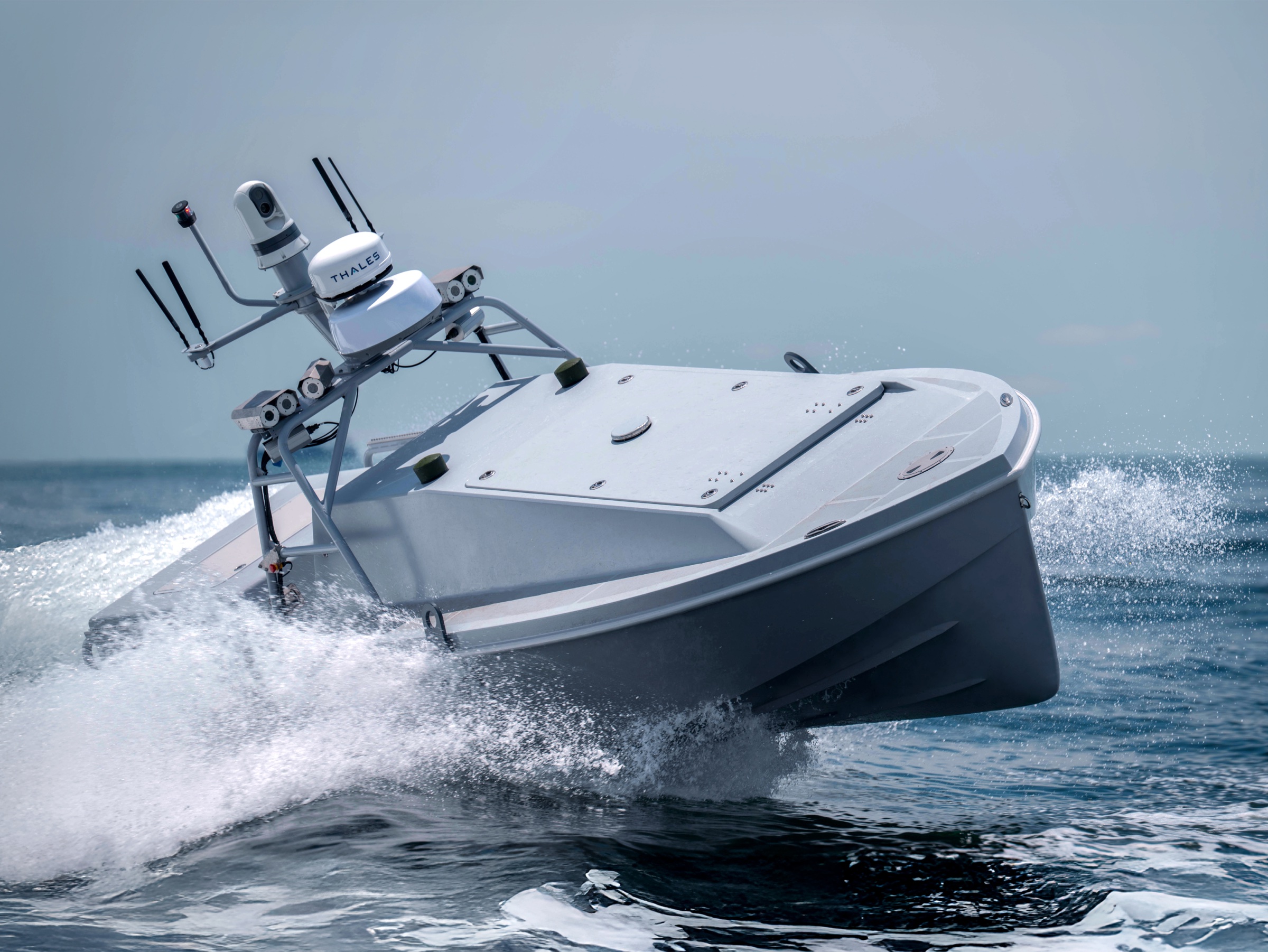
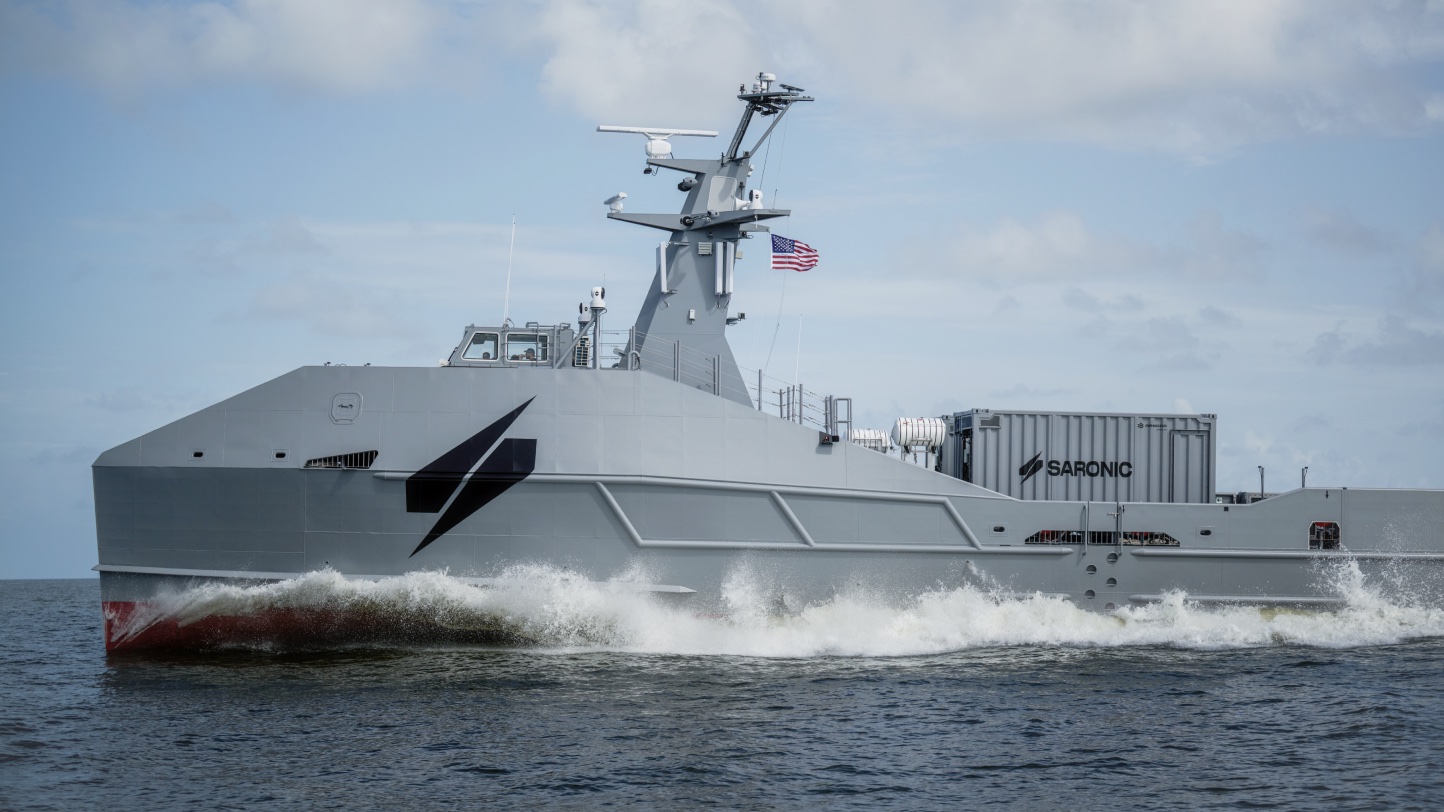
The current flagship lineup reads like a lesson in scale. Corsair is 24 feet long. Mirage measures 52 feet. Marauder reaches 180 feet. Their advertised payloads run from 1,000 pounds on Corsair to 150 metric tons on Marauder. Those dimensions describe different working envelopes, rather than three versions of the same toy.
Marauder can accommodate four 40-foot shipping containers or eight 20-foot containers. Its published range falls from 5,400 nautical miles at a 25-ton base load to 4,100 at maximum payload. Even a vessel commanded by software must obey the old bargain between cargo and distance. The specifications make that trade explicit.
Echelon supplies the operator’s interface: mission planning, simulation and command-and-control for a vessel or fleet. For users, the proposition combines physical carrying capacity with software for directing it. Sensor selection, communications and mission integration still determine what a particular deployment can accomplish.
The commercial horizon is narrower than a claim to replace shipping. A January 2026 agreement with Hornbeck Offshore proposes pilot projects and applications in offshore services and energy. It is a route to learning from an experienced operator, with safety and reliability requirements attached.
The expensive part is on land
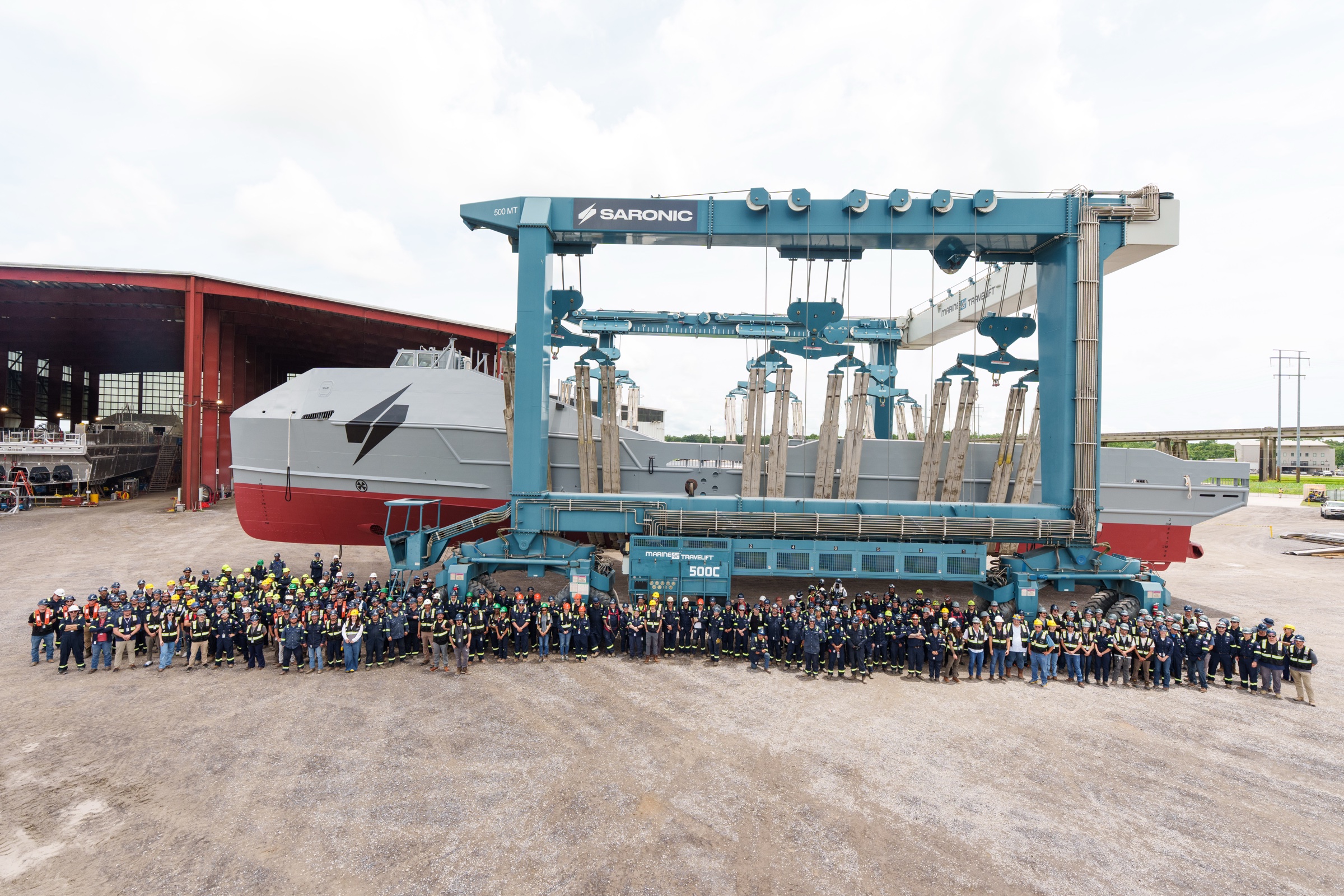
Then the boats grew. In April 2025, Saronic acquired Gulf Craft’s Louisiana shipyard and introduced Marauder as a 150-foot concept. The vessel that entered on-water trials in May 2026 was 180 feet. The company says it moved from design to launch in under a year. Its trial announcement describes an industrial milestone as much as an autonomy milestone.
The financial figures need separate drawers. Saronic raised $600 million in its 2025 Series C. Its March 2026 Series D brought another $1.75 billion at a $9.25 billion valuation. Those are investments and an investor-assigned value. The company also reported a $392 million Navy production contract for Corsair. Contract value describes customer commitments, rather than cash already earned.
March 2026
Navy production contract
in Port Alpha
Beyond Louisiana’s announced $300 million expansion, Port Alpha raises the stakes again. Saronic selected Brownsville in July 2026 and announced groundbreaking in October. The planned investment exceeds $3 billion; operations are expected in 2028. The facility is intended to build both autonomous and manned ships. That last detail matters: the company’s manufacturing ambitions now extend beyond its original drone-boat category.
The logic is understandable. Owning production gives a designer more control over how an idea becomes equipment. It also makes the company responsible for industrial problems that a software supplier might leave to someone else: facilities, workforce development and the pace at which hulls emerge. Port Alpha is a commitment to carrying those responsibilities.
The video link that ran out of room
A smaller episode makes the engineering culture easier to see. Saronic’s first video architecture connected viewers directly to boats. More viewers consumed more boat bandwidth. Customers opened dozens of streams; links became saturated, latency rose and sessions failed.
The software team’s published account says operational use changed its priorities: low delay mattered more than picture resolution. It stabilized the existing WebRTC system while developing a replacement using Media over QUIC. A relay redistributed each vessel’s stream, allowing hundreds of viewers without increasing boat uplink for every viewer.
Boat → each viewer
More viewers, more uplink demand
Boat → relay → viewers
Distribution moves off the boat
That is a copyable lesson: protect the working system while testing its successor. Early open-source dependencies still brought changing interfaces. The team contributed fixes upstream. The approach depends on having a stable baseline and time to experiment, conditions an emergency replacement may lack.
A fleet still has to earn its place
Saronic has competitors, including Saildrone, whose Spectre platform targets naval sensing and modular payloads. The difference worth watching is Saronic’s combination of an autonomy stack and shipyards it controls. That combination creates a plausible manufacturing advantage; it does not settle every mission comparison.
In its September 2026 Marauder production-award announcement, Saronic reported eight continuous days of Navy evaluation and more than 140 scenarios completed without failure. That is a useful bounded result. Long-term maintenance, mission suitability and commercial acceptance require their own evidence. The company’s next chapters will be written by operators and shipyard workers as much as investors.