Wire // Live
Verifiable raises $27M Series B from Craft Ventures Backed by Sam & Jack Altman Named to 2025 Inc. 5000 Launches CredAgent, autonomous AI credentialing agent NCQA-certified verification platform Austin, TX HQ - 150+ employees Founder track record: Branded.me, Remote.com, Dock.io, Verifiable
Profile // Founder Series // Vol. IX

Nick Macario.

Co-founder and CEO of Verifiable. He picked the least glamorous corner of healthcare and turned it into infrastructure.

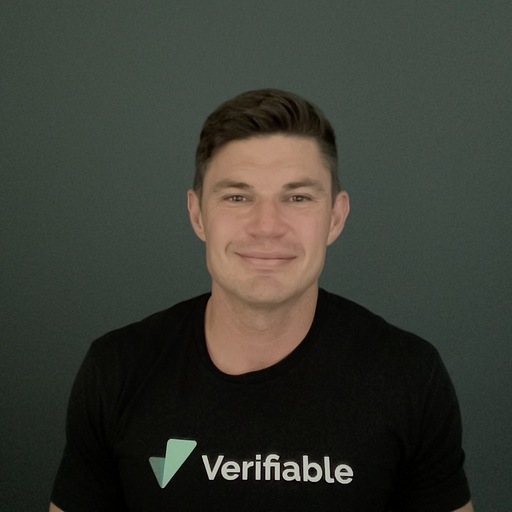
Portrait of Nick Macario, co-founder and CEO of Verifiable
Macario in a plain black t-shirt, looking mildly amused. A founder who has done this three times before and knows nobody wants to talk about credentialing at parties. Austin, TX.
By The Desk · Filed under Founders
Austin, TX · Est. read 8 min
The Story

A doctor changes states. Six weeks of paperwork.

Nick Macario runs a company whose product exists because American healthcare, for reasons no one can quite defend anymore, still verifies that a nurse practitioner is a nurse practitioner by requesting notarized documents through a fax machine. Verifiable, which he co-founded in 2019 with the engineer Vivekanand Rajkumar, sits in the middle of that process and pulls the strings taut. The company has raised roughly $47 million, employs about 150 people out of an office on Brodie Lane in Austin, and, in February 2026, shipped an autonomous AI agent that credentials providers with a human, ideally a mildly bored one, in the loop.

The pitch is legibly boring, and Macario seems to like it that way. Credentialing is the process by which a clinic, hospital, or insurance network confirms that the person about to touch a patient has an unexpired license, no active sanctions, malpractice insurance, and roughly the training their resume claims. It typically takes weeks. In the interval, a health system either pays a clinician who can't yet bill, or it doesn't hire them and loses volume. The unit economics of paperwork slowness are grim and legible: an idle credentialed provider, depending on specialty, is a four- to five-figure daily loss.

Verifiable's argument is that verification should behave like an API call. Query the state medical board, the DEA, the OIG exclusion list, the NPDB, the CAQH profile, primary sources across the fifty states, and return a structured object. Then, once the provider is on the roster, keep querying. Compliance, in this reading, is a stream, not an event. That framing is what earned the company its NCQA certification, its build on top of Salesforce, and, in July 2023, a $27 million Series B led by Craft Ventures.

Then AI happened to healthcare in the way it has been happening to everything else, and Macario made the move you would expect him to make. In February 2026, Verifiable launched CredAgent, which the company describes as the industry's first autonomous AI credentialing agent. The agent does the work a specialist would do: pull documents, chase gaps, verify against primary sources, populate applications, log the trail. The specialist, in Macario's framing, becomes a kind of manager of a small fleet of them. Early pilot data, the company says, suggests roughly 10x productivity. Whether that number survives contact with a random insurance carrier's PDF, we will find out.

What is genuinely interesting about Macario is that he has been circling a version of this problem for a decade. Branded.me, his 2014 company, let users import a LinkedIn profile with one click and generate a personal website; it grew to millions of users and was acquired by Outsource.com in 2016. That entity became Remote.com, a marketplace for distributed work, of which he was co-founder and CEO. Then, in 2017, he co-founded Dock.io, a blockchain identity protocol whose token sale was one of the more prominent of that vintage. The thread, if you squint, is that all four companies are about portable, verifiable claims about a person. The first was cosmetic. The second was economic. The third was cryptographic. The fourth, finally, is regulated. Healthcare is where the argument that identity should be portable meets a system willing to pay for it.
By the Numbers

A boring company, quantified.

$47M
Total raised
150
Employees
10x
CredAgent productivity claim
4
Companies founded
Seed
~$3M
Series A
~$17M
Series B
$27M
CredAgent represents a fundamental shift in how credentialing work gets done. — Nick Macario, February 2026
The Arc

Four companies, one obsession.

2007
Internet marketing consultant at ReachLocal. The unglamorous start.
2014
Founds Branded.me. Import your LinkedIn, get a personal site. Grows to roughly 3 million users.
2016
Branded.me acquired by Outsource.com.
2017
Co-founds Remote.com and Dock.io. Marketplaces and blockchain identity, at the same time.
2019
Co-founds Verifiable in Austin with Vivekanand Rajkumar.
2023
Verifiable closes $27M Series B, led by Craft Ventures.
2025
Named to the Inc. 5000 fastest-growing private companies list.
2026
Ships CredAgent, described as the industry's first autonomous AI credentialing agent.
Anatomy of a Founder

Three cards, one pattern.

Portable identity, cosmetic edition

Branded.me let you take your LinkedIn profile and put it somewhere prettier. Two million members. It was a design product about the same underlying idea: your credentials should follow you.

Portable identity, cryptographic edition

Dock.io, co-founded in 2017, argued the answer was on-chain. Roughly $20M raised in a token sale. He left before it became the sort of thing you have to defend at dinner parties.

Portable identity, regulated edition

Verifiable is the same argument in a jurisdiction that will actually pay for it. Health plans and provider networks need this to be right. Verifiable sells them the answer as software.

Field Notes

What's easy to miss.

The Altmans are on the cap table. That fact travels well at dinner. What it actually means, operationally, is that Verifiable has been quietly filed into a bucket of infrastructure companies that Sam Altman and his brother Jack, who runs Lattice, back when the space is unfashionable and legibly hard. Healthcare credentialing is both.

The company is Salesforce-native in a way that would embarrass a certain kind of founder and delight a certain kind of buyer. Its tech stack, according to public trackers, leans on Salesforce Flow, Copado, and Gearset alongside AWS Fargate and Aurora. This is a company designed to slot into a health plan's existing revenue operations, not to convince the CIO to rip anything out. That is the whole strategy in one sentence.

CredAgent is the piece to watch. The industry description of it is not "chatbot," which is important. The agent runs a workflow: pull the data, verify it, populate the form, chase what's missing, log the audit trail, and hand off. A credentialing specialist, historically, could work one provider at a time. The company's claim is that with CredAgent, that specialist runs dozens in parallel. If that holds up under scrutiny, it is one of the more concrete examples of augmented, rather than autonomous, AI in a regulated workflow.

Macario himself, if you look at his public presence, is not loud. The Twitter handle exists. The LinkedIn is up. He shows up on the occasional SaaS podcast to talk shop. His previous ventures were louder than he is. Verifiable is the quietest of the four and, so far, appears to be the one that works.

FAQ

Five things people ask.

Who is Nick Macario?

Co-founder and CEO of Verifiable, an Austin healthcare credentialing platform. Previously founded or co-founded Branded.me, Remote.com and Dock.io.

What does Verifiable do?

API-driven credentials verification, provider network monitoring, and, as of 2026, an autonomous AI credentialing agent called CredAgent.

How much has Verifiable raised?

Roughly $47 million in total, including a $27 million Series B led by Craft Ventures in July 2023.

Who backs the company?

Craft Ventures led the Series B. Earlier backers include Highland Capital Partners and Sam and Jack Altman.

Where is he based?

Austin, Texas, where Verifiable is headquartered on Brodie Lane.

The Rolodex

Where to find him.