Lee Watson had a number for the people who wondered whether Little Rock needed another place for entrepreneurs to gather: 53. That was the count of jobs the Venture Center reported helping create during its first year. There were other numbers, too. Forty-one active startups. Two hundred mentoring sessions. A reported $1.5 million raised by member companies over ten months. The point of getting everyone together was supposed to show up somewhere outside the room.
In 2015, Watson was running the young organization with a fondness for expressions his colleague Steve Rice called “Lee-isms.” One concerned operating at the speed of business. Another distinction mattered more: he wanted programs that produced an outcome. A calendar full of gatherings could keep a person busy indefinitely. A founder needed a company, a customer, perhaps a first employee. Those were rather less forgiving measures of a pleasant afternoon.
That early insistence helps explain the career that followed. Watson is now founder, chairman and CEO of Forge Institute, the Little Rock nonprofit he started in 2018. His work has moved into cyber defense, military partnerships and technical training. Across those settings, a recognizable question persists: what could these people accomplish if somebody made it easier for them to work together?
A program ought to produce something
Watson came to this work through business and software. A Heber Springs native, he graduated from the University of Central Arkansas with a business administration degree. His company, Clarovista, worked in digital marketing and mobile applications. Building technology exposed him to the practical difficulties of turning an idea into a business. The surrounding support network in Arkansas was still taking shape.
He became a founding champion of Startup Arkansas, then helped establish the Venture Center. Watson dates its co-founding with his mentor and friend James Hendren to 2013; its public launch followed in May 2014. The early organization used space at the Little Rock Regional Chamber before moving into a partnership with the Little Rock Technology Park. Borrowing a place to work allowed it to get on with the programs.
The mentoring was deliberately structured. Entrepreneurs could test their ideas, work through startup development and receive guidance from people equipped to give it. The institutional ambition was practical enough to be slightly unfashionable: help businesses form, raise money and employ people. Watson visited comparable programs around the country, studying their successes and mistakes before adapting what he learned for Little Rock.
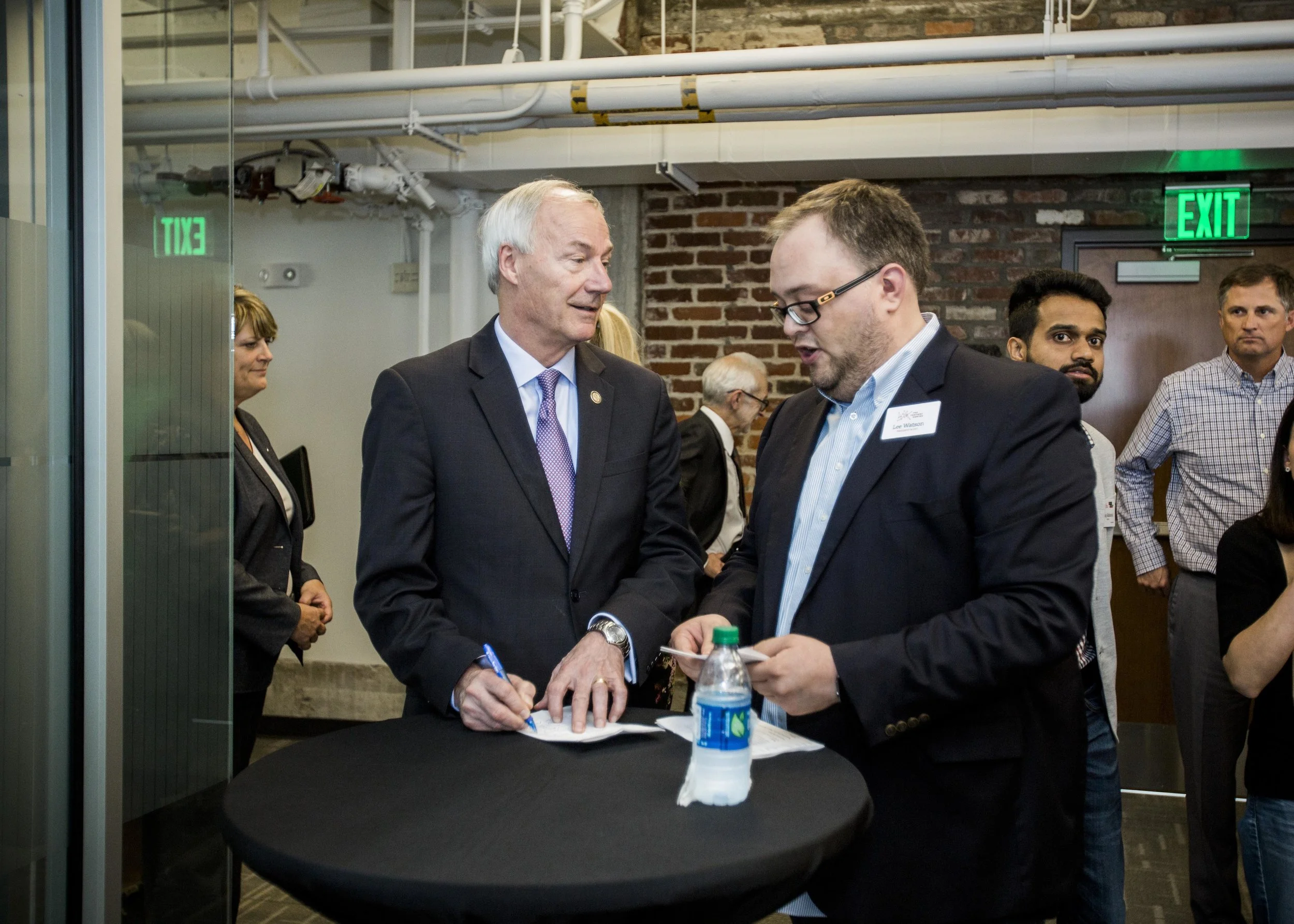
The bank was already in the neighborhood
The Venture Center's fintech accelerator gave the approach a more specific customer. Financial technology had roots in Arkansas through Systematics, whose legacy continued within FIS. A program in Little Rock could connect new companies to an established concentration of banking technology expertise. Watson's argument for the location began with something already there.
For the 2016 accelerator, ten startups entered a twelve-week program backed by FIS. Watson described a selection process that narrowed 150 applicants to the participating companies. Their preparation included financial regulation, compliance, business development and routes to market. Making software for finance required a working acquaintance with the people and rules of finance. Enthusiasm alone was unlikely to pass the compliance meeting.
The companies presented at Demo Day at the Clinton School. The event made the work visible, but the weeks before it supplied the substance: learning how a customer operated, refining a proposition and meeting people who could challenge it. Watson also became involved in VC FinTech Investment Funds, extending his startup work into the investment side of the relationship.
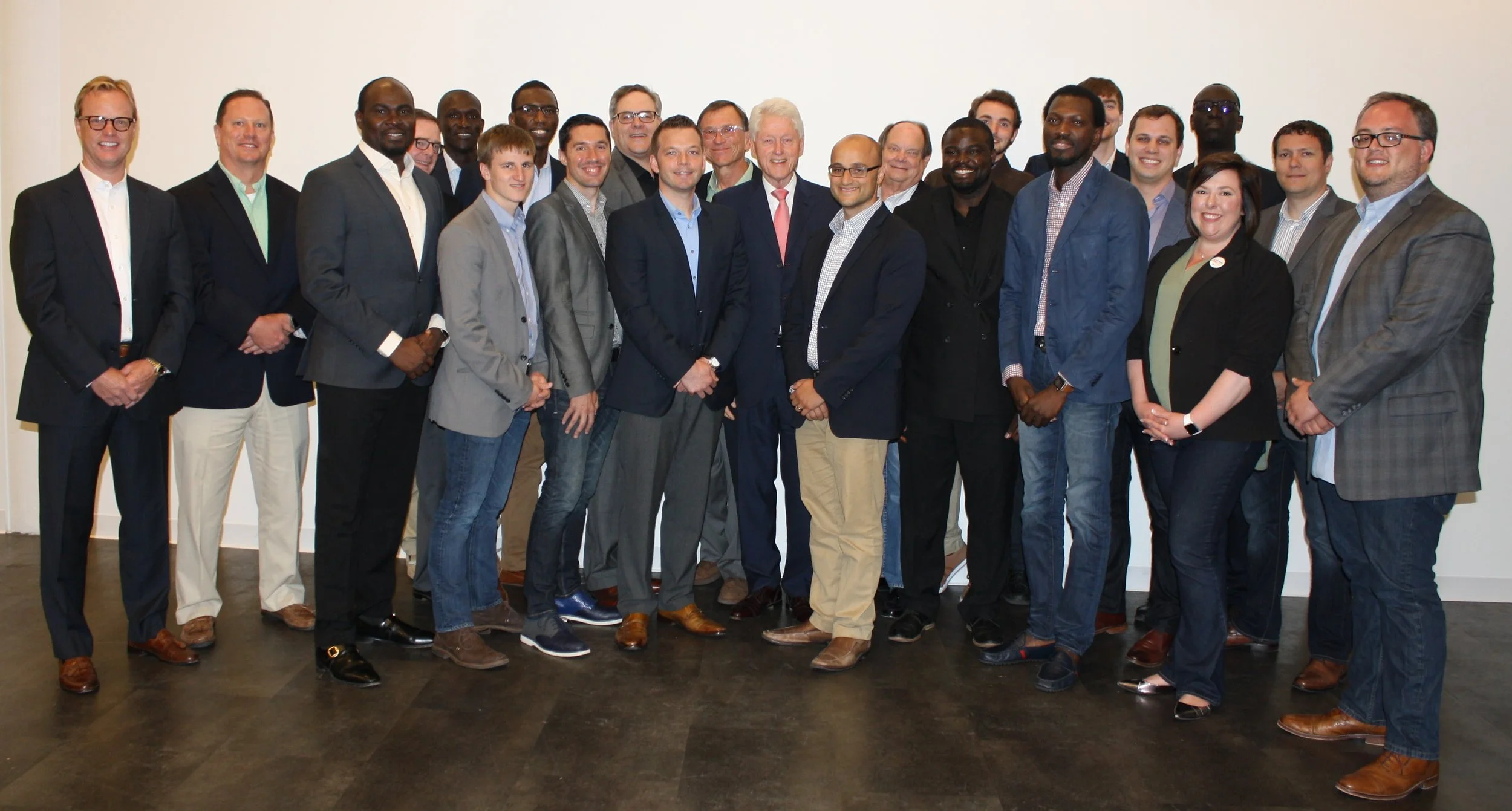
A hackathon changes the question
Cybersecurity entered Watson's account through an annual hackathon at the Venture Center. Local hackers and businesspeople both showed up. Here was another gathering of expertise and need, with consequences extending beyond the next startup. Connected devices were multiplying, and the risks attached to them were becoming harder to manage.
“I kind of backed into it, in a way.”
Lee Watson, on his route into cybersecurity
He founded Forge in 2018 to build collaborations around those challenges. The shift makes sense when viewed through his earlier work: find the people who understand a problem, connect them to institutions that need help, then organize an activity around the connection. His professional role depends on assembling different kinds of expertise. Cyber defense gives that skill a demanding setting.
Forge's development also brought Watson into state policy. He championed the Arkansas Cyber Initiative, enacted as Act 1085 in 2019, and Governor Asa Hutchinson appointed him to the Arkansas Cyber Advisory Council in 2021. Training, institutional cooperation and public policy became connected parts of his work. A company can improve its own defenses; wider preparation requires other organizations to participate.
The geographical scale mattered. Schools, local governments and smaller businesses all figured in Watson's account of collective defense. By 2024, Forge was working on training for school administrators, technical staff and policymakers, while also engaging military partners. The undertaking asked people with very different responsibilities to recognize that their technical problems could overlap.
The person on the other side of the syllabus
Training supplies the human scale in a career filled with institutional names. In January 2025, Watson published a case study about Sedrick Howard, a Walmart personal shopper who entered Forge's cyber bootcamp. Howard had long been interested in taking gadgets apart. A scam targeting his grandmother helped turn that interest toward cybersecurity.
Howard studied while working, supported by mentors and a manager willing to make space for his development. The account followed him into an internship at Walmart Global Tech, with a full-time penetration-testing role planned to follow. That sequence gives workforce development a more useful shape than a course catalogue: existing curiosity, practical instruction, support at work and an opportunity to apply new skills.
Watson has repeatedly returned to curiosity when discussing learners. His early Forge interview described cybersecurity as work requiring people who keep investigating and teaching themselves. The organization can arrange instructors and practice environments. The learner's willingness to ask the next question remains a contribution of their own.
In his June 2025 discussion of Forge's work, Watson described another route into that relationship: the Forge Fellowship, a Defense Department SkillBridge program for people transitioning out of military service. It gives participating employers an opportunity to work with service members during their final months in uniform. Alongside the Academy's instruction and employer connections, the fellowship puts experience into a new setting. A business gains a chance to understand a potential colleague's skills through actual work. Someone leaving the military gains a setting in which to demonstrate those skills. The arrangement gives both sides more to consider than a résumé.
His thinking about artificial intelligence follows the same concern with capability. In a 2023 interview, he separated people using AI from those integrating it and those building the underlying technology. He also argued for scrutiny of how models reach conclusions. The appeal of a convenient tool came with a workforce question: who would understand it well enough to manage its use?
An editorial map of the connections running through Watson's career.
The prototype needs a customer
Defense technology brought Watson back to the founder's problem with a different buyer across the table. Forge's Phoenix Xcelerator began its inaugural cohort in 2025. Walter Burgess, co-CEO of Power Technology, joined as entrepreneur in residence. The program combined company-building instruction with the specialist demands of entering defense markets.
Watson's explanation was disarmingly commercial: emotional attachment to a solution does little good if potential customers have no use for it. Phoenix worked on aligning proposed technology with military needs, alongside business models, funding proposals and connections to contractors. A prototype might be impressive. It still had to survive the question of who wanted it.
Other Forge partnerships widened the route between research and use. In January 2025, Forge announced a multiyear research agreement with the Air Force Research Laboratory on methods for analyzing publicly available information. The collaboration included work relevant to the Arkansas Air National Guard's 188th Intelligence, Surveillance and Reconnaissance Group in Fort Smith. It put research, analytical tools and a particular mission into the same arrangement.
Atomic Anvil followed in February, connecting researchers, startups and other participants with defense mission partners through activities including workshops, development sprints and mentoring. By October 2026, Forge's Project Phoenix announcement again emphasized customer validation, funding preparation and technical compliance. The terminology had acquired plenty of acronyms. Watson's underlying concern was still recognizable from the Venture Center: help a promising organization become capable of doing the work.
Keeping the lights on
On October 13, 2026, Forge announced the Secure Energy Defenders Program, a $2 million initiative funded by the U.S. Department of Energy and delivered with Idaho National Laboratory. The two-year program is designed to support participating Arkansas rural and municipal electric utilities through assessments, training, technical assistance and threat-information sharing.
The design begins with an assessment of a utility's needs, followed by assistance shaped around its systems, staffing and priorities. The announcement commits more than 2,000 hours of laboratory analyst time. Those are resources a smaller operator might struggle to arrange independently. The program's promised value depends on putting that access to practical use over the period through August 2028.
It is a fitting place to find Watson's work now: between a local institution and expertise that may otherwise feel distant. Years earlier, he was organizing mentors around founders and counting the jobs that followed. The stakes and participants have changed. The task of making the connection useful has stayed remarkably consistent. The introduction opens the door. Somebody still has to get to work.