Ken Kutaragi could live with a game console taking over the family television. The noise was another matter. The games were engaging; the little electronic bleeps seemed painfully limited. An engineer working inside a company that understood recorded music could reasonably ask why a fictional world had to sound so much poorer than the real one.
His answer would eventually help Nintendo's Super Famicom sound like a different kind of machine. Later, it would help carry Sony into a business many people inside Sony considered an unpromising distraction. Before there was a PlayStation under the television, there was an employee with a technical objection and a habit of following it further than his employer expected.
That habit is the thread through Kutaragi's career. He has been an engineer, a corporate executive, a founder and a university professor. He helped create a console business, then went into artificial intelligence and robotics. The title that follows him, “Father of the PlayStation,” is affectionate and useful. It can also make a working life sound finished. His recent remarks suggest he would object to that, too.
A computer with somewhere else to go
Born in Tokyo on August 2, 1950, Kutaragi grew up around his parents' printing business. Machines were part of the working day. He studied at the University of Electro-Communications and joined Sony in April 1975. His route into entertainment began with the practical education of an engineer: learning how things worked, then wondering why they could not work differently.
There was also a more extravagant education. He loved science fiction and repeatedly went to see Stanley Kubrick's 2001: A Space Odyssey. Its talking computer, HAL, made the future feel available for inspection. Years later, he recalled the film's natural conversation, video calls and artificial intelligence. A computer could occupy a life far beyond an office desk.
At Sony, his work included digital signal processing and magnetic recording. Away from the lab, he once built a Pong-like game and took it on a ski trip, where friends played it together. There is a pleasing mismatch in that picture: a researcher thinking about tomorrow's computing, carrying homemade entertainment to the slopes. Watching people enjoy a machine was part of the attraction.
The road to Kyoto
The Nintendo relationship began with a proposal that went nowhere. Hearing about the Famicom Disk System, Kutaragi thought Sony had a better storage technology. He and a Sony sales colleague approached Nintendo, where he met hardware designer Masayuki Uemura. The proposed disk system arrived too late for that opportunity.
Kutaragi kept talking. He thought richer sound could attract composers, arrangers and other musicians into games. A console's audio circuitry could change who wanted to make work for it. In his recollection, repeated visits to Kyoto eventually brought a request to put the idea on paper. The resulting sound technology became part of the Super Famicom.
He remembered the collaboration warmly: engineers from both companies discussing games and music, including during an overnight gathering at a Sony retreat in Mikkabi. Remembering that companionship matters. The subsequent collapse of Sony and Nintendo's CD-ROM console partnership is often told as a corporate feud. There had also been a working relationship between people who liked making things.
When the joint console plan fell apart, Sony still had to decide whether it wanted a games business at all. A broken partnership is an awkward foundation for a new division. Kutaragi believed there was enough in the technology to continue. That conviction required allies with authority, patience and room in the building.
- SoundWork with Nintendo
- 3D graphicsSony's independent project
- PlayStationJapan · December 1994
A dinosaur makes the introduction
Norio Ohga, Sony's leader, backed the independent console project. Sony Music brought people and experience from another side of entertainment. Kutaragi recalled moving roughly ten engineers into a small space in Aoyama to prepare the next machine. For a project whose name would travel around the world, its immediate geography was rather modest.
A prototype demonstration in 1993 supplied a more persuasive introduction. The audience saw three-dimensional objects with lighting and shading, followed by a textured Tyrannosaurus rex responding to a controller. The room was quiet. To the team, that initially looked like a failure to connect. The telephone calls that followed suggested a different explanation: people had been trying to absorb what they had seen.
In Kutaragi's telling, someone even looked beneath the table for a hidden graphics workstation. It is an unusually flattering form of suspicion. The demonstration made a promise about what ordinary domestic hardware might do, and at least one visitor wanted to inspect the furniture.
Sony Computer Entertainment was established in November 1993. Kutaragi was a founding director responsible for research and development; he later became president and CEO. The original PlayStation went on sale in Japan on December 3, 1994. The dinosaur had done its job. Now the machine needed games people would buy.
The engineer acquires an audience
Hardware needed a whole supporting business: developers, software tools, publishers, distribution and customers willing to try an unfamiliar platform. Shigeo Maruyama and the Sony Music side of the enterprise were part of that coalition. So were the people outside Sony who chose to build games for it. A console could demonstrate polygons by itself. Becoming a platform required company.
The scale arrived in increments that soon stopped looking small. Sony's timeline records ten million original PlayStation consoles shipped by December 1996 and fifty million by December 1998. Kutaragi became SCE president in 1999. The PlayStation 2 launched in Japan in March 2000; the PSP followed there in December 2004.
The original PlayStation eventually passed 102.4 million units in worldwide sell-in. PlayStation 2 passed 160 million. These are lifetime hardware totals, extending beyond Kutaragi's executive tenure. They measure the reach of platforms he helped establish, rather than a personal sales score. An engineer's proposal had become something other people organized their evenings around.
The awards followed, including lifetime achievement recognition from the Academy of Interactive Arts & Sciences in 2008 and the Game Developers Choice Awards in 2014. Receiving a lifetime award leaves an energetic inventor with an entertaining administrative problem: deciding what to call the work that comes afterwards.
The next machine was always waiting
Success did not make Kutaragi's ambitions tidier. After work on the PlayStation 2's core technology, he was already considering the next processor. With IBM and Toshiba, Sony developed Cell, which became central to PlayStation 3. He described approaching IBM Japan to find engineers who shared his interest in a different future for computing.
“I wanted to merge computer technology and entertainment,” he said in 2005. It is a useful sentence to keep beside the console photographs. Selling games was part of a broader ambition to change what a computer could deliver. He spoke about the possibilities of computing with the enthusiasm other executives reserve for the quarter's numbers.
That ambition brought difficult manufacturing questions, including how to produce a complex processor at consumer-electronics volume. An architectural idea had to survive a factory. PlayStation 3 launched in November 2006. Kutaragi stepped down from executive management in June 2007, with Kazuo Hirai taking over as president and group CEO.
Kutaragi became honorary chairman, leaving that role in 2011. The business continued under other leaders. A fair account of his career allows that separation: he helped set the direction, but PlayStation's subsequent history belongs to many people making decisions after him.
“I wanted to merge computer technology and entertainment.”
Ken Kutaragi · 2005
A robot has to notice the box
Kutaragi founded Cyber AI Entertainment in 2009. In August 2020, he became CEO of Ascent Robotics, a Tokyo company developing artificial intelligence for machines. His appointment moved him from advising the venture into running it. The new field still involved a familiar question: what can computing do when its surroundings become more complicated?
Ascent's work includes software for robotic picking and digital twins. Its systems address tasks such as recognizing objects and handling different materials and shapes. There is something satisfyingly unglamorous about the challenge. A simulated dinosaur can frighten an audience without having to sort a box of irregular objects. A robot has to cope with the box.
In February 2023, Ascent and Bridgestone announced work on intelligent robotics using artificial rubber muscles. Software, sensing and physical movement meet in the same project. The connection to his earlier career is easy to see, although the customer and the immediate purpose have changed. Both demand that an abstract technical capability do something convincing outside a research presentation.
Still dissatisfied with the available future
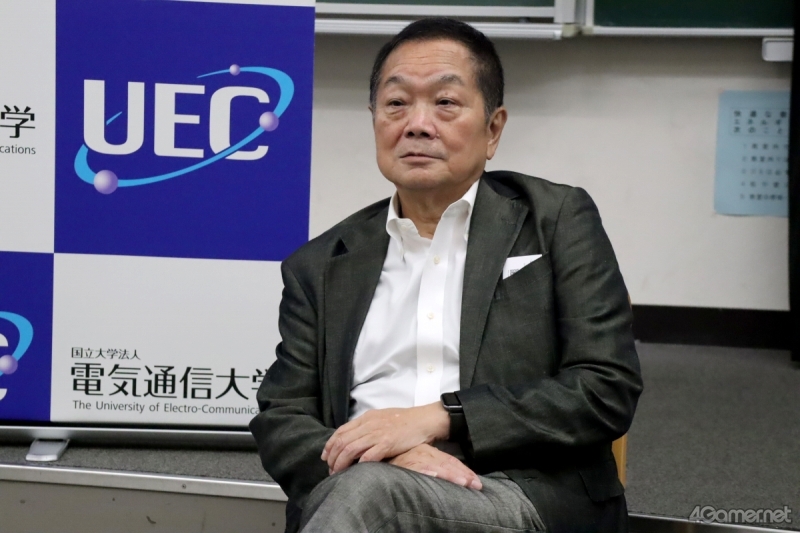
In September 2026, Kutaragi appeared at his alma mater for the opening ceremony of its Creative Entertainment Research and Education Center. He remains interested in the people who might build what comes next. He wants a more international environment, where collaborators from different countries can bring their ideas together.
His predictions remain expansive. In an October interview, he suggested that real-time AI generation of video and music could reach the speed of contemporary game consoles around 2028 or 2029. He imagined communication and daydreams becoming entertainment content. This is his forecast, with all the uncertainty a forecast carries. It is also recognizably the ambition of someone who once wanted a computer to escape the office.
At Game Republic New Horizons in Middlesbrough that month, he discussed digital distribution and the possibility that AI and cloud computing could eventually remove the need for a console. He acknowledged players' attachment to physical ownership while questioning the economics of discs. Building a famous box has apparently given him no sentimental obligation to keep the box forever.
The recurring pleasure of Kutaragi's story lies in these changes of scale. A complaint about game audio becomes a relationship with Nintendo. A small engineering group becomes PlayStation. A career associated with living-room hardware continues among robots and university students. The next step begins with something that bothers him about the present. Anyone hoping he would settle down to admire the old machines may have a long wait.