The trouble began on the inside. At a paper mill, the drive-side bearings on dryer cylinders kept failing under thermal stress. Their inner rings cracked. Bearings were replaced; production was interrupted. In NSK’s account, the annual bill for maintenance and lost production reached $261,760. A component designed to keep something turning had become a recurring reason to stop.
- NSK makes bearings, automotive parts and precision motion components.
- Its engineering work connects the failed part to the machine around it.
- The useful buying question: what does this component cost when it stops working?
NSK investigated the application and recommended its TL-Series spherical roller bearings. The company reports that annual costs fell to $35,430, a saving of $226,330, and that the solution has operated for more than ten years. Those figures describe one customer’s circumstances. They also explain why a bearing maker needs to understand more than bearings.
Annual maintenance + lost production, NSK dryer-cylinder case. Reported customer outcome.
The part is small. The system is not.
A bearing supports motion while reducing friction. The familiar version has rings and rolling elements, balls or rollers, carrying loads as parts rotate. NSK builds many variations because a car wheel, a machine-tool spindle and a paper dryer do not present the same problem. Speed, temperature, contamination and load all belong in the specification.
The product range extends into movement along a straight line. Ball screws turn rotary motion into linear travel; guides support that travel; actuators and motors put it to work. Automotive customers buy hub bearings, steering equipment and powertrain components. Industrial customers include equipment makers and operators in steel, food processing, rail, wind power and semiconductor production.
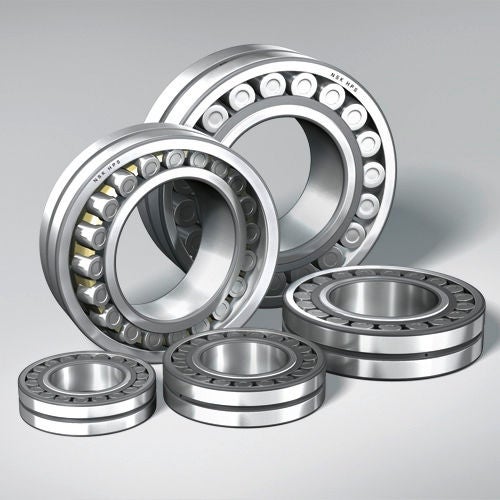
This is a business selling to other businesses. NSK manufactures components for original equipment and replacement demand, supported by distributors and regional engineering operations. Its market includes SKF, Schaeffler, Timken, JTEKT and NTN. A broad catalogue alone offers little reason to choose one established manufacturer. The practical contest happens when an engineer matches a component to the actual job.
A crack is a clue
Consider a different paper-mill case, published in 2023. Calender-roll bearings developed multiple inner-ring cracks, with as many as ten failures a year. NSK’s review found that the installed standard bearings lacked carburized inner rings, leaving them vulnerable to heat and thermal stress. The company reported $377,225 in savings over five years following the change. The failure mechanism gave the purchasing decision its direction.
Or take a milk-processing plant working with distributor ERIKS and NSK. Bearings on five conveyors needed replacement every sixteen weeks. Access made regular relubrication difficult, but the review identified water ingress and corrosion. Stainless-steel Silver-Lube units suited the washdown environment. The reported result was more than five years of service and £32,700 saved over that period.
“improvement pays”NSK’s deliberately practical name for the AIP proposition.
NSK gives this process a structure through its Added Value Programme: evaluate, recommend, implement, validate, extend. Engineers visit, examine the application and propose a change. A trial tests the recommendation. Validation asks whether it improved the economics; extension asks where else the finding applies. The sequence makes the supplier accountable to an operating result, beyond delivering another box of parts.
A plant manager can copy that discipline. Keep the failed component. Record its location, operating conditions, maintenance history and the value of lost production. Test the proposed fix before rolling it across the plant. The calculation should include installation, labour and stoppages. A corrosion-resistant bearing does not solve every heat problem; a successful trial on one machine does not establish suitability for another.
The distinction matters when the equipment is cheap to stop, too. If a shutdown has little production impact, the financial case for a specialized component will look different. The sensible comparison uses that plant’s numbers. NSK’s improvement method is useful precisely because it leaves room for the application to decide whether an upgrade earns its keep.
First, learn to make the bearing
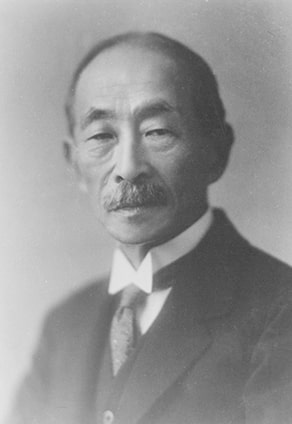
That attention to the surrounding problem reaches back to Takehiko Yamaguchi. After studying industrial technology overseas, NSK’s founder wanted Japan to produce precision machinery components domestically. A predecessor partnership began in 1914; NSK followed in 1916 and started mass-producing bearings. The starting ambition was industrial capability: make a necessary component at home and help other manufacturers advance.
Skills travelled between applications. NSK began producing ball-screw manual steering systems in 1958 and developed precision ball screws for machine tools in 1959. Its bearings supported the Tokaido Shinkansen in 1964. Today its technical foundations include tribology, materials, numerical simulation and mechatronics, backed by manufacturing engineering. Tribology, the study of friction and wear, is an unusually good subject for a company whose successes are often invisible.
The detail can be wonderfully unforgiving. NSK’s May 2026 review of MT-Frix ball screws notes that a one-degree-Celsius rise expands a metre of screw by approximately twelve micrometres. That changes positioning accuracy. The design addresses friction and heat; under the described comparison conditions, NSK reports roughly half the dynamic preload torque at equivalent rigidity. Tiny differences become consequential when a machine must repeatedly arrive at the same place.
NSK’s stated culture gives this work a prosaic backbone: safety, quality, environment and compliance. Its employee programmes include workplace learning and plant-level discussions called Vision Cafés. There is a connection between that language and the engineering task. Understanding an operating problem requires people to share what they have observed, including the awkward details of how a machine actually gets maintained.
The next machine is taking shape
NSK is now extending those capabilities through partnerships. Its May 2026 robotics memorandum with Delta Electronics covers exploring integration, prototypes and commercialization, with specific initiatives requiring further agreements. In September, NSK agreed to form a digital-services joint venture with Accenture. NSK Digital is planned for April 2027, with Accenture holding 65 percent and NSK 35 percent.
A larger proposal sits alongside them. NSK and NTN signed a May 2026 memorandum to integrate under a joint holding company, targeting October 2027 subject to agreements and approvals. These plans concern the company’s own machinery of production and management. The question customers will eventually answer is familiar: does the new arrangement help the equipment keep running?