The doll’s eyes refused to agree. Playmates Toys wanted its Baby Bright Eyes to look sleepy, happy, and alert. NanoMuscle’s first arrangement gave each eye its own tiny actuator. The eyes moved slightly out of time. The result, recalled by a company co-founder, looked like a lazy eye. That is the sort of failure a laboratory might call minor and a toy aisle cannot forgive. A parent does not inspect the mechanism. A child meets the face.
NanoMuscle was selling a way to make small things move. Founded in Antioch, California, in 1998 by Rod MacGregor and Danielle Fowler, it built miniature actuators from nickel-titanium shape-memory alloy, electronics, and software. The wire shortened when current heated it; a spring helped return it when the wire cooled. To a designer trying to animate a face or open a vent, the appeal was simple: motion without the familiar whirr of gears and a motor.
MacGregor later traced the idea to a small walking creature he tried to build. Each larger motor demanded a larger battery; each larger battery made the creature bigger. Soon his little robot was roughly shoebox-sized. The lesson was physical, not philosophical: if the motor kept growing, the toy would too. With contract engineers, he pursued a shape-memory actuator that could provide motion in far less space.
The short version
- NanoMuscle supplied compact, quiet motion components for other companies’ products.
- Optical networking equipment was an early commercial use; Playmates’ blinking doll made the technology visible.
- The hard problems were small travel, slow cooling, fatigue, and reliable control.
- Strategic investors, outsourced manufacturing, and design work near customers took it toward global production.
A wire with a memory, and a very short attention span
Shape-memory alloy was not new. The difficulty was persuading it to perform on command, over and over, inside a product people would buy. A straight wire contracts only a small fraction of its length. To get a useful four-millimetre stroke in a compact package, NanoMuscle arranged multiple fine wires between sliding metal plates. Add their movements together and the device travels farther than any one strand. The control electronics managed heating and position; cooling and a return spring completed the cycle.
The engineering was less magical than the name. Early alloy devices could be slow because the wire must cool before it can reset. They could also lose stroke through fatigue. NanoMuscle’s chief engineer described cycle life and speed as the barriers that had kept similar ideas out of mass use. The company’s answer combined geometry, cooling, and controls. Its 2001 product line advertised a four-millimetre stroke, low-voltage operation, and lifetimes measured in millions of cycles. By 2002 it had introduced the NM125, a model rated at 125 grams of force.
There was a competitive opening here, but it was narrow. Conventional electromagnetic motors and solenoids were well understood, available from many suppliers, and could offer longer travel or greater force. At very small sizes, though, gears, magnets, noise, and assembly became awkward. NanoMuscle’s actuator was meant for the places where compactness and quiet movement mattered more than a long stroke. It sold into the space between microscopic devices too small to move an ordinary object and miniature motors that were still too bulky.
The customer wanted a face
Before the doll, the technology had a commercial use in optical networking equipment, moving lenses, filters, and covers. But toys gave engineers an unusually candid product test. The movement had to look right, fit within a doll’s head, run on batteries, and survive a price-sensitive retail business. Playmates’ Baby Bright Eyes was planned at $49.99 in 2003. A Playmates executive told Design News that the actuator and related electronics accounted for about 70 percent of the doll’s total cost. That figure describes the toy’s bill of materials, not NanoMuscle’s selling price, which varied by volume.
The two-independent-eye idea failed its first audition. The revised design used two rotary actuators to move both eyes and eyelids together across two axes. Switches in the doll’s hand and a tilt sensor told software which expression to make; pulse-width control held the eyes between endpoints while conserving battery power. None of that circuitry mattered to the buyer except for the result: a doll whose gaze appeared deliberate.
“You’re just not going to sell them a $300 actuator.”Danielle Fowler, speaking about toy economics in 2003
A prototype can work and still be a poor salesman. Playmates’ marketing executive carried an early Baby Bright Eyes in a Tupperware container to demonstrations, then asked for an engineer to accompany major toy-fair trips because the machine could behave unpredictably. That episode is almost comic, until one remembers what a trade-show failure can cost a launch. NanoMuscle did not merely need to make a component move. It had to make a customer confident enough to put the component in front of retailers.
From the toy shelf to the car cabin
NanoMuscle’s revenue logic was business-to-business: supply components and paid application development to manufacturers, then let their products carry the visible brand. The company outsourced manufacturing and put engineers near customers. By 2004, MacGregor had moved major operations toward Hong Kong and opened a Shenzhen design center near the toy-making supply chain. Contemporary reporting put about 60 of roughly 100 employees in China. Research remained in California; sales efforts reached Europe.
The automotive pitch had a different rhythm. A doll needed expressive eyes. A car needed small, quiet, repeatable adjustments in vents, seats, mirrors, and interior mechanisms. AutoVision, a Volkswagen subsidiary, invested $2 million in 2003 and helped NanoMuscle establish a European presence in Wolfsburg. Its $16 million Series C later that year included venture investors and strategic partners from several countries. Across publicly listed 2002 and 2003 rounds, the company raised $21 million.
The automotive ambition came with physical limits. A shape-memory wire needs heat to move and time to cool; those facts shape how fast it can cycle and where it can sit. Design News reported that proposed car uses were limited to interior areas that stayed below the alloy’s roughly 90°C transition temperature. In a hot, forceful, long-travel application, a conventional motor could remain the sensible choice. A company selling a new material had to learn where its own argument ended.
What the blink is worth
NanoMuscle’s distinctive achievement was packaging a materials-science effect as a component a customer could design around. The wire alone was an interesting experiment. The useful product included a predictable stroke, power control, a return mechanism, support for specific applications, and manufacturing at volume. The company’s work appeared inside a doll, not on the doll’s box. That is how component businesses often win: the end user notices the experience, never the supplier.
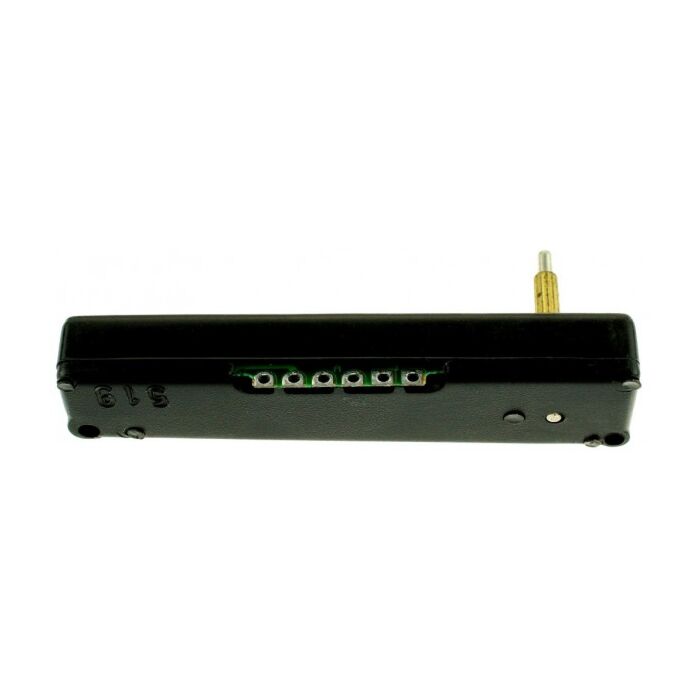
The record after the company’s mid-2000s expansion is thinner than the sales pitch of the time. Miga Robotics later listed NanoMuscle-branded rotary models, including two-pin and six-pin versions, in its specialist catalog. That continuity is modest but telling. A component designed for a big toy and automotive market could still have a life among engineers and hobbyists who needed a very particular movement.
For a product team, the practical lesson is smaller than the grand promise of a motor revolution. Start with the movement a customer can see. Put the prototype through the conditions in which that customer must sell it. Count the whole integration cost, not the price of the clever part. And if two doll eyes must agree, make them share a mechanism before asking a parent to find them charming.
Follow the mechanism
- NanoMuscle on LinkedIn - historical company profile
- NM70R-2P rotary actuator - product listing and specifications
- Baby Bright Eyes at the workbench - contemporary reporting
- The original actuator problem - engineering coverage