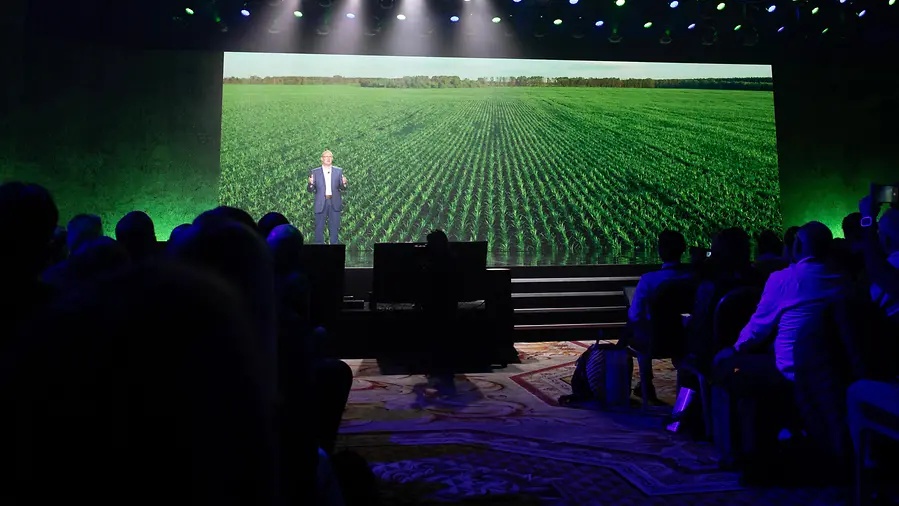
Las Vegas is a peculiar place to explain a farm. The carpets are elaborate, the lighting is theatrical, and practically everything has been arranged to make people forget the time. Farming tends to require the opposite. Yet on January 5, 2023, John May stood at CES, with rows of green crops filling the screen behind him, and made agriculture the opening attraction. Deere’s chairman and chief executive had brought the field to the people who usually preferred a screen.
There was a useful awkwardness to the occasion. A tractor company had to explain why it belonged at a technology show. May had already encountered the question when Deere first exhibited there in 2019. By the time he reached the keynote stage, he was using that uncertainty as an invitation: look again at what happens between planting a seed and buying dinner. The green paint was familiar. The work underneath it was becoming harder to recognize.
“Technology is core to Deere’s DNA,” he had written before the appearance. The interesting part of that claim was the burden it put on him. Plenty of executives can announce a new identity. May had to make this one work in machinery that customers buy to earn a living, under conditions a showroom cannot reproduce. A field is a rather unforgiving product review.
His career helps explain why he approached the problem through operations. Before becoming chief executive, May had run a construction-equipment factory, led Deere’s business in China and held the chief information officer’s job. His route to the stage passed through places where a clever idea still has to survive the next shift.
Before the keynote, the factory
May joined Deere in 1997 after working as a management consultant at KPMG Peat Marwick. He had earned a bachelor’s degree at the University of New Hampshire and an MBA at the University of Maine. Those are the straightforward coordinates of his early professional life. The more revealing detail is how many different kinds of Deere he subsequently encountered.
There was the Deere of overseas expansion: he became managing director of its China operations. There was the Deere of physical production: he managed the construction-equipment factory in Dubuque, Iowa. There was the Deere of smaller machines and different customers, through his work leading the Global Turf & Utility platform. These assignments put geography, manufacturing and the customer’s particular job on the same résumé.
In a 2022 conversation with GadgetMatch’s Michael Josh Villanueva, May recalled living in China for three years with his wife and two children. He remembered ordinary things: groceries, restaurants, making friends. He also described a professional lesson. Markets differ in what farmers can afford, how they farm and how far mechanization has progressed. A solution developed for an American farm cannot simply be dropped into another country and expected to fit.
That observation gives his technology program a necessary complication. A machine can be advanced and still be wrong for its buyer. The experience in China makes a useful lens for reading May’s later promises: the relevant measure is whether a customer can use the thing, in that customer’s circumstances. The machinery business has an efficient way of punishing indifference to such details. Customers keep the old machine.
- 1997Joins Deere from consulting
- 2012Agricultural Solutions + CIO
- 2019Becomes chief executive
- 2020Adds the chairmanship
A weed becomes a business decision
In 2012, May entered Deere’s senior management team as president of Agricultural Solutions and chief information officer. The pairing matters. Information systems were connected to a business responsibility, with agricultural work at the center. By 2017, he was publicly making the case for machine learning as Deere announced its agreement to acquire Blue River Technology for $305 million.
Blue River, based in Sunnyvale, California, applied computer vision and machine learning to agricultural spraying. May compared the investment with Deere’s 1999 acquisition of NavCom Technology, which had helped extend GPS into agriculture. The comparison placed the new purchase in a longer sequence: first locating the machine more precisely, then improving what it could distinguish in front of it.
“Machine learning is an important capability for Deere’s future,” he said. It was a modest sentence attached to an expensive decision. The business question was wonderfully concrete. Could a sprayer recognize where treatment was needed, rather than treating every part of a field alike? A weed had become something a computer could identify and a nozzle could act upon.
For May, this supplied an unusually clear explanation of what the software was for. Selective spraying connects recognition to a physical action and, potentially, to a farmer’s spending. It also demands more than a convincing demonstration. Cameras, computation, equipment and the person operating it have to function together. The intelligence has to arrive at the nozzle, on time. Otherwise, the farmer has bought an elaborate spectator.
It would be misleading to assign a whole company’s engineering to its chief executive. May’s place in this story is as an executive arguing for the capability before he reached the top, then organizing the business around the possibilities it opened.
“Machine learning is an important capability for Deere’s future.”John May · 2017
The job replaces the product catalogue
May became president and chief operating officer in April 2019. On November 4, he succeeded Samuel Allen as chief executive, becoming Deere’s tenth CEO in its then 182-year history. The chairmanship followed in May 2020. Such a small succession count carries its own expectation: a new leader inherits a company that intends to remain recognizable long after the appointment announcement has yellowed.
In June 2020, Deere introduced its Smart Industrial operating model. Behind the corporate name was a practical reorganization. The company would align work around customers’ production systems, bring together the technologies inside and around its machines, and support equipment throughout its working life. It also promised to direct investment toward opportunities with stronger customer value and financial prospects.
Consider the difference this makes to a planting business. A product catalogue separates machines into things that can be ordered. A production system asks how preparing ground, placing seed, applying inputs and harvesting affect one another. Each stage leaves consequences for the next. Organizing around that sequence gives the technology teams a larger problem to solve than adding a feature to a tractor.
The approach also extends the relationship after delivery. Software, connectivity and service become part of how the equipment works over time. This is attractive territory for a manufacturer, but it raises the standard customers will apply. If the sales pitch concerns the whole job, the buyer can reasonably judge the whole job. A machine that runs beautifully while another part of the process stalls has supplied only a partial answer.
May’s factory experience gives this strategy a grounded reading. New technology still depends on build quality, support and cost control. In a February 2024 earnings discussion, he returned to those fundamentals: execution inside the factories, quality and management of expenses. The chief executive selling a more intelligent machine was still talking about the production floor.
A machine that works, and an owner who can fix it
The ambitions became easier to picture in 2022, when Deere unveiled an autonomous 8R tractor for large-scale production. Its six pairs of stereo cameras supplied a view around the machine and helped determine the distance of objects. The hardware made an abstract promise visible: equipment could gather information about its surroundings and use it while doing field work.
At CES the following year, Deere introduced ExactShot, a system designed to place starter fertilizer with individual seeds during planting. The company said dosing could reduce in-furrow starter fertilizer use by more than 60 percent compared with its ExactRate system. That comparison concerns a particular input and application method. It is a useful illustration of precision, rather than a universal promise about every farm’s total fertilizer bill.
As the machinery becomes more dependent on software, another question becomes unavoidable: who gets the tools to repair it? The question reached federal court during May’s tenure. In January 2025, the Federal Trade Commission and states sued Deere, alleging restrictions that prevented farmers and independent providers from performing certain repairs and pushed work toward authorized dealers. Deere disputed the allegations.
In July 2026, the FTC announced a settlement with Deere and five states. The proposed order called for farmers and independent repair providers to receive equivalent repair resources, including applicable software capabilities, on fair and reasonable terms. It provided for ten years of oversight. The announcement specified that the stipulated order would have legal force when approved and signed by the judge.
For May’s customer-centered strategy, repair access is a substantial test. Software can make equipment more capable while also making the owner more dependent on whoever controls the tools. A farmer experiences those two developments together. The same customer being invited to trust an autonomous machine has good reason to care about what happens when it stops.
The calendar still belongs to the farmer
By August 2025, May was explaining a less glamorous task: matching production to retail demand and working down high levels of used equipment. He pointed to See & Spray and harvest automation as ways customers could improve productivity while the industry faced uncertainty. The argument for useful technology had met the old machinery problem of when customers would buy.
A year later, Deere’s third-quarter results offered a mixed view. Net income reached $1.379 billion, up from $1.289 billion a year earlier. Nine-month net income remained lower than the prior-year total. Production & Precision Agriculture sales fell 6 percent in the quarter even as total company net sales and revenues rose 5 percent. May said he continued to expect 2026 to mark the bottom of the agricultural-equipment cycle. That was his outlook, with the next turn still ahead.
This is the tension that makes his career worth following. He is building a case for machines that see, decide and work with less supervision, while managing a manufacturer whose customers must still reckon with equipment costs and the timing of replacement. Autonomy cannot abolish the purchase decision. A better sprayer must eventually persuade someone to pay for it.
May’s public aspirations remain tied to more productive, profitable and resource-conscious work for customers. His route through China, Dubuque and information technology helps explain the breadth of that task. The geography matters. The factory matters. So does the software. At CES, a field could fill an enormous screen and make a persuasive picture. Back on a farm, the picture has to become a machine that earns its place.
Keep following the story
- John May’s official biography
- John May on LinkedIn
- Watch: May in conversation with GadgetMatch
- Watch: the CES 2023 keynote
- Deere’s 2017 machine-learning investment
- The 2020 operating-model announcement
- Deere’s 2022 annual report
- The July 2026 repair-access settlement
- Deere’s August 2026 results
- John Deere website