The assignment was measured in pennies. Dan Michaeli and Justin DiPietro were helping a Fortune 50 retailer compete with online rivals, adjusting prices a little here, a little there. It was respectable consulting work, with the familiar appeal of a number that could be made smaller. But the retailer’s advantage was sitting elsewhere: in the quality of its service when a customer walked through the door.
Online, that advantage was harder to find. The company could move its merchandise onto a website. Moving the helpful person beside the merchandise was a different undertaking. Michaeli became interested in that missing piece. A penny was easy to copy; a useful conversation offered another way to compete.
The advantage the spreadsheet missed
In 2012, Michaeli, DiPietro and Carlos Paniagua founded the company that would become Glia. The original question was simple enough to survive fourteen years of product development: how could a business bring the experience of good personal service online? Michaeli took the CEO role and stayed involved in strategy, the technology roadmap and execution.
Their answer put several ways of communicating together: messaging, voice, video and shared guidance through a webpage. Customers could ask for assistance without being sent away from what they were trying to accomplish. The ambition sounds almost modest when expressed from the customer’s chair. You have reached the difficult part. Someone should be able to help you there.
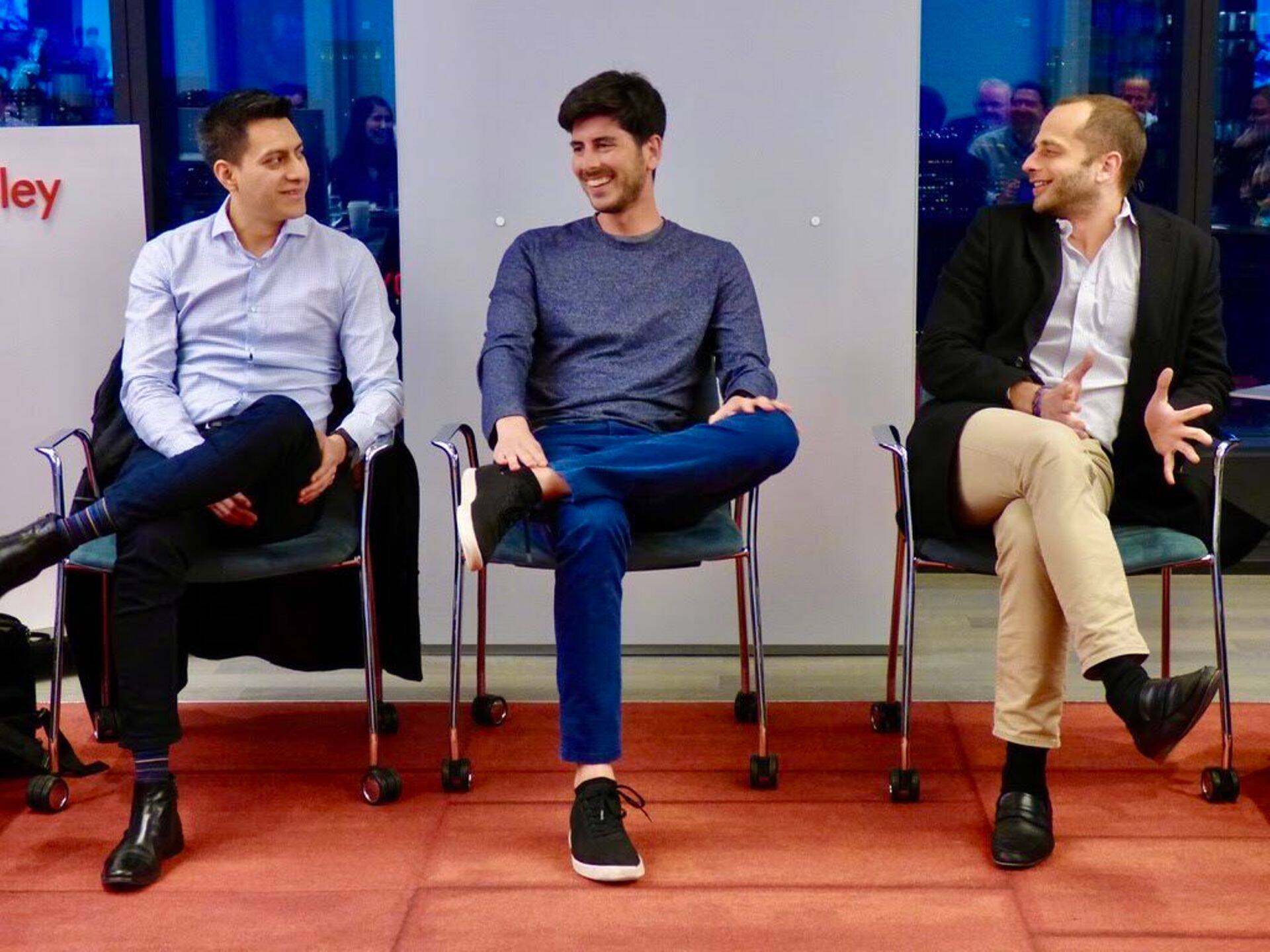
A family business, then a business of his own
Business was familiar territory long before the consulting assignment. Michaeli was born in New York and grew up in Guatemala, where his family operated a plastics business. His grandfather had started by selling plastic combs from a bicycle. At eleven, Michaeli was asking to work there and doing data entry. Entrepreneurship arrived with products and records to handle, before it arrived with a title.
That childhood gave him a close view of what a family enterprise required. His route eventually took him to the University of Pennsylvania and then into consulting. His public university activities include club volleyball and work with Communication within the Curriculum. The combination is pleasingly unpolished: a future software CEO with experience around inventory, public speaking and a volleyball net.
He graduated summa cum laude. His professional biography also includes work at Accenture. By the time he started Glia, he had seen business from the family side and the advisory side. The next step meant taking responsibility for a company’s choices himself.
Away from the company, his public speaker biography offers a quieter itinerary: time with family, travel and walks with his dog, Seneca. It is a useful reminder of the person behind the job title. There are no elaborate founder rituals in that account, just the ordinary pleasures of going somewhere with people you like, or taking a dog outside.
A name with room to grow
The company began as SaleMove. It was an efficient name for the initial commercial proposition, almost an instruction: help the sale move along. Customers, however, were using the platform for more than the name suggested. Service and support were becoming part of its identity. A name that had once explained the business now needed explaining.
By 2019, SaleMove had become Glia. Michaeli described customers discovering uses the founders had not originally imagined. The rebrand gave those uses more room. It also marked a shift in how the company presented the value of a conversation, whether the customer was buying something or asking for help afterward.
That March, Glia announced a $20 million Series B led by Insight Venture Partners, taking its total funding at the time to $29 million. The money was intended for product development and the teams that would take it to customers. The name had changed; building the organization around the wider proposition remained a considerable job.
The road to Tartu
Glia’s geography followed a person rather than a slogan about global talent. Paniagua was finishing his master’s program at the University of Tartu when the founders started building the company. He spoke highly of Estonia. The team invested there, and Estonia became part of Glia’s working life alongside the United States.
By August 2021, Michaeli estimated he had visited close to fifty times. He admired the people he encountered and the cooperation within the technology community. His account of what an ecosystem needed was practical: capable people, money to grow and peers willing to share knowledge.
He was less sentimental about keeping the startup label forever. A company searching for its business model occupied one stage; a company that had found a model needed to learn how to scale. The label, in his view, ought to describe a phase. Eventually the business had to graduate, even if the office wardrobe felt no obligation to follow.
“I believe it is crucial to understand that ‘startup’ is just a phase.”
Dan Michaeli, 2021
Putting the argument between covers
In 2021, Michaeli and Rick DeLisi turned the service argument into a book, Digital Customer Service: Transforming Customer Experience for an On-Screen World. DeLisi brought research into customer expectations and experience; Michaeli brought the perspective of someone building the technology. Wiley published their work that August.
The book addressed a persistent business puzzle: how to improve customer experience while controlling the cost of providing it. The authors argued for service that stayed on the customer’s screen, including occasions when speaking to another person was a useful way forward. Digital service could include a voice. The screen did not have to become a barrier between people.
The distinction becomes clearer in the mechanics of co-browsing. In Glia’s product demonstrations, an agent can help a customer navigate a particular webpage with permission. The shared view is restricted to that experience, with sensitive information protected. Assistance can become more specific because the agent has context about where the customer is stuck.
- Keep the placeThe customer is already on a page.
- Add the helpChat, voice or guided browsing.
- Carry the contextThe conversation can continue as the mode changes.
A conceptual view of Glia’s approach, rather than a performance comparison.
Anyone who has tried to describe a troublesome form over the phone can appreciate the attraction. “The button near the other button” is a poor basis for collaboration. Being able to work on the same page gives the conversation something firmer to stand on. It is a technical feature with a thoroughly ordinary purpose.
The calendar behind the software
Michaeli’s operating habits are similarly concrete. Asked in 2024 which leadership practice he would repeat in another company, he chose a predictable rhythm for the business year. He compared it to a school calendar: major events, regular meetings and explicit expectations about preparation and decisions. Even an inventive company benefits from knowing what Thursday is for.
His account of working culture includes flexibility about location. In 2022, he described a company policy allowing remote, office or hybrid work, accompanied by gatherings for collaboration. One company event carried the name CChaMP Camp, a reference to Glia’s values. He also emphasized the range of ages represented in its technical team and the value of different experiences.
There is a consistent concern with how people work together. Customers need a useful handoff between forms of assistance. Employees need clarity about the moments when they come together. Neither arrangement maintains itself simply because the company sells software.
A bank needs an answer it can stand behind
As Glia’s focus has moved toward banking AI, Michaeli has kept returning to the relationship between automation and personal service. In January 2026, he described an approach that used generative AI to understand what a customer meant while keeping responses under the financial institution’s control. Understanding a question and deciding what may be said in reply are separate responsibilities.
His argument for automation includes giving staff more time for complicated conversations. Routine requests consume capacity; relieving that pressure can leave people available for work that benefits from judgment and attention. It is the original service question with a newer set of tools. The institution still has to deliver an answer the customer can use.
A March 2026 implementation with Quorum Federal Credit Union put that approach into practice. The teams worked on voice workflows, authentication and escalation so members could move from automated support to a person with context intact. Those details are where Michaeli’s proposition has to earn its keep. A helpful idea on a stage must eventually become an interaction someone can complete.
He can also laugh at the technology. At a 2026 credit union conference, he posted about an AI caricature of himself, joking about the size of his forehead. The accompanying point was that a playful image and a banking interaction call for different expectations. A caricature gets considerable artistic license. An answer about someone’s account has a less forgiving audience.
In his conversations with banking leaders, Michaeli says he finds shared concerns: introducing AI into established processes, helping teams adapt and keeping up with change. Glia has to confront those questions internally too. He describes enjoying the chance to discuss them as a peer, beyond the demonstration and its list of features.
Banks and credit unions partnering with Glia, as reported by the company in October 2026.
On October 14, 2026, Goldman Sachs recognized Michaeli at its Builders and Innovators Summit in California. It was his fifth consecutive year receiving the entrepreneurship recognition. Glia’s latest expansion included branch tools, relationship management and automated workflows. He used the occasion to emphasize the team and its partnerships with more than 700 banks and credit unions.
His stated ambition is to help community and regional institutions stay competitive while retaining the personal service their customers value. Fourteen years after the retailer’s pricing assignment, the setting has changed considerably. The question remains recognizable. When a customer reaches the difficult part, who helps, what do they know, and how much explaining must happen before the useful conversation can begin?