The most revealing moment in a bank's technology stack arrives when a customer types into chat, gets nowhere, calls the contact center and is asked to explain everything again. The bank may call that omnichannel. The customer calls it Tuesday. Glia built its business around removing that restart button. Its software lets a conversation move among an AI assistant, a human agent, phone, messaging, video and a shared screen while carrying the context along for the ride.
That sounds like plumbing because it is plumbing - expensive, regulated, consequential plumbing. Glia sells it to regional banks, credit unions and other financial institutions that need the conveniences of a megabank without sanding away the local service that makes them worth choosing. More than 700 institutions now use the platform, according to the company. The product sits above core banking systems, online banking products and customer records, then coordinates what happens when a person asks for help.
The original mistake was treating online service like a cheaper store
Glia began in 2012 as SaleMove. Co-founders Dan Michaeli and Justin DiPietro had been consulting for a Fortune 50 retailer whose advantage was unusually good in-person service. The obvious corporate instinct was to move customers online and lower the cost to serve them. The founders noticed the trap: if the store's advantage lived in the human experience, stripping that experience out of the website was a losing proposition. With technologist Carlos Paniagua, they asked a better question: how could the web reproduce the useful parts of an in-person interaction?
The early answer combined live chat, video, voice and co-browsing. Co-browsing is the quietly potent piece. An agent can see the customer's location in a digital journey and guide the person through a form or application without the clumsy ritual of describing every button over the phone. The company later rebranded from SaleMove to Glia, a name that suggests connective tissue. The metaphor fits: the product is less a destination than the layer holding many customer-service parts together.
“How can we replicate that same, winning experience online?”Dan Michaeli, co-founder and CEO
Financial services became the sharp end of the wedge. A bank conversation is unusually rich in context and unusually intolerant of mistakes. The customer might need to unlock online banking, dispute a transaction, renew a certificate or finish a loan application. A generic chat widget can collect a question. A banking platform has to know which system can answer it, what the institution permits, when identity must be checked and when a human should step in.
One conversation, four moments
What it actually sells
Glia now organizes the platform into Voice, Digital and AI. Glia Voice handles calls, routing, automation, coaching and analysis. Glia Digital covers messaging, video, on-screen voice, co-browsing and live observation. The AI range includes Glia Banker for customer self-service; CoPilot for source-backed answers and prompts inside an employee's workflow; and Analyst for quality review, coaching and workforce planning. AI Outreach runs outbound campaigns for loan conversion, payments and renewals. Agentic Workflows can execute approved multi-step procedures such as freezing a card or adding a travel notice.
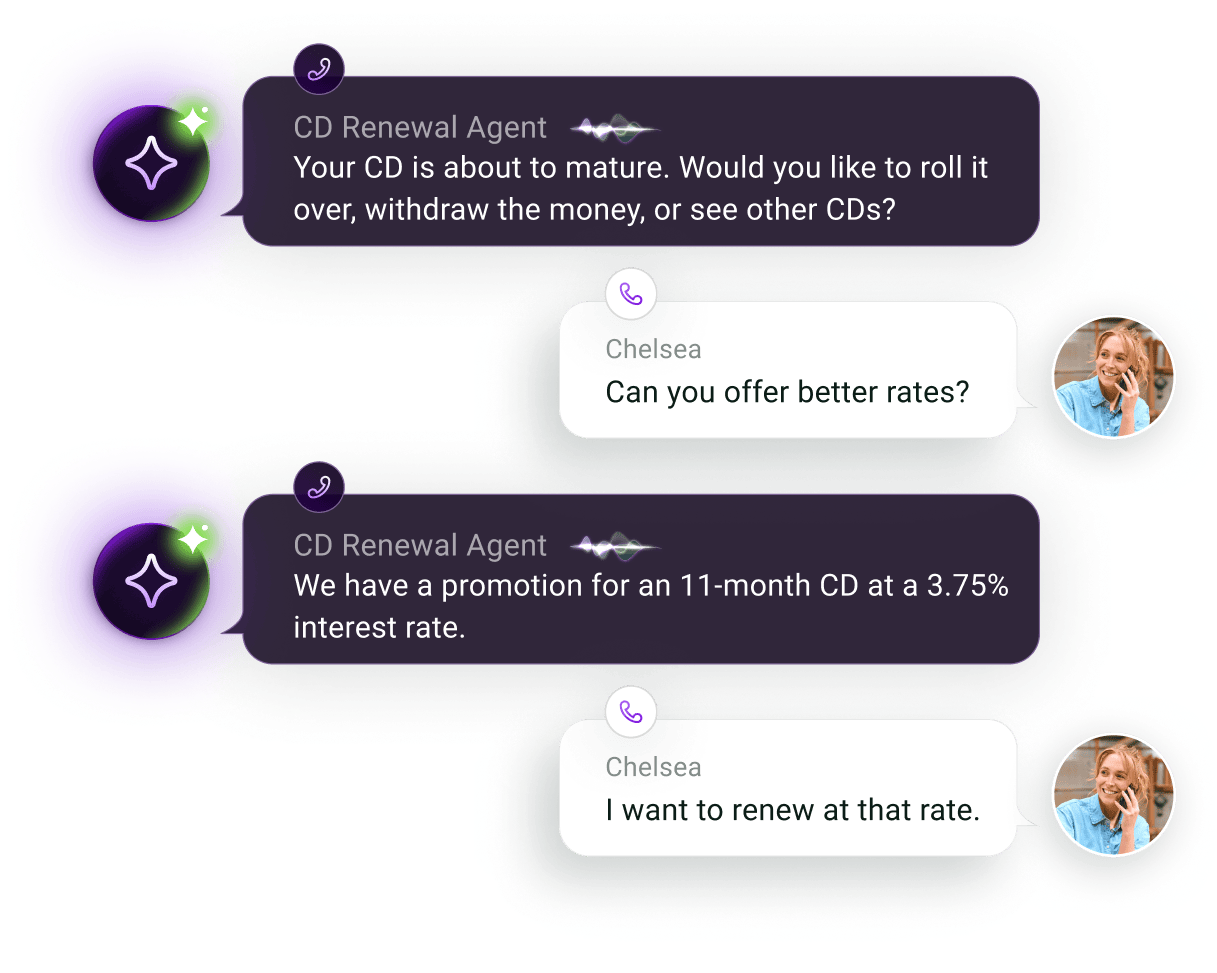
Outbound banking gets a software colleague: diligent, tireless and blissfully unaware of the office coffee situation.
The difference from a conventional contact-center vendor is specialization. Glia says it supports more than 1,000 banking journeys and more than 100 prebuilt integrations, including common credit-union cores and online banking systems. Its “ChannelLess” architecture is marketing language with a sound product observation underneath: channels are an implementation detail. Customers do not want an omnichannel strategy. They want the next person - or machine - to know what just happened.
The newest distinction is control. Glia Banker offers Strict, Rephrase and Compose response modes. An institution can require exact approved language for a money-movement topic, allow conversational rewording for account service, and permit more flexible generation from approved documents for lower-risk questions. Glia attaches a contractual no-hallucination and no-prompt-injection guarantee to its strict controls. The claim should still face serious diligence, but the product direction is right: risk is not binary, and a branch-hours question should not be governed like a wire transfer.
The bet that changed the company
COVID did not create digital banking, but it made the old operating model fail in public. Branches closed. Agents tied to on-premise phone systems went home. Michaeli has described Glia activating remote call-center capability for customers in hours and worrying about charging later. Demand accelerated because the continuity problem stopped being a roadmap item and became that morning's emergency.
Then, in June 2022, Glia acquired Vancouver-based Finn AI, a specialist in virtual assistants for banks and credit unions. The purchase supplied the automated front door that Glia's human-assistance platform needed. A bot alone can become a conversational cul-de-sac. A live-agent platform alone leaves staff answering balance and routing-number questions all day. Put them together, and automation can contain the routine work while handing consequential moments to a person with the transcript and context intact.

Enterprise software's natural habitat: five people, four lanyards and enough colored light to make a contact-center conference look faintly tropical.
Capital followed the trajectory. Insight Partners led a $20 million Series B in 2019 and a $78 million Series C in 2021. A $45 million Series D in March 2022, joined by Wildcat Capital Management and RingCentral Ventures, pushed disclosed funding above $150 million and valued Glia at more than $1 billion. The company said that money would fund research, AI, analytics, voice, video and geographic expansion. Three months later came Finn AI.
The proof is operational, not theatrical
Glia's strongest evidence comes from the boring numbers operators care about. Granite Credit Union says it opened four branches without adding headcount and saved 1,400 hours of manual work in four months. Texas Tech Federal Credit Union reported that voice AI fully handled 25 percent of calls and saved 81 agent hours a month. One unnamed $16 billion community bank reported $198,000 in annual savings across overflow support, translation and bank-by-phone costs, while call abandonment fell 71 percent.
These are vendor-selected case studies, not controlled trials, and the conditions matter. Savings arrive when an institution has enough repetitive volume to automate, clean integrations, approved knowledge and leaders willing to change staffing and process. Glia cannot rescue a broken policy by making it answer faster. It also does not fit every buyer. A tiny institution with light call volume may never earn back an enterprise implementation. A company outside financial services may prefer a horizontal vendor. A bank hoping to bolt on AI without owners, measurement or escalation rules is shopping for a demo, not an operating system.
What does it cost?
Glia does not publish a dollar price. It markets one predictable monthly fee with unlimited seats, minutes and AI capabilities, avoiding per-minute and transfer charges. That is a meaningful business-model choice: when the vendor earns more every time automation fails, buyer and seller incentives bend apart. Unlimited usage can reward adoption and efficiency. Procurement teams should still model implementation, integration, data work, change management and any surrounding systems. “Predictable” is not the same as cheap.
The playbook worth stealing
- Pick a vertical where context is expensive. Generic chat is a feature; regulated banking journeys can become a moat.
- Turn repeated work into a library. Glia's 1,000-plus banking journeys shorten the distance from purchase to useful automation.
- Build the handoff before the bot. Automation earns trust when escalation preserves history, intent and identity.
- Price for the behavior you want. Unlimited usage encourages customers to spread the platform instead of rationing it.
- Measure capacity, not novelty. Saved hours, lower abandonment and absorbed growth beat a glamorous AI demo.
Where the thesis breaks
It can work when
- Interaction volume is high and repetitive.
- Core systems expose reliable integrations.
- Approved knowledge has clear owners.
- Humans can absorb escalations with context.
It can fail when
- The underlying process is contradictory.
- Buyers expect AI without workflow change.
- Volume is too low to justify implementation.
- Success is measured only as call deflection.
The larger market is crowded: Genesys, NICE, Five9, Talkdesk, Twilio and Salesforce all sell parts of the contact-center future, while banking specialists attack narrower slices. Glia's place is between the broad CCaaS suite and the point chatbot. Its defense is the specificity accumulated between them - integrations, banking journeys, response controls, interaction history and a workforce that includes both people and software.
That also explains the company's evolution from co-browsing to agentic workflows. The first product helped an employee show a customer what to click. The newest can perform an approved action, with human approval where required. The interface is moving from conversation to execution. Yet the founding observation survives: the technology is valuable only if the experience feels continuous. Glia's most important product is still not the bot, the video window or the voice. It is the absence of “Could you explain that again?”