Dan Bartfield’s route into recruiting software included an unusually useful phone call. In the spring of 2000, his business partner, Jason Weingarten, had boarded a flight to Florida and started talking business with the passenger beside him. After landing, Weingarten called Bartfield with a name to look up: Fred DeLuca. The stranger was the co-founder of Subway.
Bartfield soon flew to Florida himself. At DeLuca’s house, the young founders discussed their market, their sales approach and the money their business would need. The idea was to help college students find work online. The connection became a mentorship that lasted for years, with occasional diversions into yacht fireworks and a Super Bowl party. There are worse ways to discover that someone takes your business plan seriously.
It is a fitting opening for Bartfield, now Yello’s co-founder and CEO. His career has been spent organizing introductions between strangers. One of the consequential introductions in his own business arrived through an airline seating arrangement. A quarter-century later, he is asking how much of that encounter a recruiter should leave to chance.
The students became the suppliers
Bartfield studied at Miami University from 1995 to 1999, graduating in marketing. He and Weingarten recognized a problem familiar to their contemporaries: finding a first job was awkward, even for students with a university behind them. They began building a business around the search. Long before campus recruiting became his executive specialty, Bartfield had encountered it from the other side of the desk.
Their earlier venture included EASE, a career services software platform used by more than 450 institutions in the United States. That footprint put the pair close to the machinery behind a student’s first professional introduction: the career center, the employer relationship and the systems connecting them.
They sold their online college-jobs business in 2008. Then former customers asked for help with recruiting problems. The same year, Bartfield and Weingarten founded Recsolu, the business that would become Yello. A sale had given them an exit; their customers supplied a reason to return. The partnership continued, with a new set of people paying for the software.
A career fair, minus the filing cabinet
The early problem was wonderfully unglamorous. Employers were collecting student applications at career fairs, and the process involved a great deal of paper. A recruiter could have a useful conversation and still leave the next person with a sorting job. The meeting happened quickly. Turning the meeting into something the organization could act on took longer.
Recsolu attacked those delays. By its $6 million Series A announcement in November 2014, its work covered candidate information, résumés, job marketing, interviews and shared evaluations. Mobile recruiting was central to the proposition. The point of taking a device to a fair was to make the conversation usable after everyone had packed up.
That detail helps explain Bartfield’s persistence in this field. Campus recruiting contains lots of small transactions surrounding a very large personal decision. Registration, an invitation and an interview slot can look like office housekeeping. For a student, they are the route into work. Getting those details right gives the promising conversation somewhere to go.
In 2015, Recsolu became Yello. Its company history describes a broader professional-recruiting brief at the time of the change. The business still depended on helping employers carry a conversation forward.
The job before the CEO job
For years, Bartfield’s responsibilities centered on sales and client success. That meant working with the teams responsible for persuading employers to buy the product and helping them use it. It is a revealing combination: the promise made in the sales conversation remains nearby when the customer begins asking questions.
In February 2024, Yello announced his appointment as CEO. Bartfield’s explanation of the role emphasized customer success and software designed for advanced campus recruiting programs. He wanted to address gaps left by tools built around professional recruiting. His opening message concerned the customers’ work, rather than the novelty of his title.
Weingarten joined the congratulations, welcoming the next chapter for his longtime collaborator. Their shared history gives that exchange some substance. The two had already built, sold and started again together. By the time Bartfield took the CEO seat, the partnership had survived several changes in how employers met students, how students applied and what both sides expected from a recruiting system.
“Our aim is to create software and services tailored for advanced campus recruiting programs”
Dan Bartfield · on becoming CEO, 2024
The difficult business of celebrating
When WayUp joined Yello in July 2021, Bartfield briefly interrupted his usual forward motion. He described himself as someone who rarely spent much time looking backward. The occasion warranted an exception. Yello was adding a sourcing business that could help employers reach candidates beyond the schools they already visited.
He had known WayUp’s co-founders, Liz and JJ, for years. His response mixed the practical advantages of bringing the businesses together with pleasure at working alongside people he already respected. He thanked his colleagues and customers, then admitted that celebrating a win could be difficult when he could still see more to do.
That is a recognizable founder’s predicament. A milestone arrives with a fresh to-do list attached. Bartfield’s own account suggests someone more comfortable considering the next improvement than admiring the distance traveled. The pleasure was there, but so was another recruiting problem waiting for attention.
The school list is a decision
Bartfield’s arguments about access are usually grounded in a practical question: where does an employer look? Familiar campuses make a comfortable itinerary. They also establish a boundary around who gets noticed. In a 2023 interview, he described how virtual recruiting allowed companies to reach students beyond a small selection of schools.
His advice included a less technical obligation. Employers needed to tell candidates a meaningful story about the organization and its place in the community. A student should be able to remember the company when the moment to apply arrived. A database could widen the introduction; the employer still needed to give someone a reason to respond.
There is a marketer’s sensibility in that distinction. Bartfield’s degree has a visible connection to his work: attention must lead somewhere. Reaching another thousand candidates is useful only if the message makes sense to them and the opportunity is relevant. An invitation without a clear account of the job leaves a surprisingly large amount of the recruiting to the candidate.
A small joke, a serious dashboard
Talking with William Tincup in 2022, Bartfield joked about having moved from being the youngest person in the room to being among the oldest. The joke came with an impatience earned over years of similar conversations. He wanted employers to specify their hiring goals, establish a plan and examine where candidates were disappearing.
His proposed discipline was to check the recruiting funnel while a season was still underway. Waiting until the end meant discovering missed goals after the useful opportunities to intervene had passed. A drop at a particular stage could prompt a question about a form, an interview or a hiring manager’s decisions.
That is a fairly exacting version of being customer focused. The software supplies evidence that may complicate the customer’s assumptions. An organization can discover that the weakness lies in its own process. Bartfield’s advice makes the dashboard an invitation to act, including when the action involves changing a habit rather than buying another feature.
The offer is an awkward place to stop
Yello’s November 2025 acquisition of Symba extended the business further into what happens after a candidate accepts an offer. Symba worked on new-hire readiness, internship programs and engagement. Its co-founders, Ahva Sadeghi and Nikita Gupta, joined Yello in significant roles. A partnership earlier that year had preceded the acquisition.
Bartfield framed the purchase around gaps in engagement and visibility across early-career programs. The aim included improving conversions and addressing reneges, when candidates back out. For an employer, an accepted offer can feel like the end of recruiting. For the person accepting it, a new set of questions is just beginning.
The acquisition makes sense alongside his earlier emphasis on relationships. Recruiting has a long interval between first interest and first day. The company that remembers a candidate at a fair must also remember the person waiting to start. The paperwork may say the transaction is complete before the relationship feels secure.
Arrive with the appointments already made
On May 27, 2026, Yello launched its Campus Recruiting Agent. Its proposition brought Bartfield back to the career fair, with more preparation happening before the event. The agent helps build events, identify candidates, conduct outreach and schedule interviews. Employers can arrive with appointments already arranged.
“Yello Campus Recruiting Agent reorients everything around outcomes,” Bartfield said. His complaint was that recruiting success had too often been counted through visits, meetings and collected résumés. He wanted teams to connect their spending to actual hires. A busy booth makes a photograph; a filled role answers the employer’s question.
A workflow comparison, not a measured performance result.
June brought a Symplicity partnership giving Yello customers access to a network of more than 600,000 early-talent candidates. The agent could match against that pool alongside existing candidate records and other channels. More introductions became possible before anyone reached for a conference badge.
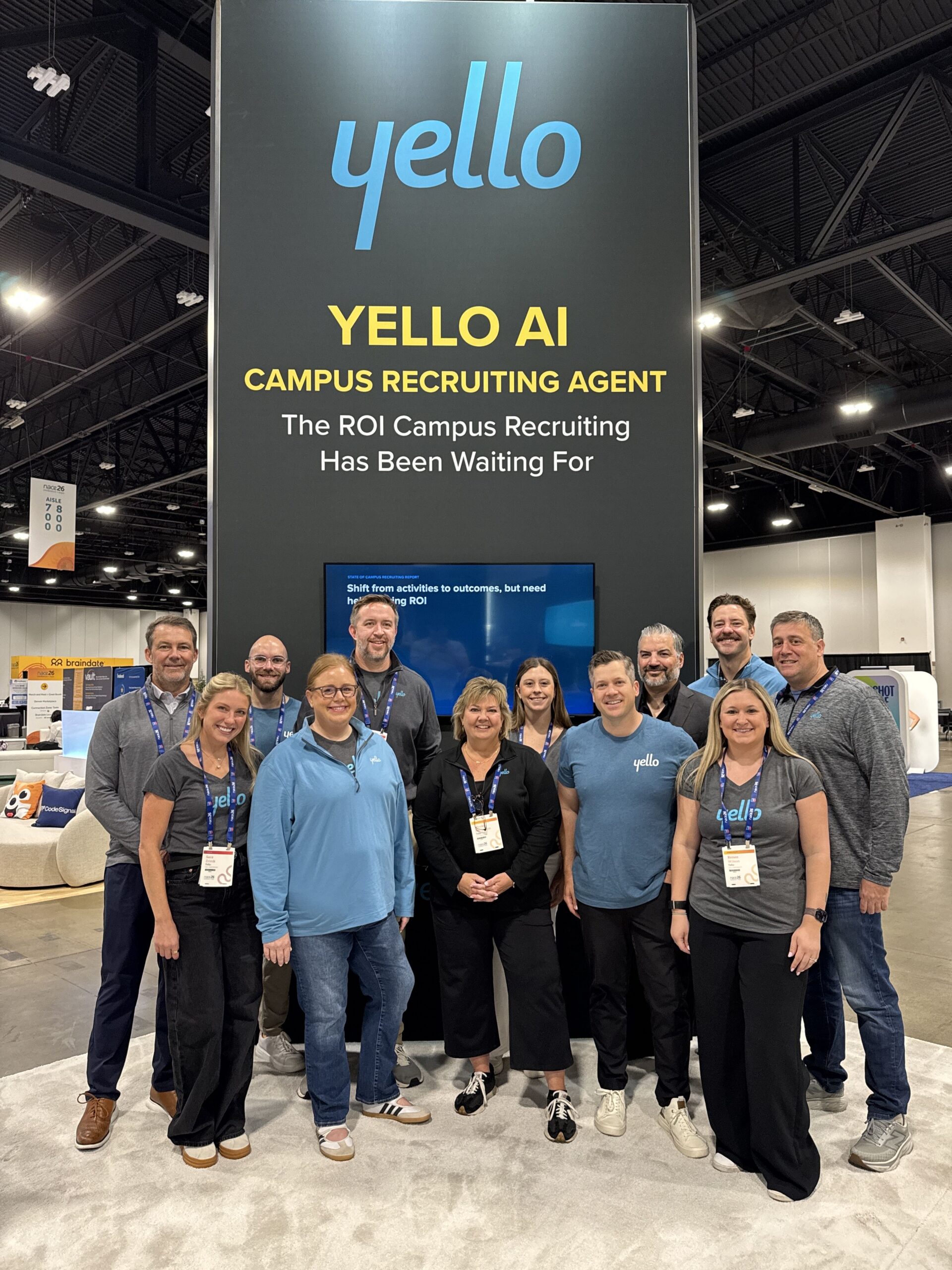
At NACE26 in Denver, Bartfield joined Tamara Welch of LPL Financial and NACE’s Matthew Brink for a session about whether campus recruiting could become autonomous. Yello’s account of the discussion described an audience more interested in freeing recruiters for valuable work than having software make decisions for them.
That leaves a useful tension in Bartfield’s current ambition. He is building more automation around an encounter that matters because two people are involved. The plane conversation that helped his first business could hardly have been scheduled by a campus recruiting platform. Yet someone had to make the follow-up call, book the next flight and turn a promising introduction into a working relationship. Bartfield has spent much of his career attending to that part.