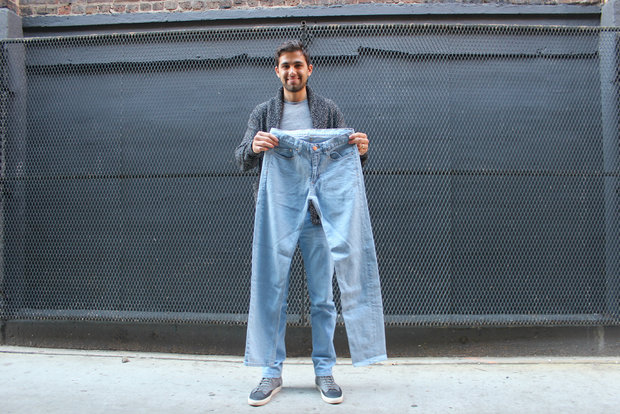
Leo Tropeano’s business began with the sort of performance review nobody requests. A coworker told him his baggy jeans looked awful. He had moved to New York after college, and his wardrobe had apparently arrived carrying rather too much college with it. Finding a sharper pair should have been a modest errand. Instead, it became the problem around which he would build his working life.
The replacement jeans had their own objections. The slimmer cuts looked better but felt restrictive. Tropeano wanted to look presentable and move comfortably, a request that seems reasonable until you try to persuade a pair of trousers. He spent years working with industry experts and testing thousands of fabrics. A colleague’s blunt observation eventually acquired a supply chain.
Before any of that, there was accounting. Tropeano studied at Miami University in Ohio, then started his career as a CPA at PwC in New York. His early professional world offered plenty of numbers to reconcile. The denim problem was harder to put in a spreadsheet: why did improving the appearance of a familiar garment seem to require accepting a worse experience of wearing it?
His background makes the detour interesting. He entered apparel without fashion training, so learning the trade became part of the job he had invented for himself. The idea was familiar enough to explain to friends. Turning it into something a manufacturer could reliably produce required a different kind of fluency. Anyone can dislike a pair of jeans. A founder has to make the next pair.
The first yes was only the beginning
An early crowdfunding campaign gave him a useful answer. People would pay for the idea. In May 2014, Tropeano and his then-roommate launched a Kickstarter that raised more than $20,000, roughly twice its goal. He later described the campaign as a test of the concept. It had worked. The product, in his judgment, still needed work.
This is the revealing turn in the story. A successful campaign offers a convenient place to declare victory, particularly when you have spent years trying to get strangers interested. Tropeano returned to development. Approval from buyers and satisfaction with the jeans remained separate questions. The money had answered one; the work had to answer the other.
Mugsy first appeared in Chicago in 2015, with Tropeano operating from his West Loop condo. The name had a family origin: Mugsy was his father’s pet name for his mother. That is an unusually affectionate pedigree for a brand willing to make jokes about the crotch of a pair of trousers. The family nickname survived the transfer to clothing.
The redesigned stretch line arrived in November 2016. That date matters because a business can begin before the version of its product that defines it. Tropeano’s path includes both the first attempt and the more considered launch. The useful part is the interval between them, when a founder had enough encouragement to continue and enough dissatisfaction to change what he was making.
Failure, with the inventory attached
By 2018, his account of entrepreneurship had acquired a less glamorous vocabulary. He described inventory held hostage by warehouses, websites crashing on major shopping days, and entire production runs of jeans that could not be sold. These are expensive problems to encounter after a product has left the realm of sketches. Fabric takes up space. Mistakes arrive in boxes.
“Everything will go wrong,” was an early saying of his. He could laugh about it when telling the story, but the examples give the joke its weight. A website failure can cut off customers precisely when they are ready to spend. An unusable production run puts the disappointment on a shelf. Neither problem becomes smaller because the brand’s copy is funny.
He also said those failures led to breakthroughs. That is a claim about his experience, rather than a promise that every setback will be useful. His record gives it a concrete setting: Mugsy kept operating after problems with stock, production, and online selling. The work involved making improvements while customers still expected the ordinary courtesy of receiving the jeans they had ordered.
The sharpest thing about this portion of his story is its lack of romance. Learning fabrics gets the founder into the business. Learning what happens when a warehouse or website fails helps keep him there. A clothing company has to make a convincing garment and then perform an enormous amount of unconvincing-looking administrative work so that somebody can wear it on Saturday.
“Everything will go wrong.”
Leo Tropeano, on Mugsy’s early days
A jeans shop with a dartboard
Tropeano gave the customer experience a different sort of attention. The early Mugsy Lounge served whiskey, and the first store’s furnishings included leather couches, a dartboard, a video game machine, and a vinyl player. The retail setting borrowed from hanging out with friends. It offered a less solemn place to make a decision about your legs.
There was practical reasoning behind the hospitality. A customer who has always bought one kind of jeans needs a reason to try another. A relaxed store gives him time to handle the product and see how it fits. Mugsy’s humor does similar work in language: it makes an everyday complaint recognizable before asking anyone to care about the construction of denim.
The comfort idea eventually traveled beyond jeans. By 2025, Mugsy’s assortment included chinos, shorts, tees, and outerwear. Miami University listed the company among its RedHawk50 honorees that year. A wardrobe problem had grown into a business with more garments and more opportunities to either satisfy or disappoint the same customer. Each expansion carried the original promise into another category.
His fiancée’s enthusiasm for jeggings was another influence on the idea. The detail is pleasingly domestic: an apparel idea can emerge through noticing what someone close to you enjoys wearing. His route into menswear involved paying attention to the experience of clothing, even when the relevant clue came from somewhere outside the men’s denim rack.
The less photogenic half of growth
More products make the operational question larger. Mugsy looked for a new fulfillment partner in 2021 after recurring issues with its existing provider. The team sought recommendations from other brands and its advisory group, eventually choosing Ryder. Chief operating officer Scott Dulany explained the desire to check a provider’s reputation after being disappointed before. Experience had made the company a more careful buyer.
By 2025, the range had grown to more than 40 jeans styles alongside other clothing. Behind that choice sit combinations of sizes, washes, and stock levels. A customer sees a pair he wants. The company has to know where the right pair is and get it into the right parcel. Product variety creates work long before it creates delight.
Tropeano has also described trying to identify likely repeat buyers and plan stock around their purchasing patterns. In 2025, that work centered on customer lifetime value and inventory forecasting. Those terms sound remote from the original dressing-room complaint, but they concern the same relationship over time: can the company understand a customer well enough to keep serving him?
Banking became another part of the story. His relationship with Byline included visits to Mugsy’s Ohio warehouse and personal attention from banker Stephen Ball. Tropeano recalled Ball coming to his suburban home to complete a time-sensitive credit renewal. A founder can spend years thinking about the product and still need someone dependable when a piece of paperwork becomes urgent.
- 2014The Kickstarter test
- 2015Mugsy’s first Chicago launch
- 2016The redesigned stretch line
- 2025EY Midwest recognition
- 2026New tools for physical retail
The award application he nearly left unfinished
In June 2025, Tropeano became an EY Entrepreneur Of The Year Midwest award winner. The regional program covers Illinois, Indiana, and Wisconsin, and an independent panel selects its winners. For a founder who started by trying to improve his own jeans, the recognition marked a considerably more formal kind of assessment than a coworker’s opinion of his wardrobe.
His reaction was less formal. In a public post, he said Jonathan Greisch had nominated him and that he had nearly missed the application deadline. He found it far-fetched that anyone would take his “weird little jeans company” seriously. Greisch helped get the application finished. Even the successful founder in this story occasionally requires somebody else to insist on completing a form.
That phrase captures his public manner: lightly amused at the distance between a practical clothing problem and an entrepreneurship award. It allows the company to be meaningful without requiring its founder to become grand about it. His gratitude also leaves room for another person’s contribution. The award had his name on it; getting into contention involved a nudge from a friend of the business.
The next fitting room
The physical store has become a larger part of his thinking. Tropeano has discussed how stores change the marketing calculation by bringing in customers whose value continues beyond a single visit. The channel has consequences for how the company evaluates its spending. A shop can sell a pair today and introduce someone who later returns through the website.
In 2025, Mugsy operated seven locations, with plans to reach 20 in the coming years. Those were plans, with the usual work of retail still ahead of them. In March 2026, Mugsy announced a partnership with WVN to improve its view of store performance and customer behavior. Growing the footprint also meant finding better ways to understand what happened inside it.
The progression is easy to miss if you concentrate on the jeans alone. Tropeano began as the dissatisfied wearer, became the learner working through fabric and fit, and now runs a business that must coordinate stores, stock, marketing, and partners. Each stage adds decisions. The original question remains wonderfully small enough to remember: would someone actually enjoy wearing this?
His story gives starting over a useful specificity. He had already found people willing to buy when he returned to the product. Years later, the business kept revisiting how it delivered orders and understood shoppers. The willingness to revise has had several jobs at Mugsy. The first was making a better pair of jeans. A person should be able to sit down in his good ideas.
More of Leo, in his own words
Mugsy’s founder story · Leo on LinkedIn · Watch Mugsy’s origin video on YouTube · Watch the tms interview
The early Chicago interview · EY’s 2025 Midwest winners · Mugsy’s blog