Before there were candidate databases, there was a bicycle. Growing up in Anantapur, India, Sameer Penakalapati rode out around four in the morning to collect milk for his family. A mile there, a mile back. Both his parents were teachers. Doing the homework was advisable; the people most likely to hear about an omission were already at the dinner table.
Education offered a way forward. He earned an engineering degree at Gulbarga University in 1993 and a master's at Birla Institute of Technology & Science in 1996. Mechanical engineering jobs had proved an uneasy fit. The qualification was a beginning, rather than a promise that the first career choice would stick.
Today, Penakalapati is the founder and CEO of Ceipal, a Rochester-based recruiting software business. His subject has changed from engineering components to the arrangements that put people to work. The question underneath has a familiar shape: how does someone capable get through the door?
A bag of clothes, then a business
He arrived in the United States in 1999 with a bag of clothes and $100. By 2002, work had brought him to Rochester and Eastman Kodak. The move put an Indian engineering graduate in a city whose working life had long been tied to a company name. Eventually, his own company names would become part of the local business landscape.
Avani Technology Solutions began operations in 2010. Consulting gave him a business to run, while a product idea gave him something else to pursue: software that smaller employers could afford. His later interests would spread across staffing, software, and digital marketing. He has founded or acquired more than six companies.
That range has a practical connection. A staffing business has to find people and win clients. A software business has to understand the people using it. Marketing has to explain why anyone should care. Penakalapati has operated in all three, giving his product ambitions a working acquaintance with the problems on the other side of the screen.
When asked in 2016 what had made starting difficult, he identified financing and customer acquisition. When asked what he would change, he wished he had begun earlier. The familiar founder's dilemma was there in miniature: wanting to start, while needing enough money to make starting survivable.
The customer he had to change
Ceipal dates its founding to 2015. The origin story contains a detail more useful than a tidy tale of instant product insight. Penakalapati initially aimed the platform at educational staffing professionals. He later acknowledged that this was the wrong market for the product. IT and engineering became a better fit.
He calls the principle “failing fast and failing frugal.” It is a compact way of describing an uncomfortable managerial act: admitting that an idea can deserve another attempt while its original customer choice deserves to be abandoned. Persistence can become expensive when it refuses to change its address.
His account of entering staffing has a similar bend. People warned him about competition. He looked for sectors where he could solve a particular staffing problem, including aerospace and defense. The lesson he draws is to learn from other businesses without copying their route.
Ceipal's pitch also came from a specific irritation. Recruiting systems, in his telling, could be expensive, awkward, and assembled from disconnected parts. He wanted an affordable platform that joined the work together. The ambition was substantial; the complaint behind it was wonderfully ordinary. Too many systems make the user do the joining.
“Learn from others but carve out your own niche”
Sameer Penakalapati, founder interview, 2021
Twenty-one million, with the arithmetic showing
In June 2022, Ceipal announced $21 million in financing. Of that, $16.5 million was Series B equity and $4.5 million was debt. Camden Partners led the equity round, with other new and existing investors participating. The distinction matters. A financing headline can look like one large cheque; this one had two different parts.
The company described plans to expand in the United States, United Kingdom, and India, develop its products, and grow its customer base. At the time, it reported serving more than 2,000 customers and 120,000 recruiters. Those are figures from the 2022 announcement, a snapshot of the business at that point.
Alongside applicant tracking, Ceipal was bringing vendor management into the same system through ProcureWise. The intended scope included permanent staff and contingent workers. That helps explain Penakalapati's repeated interest in total talent management: the hiring problem continues beyond finding a promising résumé.
A person can be a good match on paper while the hiring process remains a procession of delays. Bringing the pieces together is the less glamorous half of the software proposition. It is also the half that has to work after the product demonstration ends and everyone goes back to their desk.
Software gets an assistant. Recruiters keep the conversation.
Ceipal introduced Copilot in June 2024. Its announced features included applicant profile summaries, help constructing Boolean searches, checks of candidate relevance, and generated responses. These are recognisable pieces of a recruiter's working day, which makes the product a useful window into Penakalapati's priorities.
A résumé summary can shorten preparation. A search query can help a recruiter find candidates. Neither tells the entire story of why a person might accept a job, hesitate over a move, or trust the person calling. The product's stated purpose was to free recruiters to connect candidates with opportunities.
In a September 2024 podcast conversation with Ceipal marketing chief Andy Weiss, Penakalapati compared applications built on large language models with the earlier wave of applications built for mobile platforms. He saw existing enterprise platforms gaining new capabilities from models they did not need to build themselves.
His argument returned to the recruiter's time. Automate basic qualification exchanges and time spent browsing unsuitable candidates, he suggested, and the recruiter can have a more informed conversation with the people who fit. Efficiency becomes useful when the saved time turns into attention.
There is a small irony here. A software founder makes a case for more automation, then describes its value in terms of better human conversations. For a hiring business, that is a practical test: what happens when someone finally picks up the phone?
The org chart acquires some unusual colleagues
By a later fireside conversation about AI and recruiting, Penakalapati was describing a workplace where human and digital recruiters could occupy the same organisational chart. His emphasis was on augmentation, with people retaining a role alongside automated systems. A chart with software as a colleague takes some getting used to. It does at least save the software an argument about where to sit.
The interest has continued into 2026. In February, he published a LinkedIn article about AI's effect on talent; in June, another reflected on six months of building AI for business problems. More recent public posts discuss the move toward agentic workflows and the engineering work involved in making them useful.
These are his directions of travel, rather than a reason to assume every recruiting task has already changed. What makes them interesting in his career is the continuity. He began by objecting to disconnected systems. He now argues for AI that can understand the wider workflow, with people responsible for consequential judgments.
A hiring promise needs a measuring stick
Penakalapati's focus on data also appears in his work on diversity and inclusion. In 2024, Staffing Industry Analysts named him a DE&I Influencer. His explanation of the work emphasised measuring how candidates are sourced and examining the composition of a workforce.
In 2023, he led efforts to give clients a view of three years of hiring data against their current objectives. At Indotronix Avani Group, he also established an initiative aiming for 50 percent representation of women in the workforce. That was a stated goal, and should be read as one.
The distinction between an intention and a measured result suits the subject. Hiring gives organisations plenty of opportunities to announce what they value. Tracking the route candidates take into the business asks a harder question: whether the process is producing the result people say they want.
Penakalapati has linked his perspective on diverse teams to his experience as an immigrant. The connection is concrete. His own working life crossed countries, qualifications, and sectors. A recruiting process decides which differences count as useful experience and which are treated as reasons to move on.
Back outside the office
The Nigama Foundation puts another part of his work in view. Its founder is also the CEO of Indotronix Avani Group, but the foundation's activities reach people outside a hiring pipeline. Its work includes school supplies and educational support, with programmes in Telangana and Andhra Pradesh.
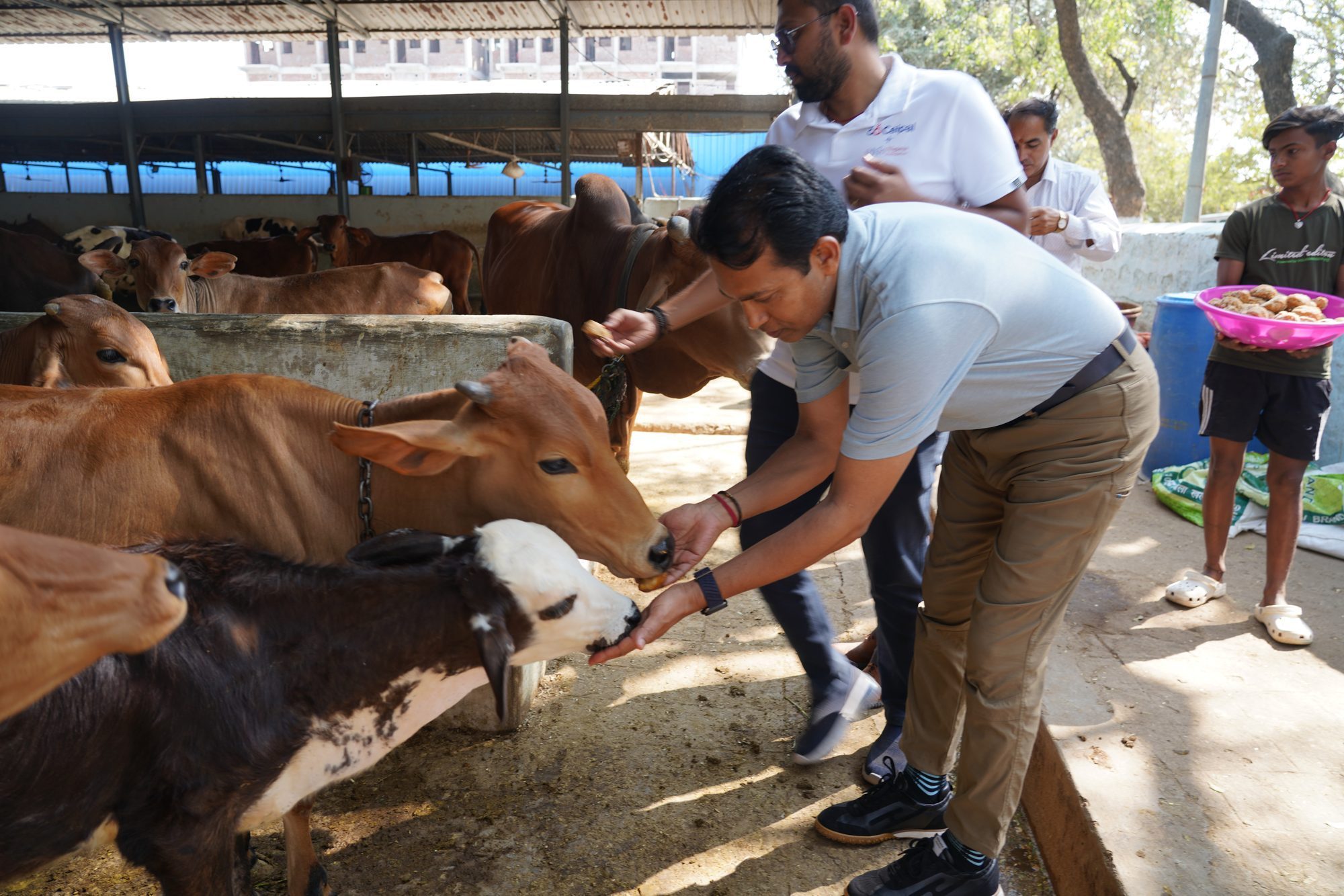
In February 2025, he was photographed at a community goshala in Hyderabad, leaning forward to feed cattle. It is an agreeably uncorporate image: hands occupied, animals close, no presentation screen in sight. The foundation connects his professional work of opening opportunities with a broader obligation to show up in person.
There are other forms of showing up. He has mentored a startup team at the University of Rochester's Center for Entrepreneurship, helping prepare ideas and a first pitch. He joined the Fast Company Executive Board in 2022, adding another setting for exchanging business experience.
The teacher's son has become a founder who keeps returning to learning: choosing a market, changing it, studying how people hire, helping someone else prepare to begin. He has described himself as “notoriously hopeful.” Hope, in this career, has acquired some practical equipment: a product, a process, a budget, and a willingness to revise the plan when the first door stays shut.