The rock is the awkward part. Before a mine can decide how much explosive to use, it needs to understand what it is breaking. Too blunt an estimate and the decisions downstream become harder. In one published project, Option built a system to estimate rock hardness, predict the size of blasted material and put the operation on a dashboard. The reported saving in drilling and blasting costs was 3%. A small number, attached to a very physical problem.
- Option builds data platforms, analytics and AI for large organizations.
- Its work connects models to operating decisions, from mine maintenance to appointment scheduling.
- Customers can hire specialists, a dedicated squad or a complete project.
That project is a good introduction to a company whose vocabulary includes most of the fashionable things in enterprise technology. Cloud. Machine learning. Autonomous agents. Yet the compelling details are wonderfully unfashionable: the hardness of rock, a technician’s phone, a medical appointment that might otherwise go empty.
The difference between knowing and doing
The drilling-and-blasting platform had three parts: hardness estimation, particle-size prediction and management dashboards. Option reports 90% accuracy for the hardness estimate and 92% precision for the particle-size prediction. Its published technology list includes Google Cloud, BigQuery, Python, Airflow, Power BI and Node.js. The team combined project management, business intelligence, data science, engineering and architecture.
The three percentages describe different things. Two concern predictions; the third concerns operating costs. Keeping that distinction matters. A model can produce an impressive score without changing what anyone does. Here, the business question was specific: how should explosive use change with the rock across the drilling pattern?
Lower direct costs in one published project.
Another mining project makes the connection even plainer. Option describes a platform that detects abnormal readings from material-quality sensors and sends alerts to technicians by SMS. The case reports 90% of alerts handled within the agreed service window. It also says the system was replicated at other mine sites. Sophisticated processing; a familiar notification.
A borrowed room, then a mining fair
Option began in 2008 with Raimundo Page and Fernando Oliver. In a retrospective, Oliver recalls a borrowed room at Universidad Adolfo Ibáñez, early university marketing work and copying marketing CDs to keep going. He remembers Page growing a beard because prospective clients kept asking their age. It is an unusually human origin for a business now discussing industrial AI.
The early work widened into software development. Oliver’s account describes projects for Swedish customers, applications for LG and the marketing software GuruContact, later sold to emBlue. Those experiences help explain Option’s recurring interest in building things that reach users. The company’s current identity rests on data, but its history runs through applications and delivery.
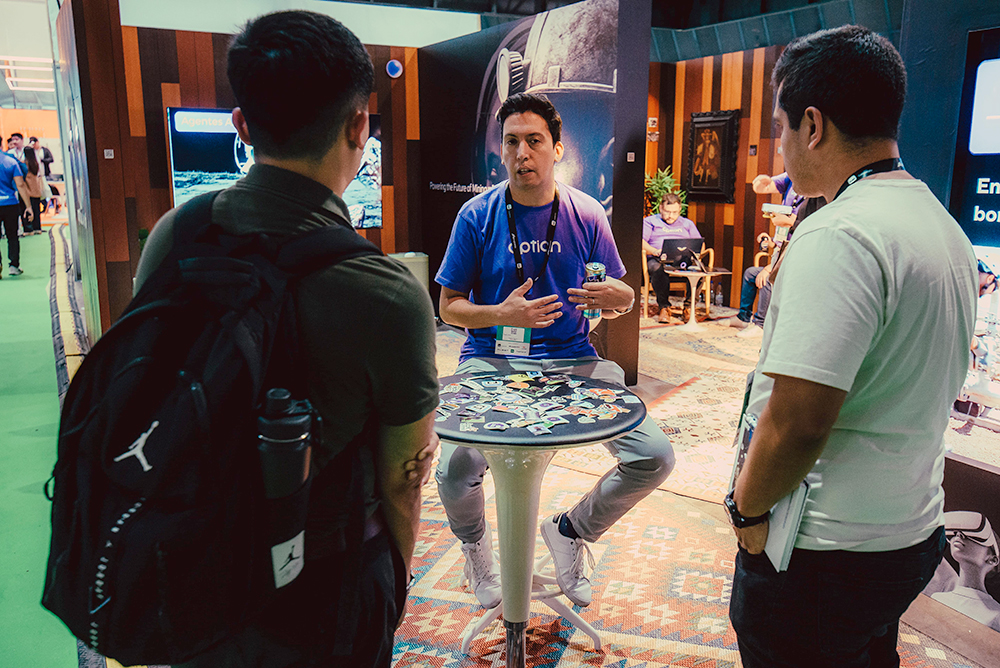
At Expomin in 2021, Option took the customer-proximity idea literally. It brought its Lastarria office experience into the mining exhibition. Its pitch included Talent as a Service: people from Option working full time inside a client organization for a period. Bringing the office to the fair was theatre with a commercial purpose. The operating team was the audience.
The tools are available. The fitting takes work.
Today, Option names Codelco, BHP and Antofagasta Minerals in its mining work. Its website also displays customers including LATAM Airlines, Falabella and Mercado Libre. These are organizations with existing systems, established processes and people who cannot suspend operations while a new data architecture settles in.
Option’s offering follows that reality. Data Consultancy defines the problem and roadmap. Data Foundations integrates sources into governed infrastructure. Data Analytics provides reporting and visualizations. AI and machine learning add predictions and recommendations. Data Talents supplies the people. The sequence is useful because it gives an enterprise somewhere to begin before commissioning a model.
the decision
the data
the model
the action
Its cloud relationships include Google Cloud, AWS and Microsoft Azure, with Databricks and Rockwell Automation also in the partner roster. Rockwell brings the industrial context into view: connecting operational technology with information systems. Option occupies the space between available technology and a client’s working process. An internal engineering team or another consultancy can fill that space too. The buyer is choosing expertise and responsibility for execution.
The commercial choices are staffing, dedicated squads and turnkey projects. Each assigns work differently between client and supplier. A company with an established technical leader may need another specialist; a defined delivery problem may need a whole team. That flexibility is part of the service being sold.
The empty chair is a data problem, too
Option’s medical scheduling case starts with patient booking histories. It groups patients using different parameters and predicts attendance up to two days before an appointment. The reported prediction accuracy reaches 87%. The next step is concrete: a personalized call to help prevent an absence, or an additional booking to use the slot.
This is a different environment from a mine, but the shape of the work is familiar. Find a costly uncertainty. Use relevant history. Deliver an answer early enough for someone to respond. The model’s usefulness depends on the scheduling team having a practical response available.
“Piensa como una startup.”Think like a startup. One of Option’s published values.
Maintaining that delivery capacity takes people. Option promotes its Academy, support for professional certifications and regular salary adjustments. Its values include curiosity, intelligent risk-taking and recording what has been learned. For a consultancy, those habits have a direct commercial consequence: the expertise has to remain available when the next customer calls.
Give the prediction somewhere to go
Option now promotes agentic systems, including proposed mining agents for maintenance and operating coordination, and publishes an Agentic Handbook. Moving from recommending an action to initiating one makes permissions and operational oversight more consequential. Buyers should distinguish a described capability from a measured deployment result.
The lesson to borrow is more grounded: choose a recurring decision, name the person responsible, connect trustworthy data and measure what changes. If the data cannot support the prediction, or nobody can act on it, the chain stops. Option’s most persuasive work puts every link in view. Sometimes the destination is a dashboard. Sometimes it is a text message.
Option · Mining projects · Agentic Handbook · Life at Option