The smallest useful clue to Damon Ockey's career sits in a kitchen. It is a section of island designed to travel between standard counter height and wheelchair height. The mechanism is quiet. The effect is social: a person who would otherwise meet the edge of the counter at face level can join the work and conversation on top of it. Ockey proposed the feature for Clare's House, an accessible home Cardel Homes helped create in Calgary's Shawnee Park. He drew on the industrial-design education that preceded his long career in marketing. In a life split between homebuilding and motorsport, this moving piece of furniture is the hinge. It shows a designer's instinct to make a system meet a person where they are.
Ockey is the chief marketing officer of Cardel Homes, the company his parents, Del and Caryl, started in Calgary in 1973. He is also a race driver with a Ferrari Challenge championship and a current seat in the Whelen Mazda MX-5 Cup. The combination sounds like two biographies stapled together. Look at the work for long enough and the seam disappears. A house, a brand and a race car all reward the same habit: pay close attention to what the system is telling you, then make a deliberate adjustment.
A family name, built forward
Cardel began with a practical family problem. Two former teachers were outgrowing their house. Del had framing experience and had taken construction courses, so he and Caryl built a new one. A friend asked them to build another, and the business followed. Its name joined the first three letters of Caryl and Del. The children - Ryan, Damon and Carlee - grew up alongside a company whose origin story was also their family story.
Second-generation careers carry an unusual tension. The company arrives with history, customers and a working vocabulary. It also arrives with an obligation. The next generation has to protect the recognizable parts while adapting everything that cannot stand still. Damon and Ryan became involved in Cardel in the late 1980s. Ryan eventually became president and chief executive; Damon took responsibility for marketing. Carlee worked in interior decorating and design.
Damon did not come to the role solely through the family trade. His public résumé lists Brigham Young University, where he played rugby, and identifies his training as industrial design. Before his long Cardel tenure, he worked in design roles linked to Axis Design and Toolless Plastic Solutions. That path matters because marketing a home is not a matter of packaging a finished object. The product is a network of decisions: a plan, a room, a material, a street, a sales experience and a promise that may take months to become physical.
Make daily life legible
Industrial design begins with use: how a hand reaches, where a body pauses, what a mechanism makes easier. In Clare's House, the adjustable island translated inclusion into a surface that moved.
Read, respond, repeat
Track driving compresses feedback. Braking, grip and line produce an immediate answer. Ockey's two worlds share a respect for adjustments that can be felt, not merely announced.
By Cardel's fiftieth anniversary, the company said it had shaped more than 150 communities and built more than 20,000 homes across Alberta, Ontario, Colorado and Florida. Scale changes the marketing problem. A builder must speak to local buyers while remaining recognizably itself across borders. Cardel's public story leans on family ownership, quick decisions and community involvement. Ockey's work has repeatedly put that last idea into places where people gather.
“We both like to win.”Damon Ockey, on racing with his brother Ryan
In Calgary, Cardel's recreation-centre sponsorship gave its name to arenas and a gymnasium, with sponsorship money directed back into the facility. Ockey described the partnership as a natural extension of Cardel's long history in south Calgary and talked about bringing in events with local sports teams. The marketing logic was visible without being abstract: attach the company to a place families actually use, then help keep that place useful.
The passenger seat opens
Cars supplied another community format. Ockey has said that watching friends experience a performance car for the first time could be almost as much fun as driving. The observation became the Cardel Ride of a Lifetime, started with Ryan in 2007. The premise was direct: put young passengers beside experienced drivers, let them feel a machine far outside ordinary life, and build a fundraising event around the access.
The program's current site reports 282 children hosted, more than $90,000 raised, seven organizations supported, over 8,000 laps completed and 12,500 kilometres driven on track. Those numbers are less about exotic machinery than repeatability. An enthusiasm became an event; the event became infrastructure; the infrastructure can return with new drivers, cars and beneficiaries.
That infrastructure is still active. The September 2026 edition at Rocky Mountain Motorsports lists Ockey as the driver of a Lamborghini Huracan Super Trofeo, with public sessions following a morning reserved for participating families. Sponsors cover operating costs, allowing ride proceeds to move to the designated organization. The setup answers the hard question that follows any generous idea: how does it work again next year? It has a venue, a calendar, drivers, priced seats and a clear transfer of value. The spectacle attracts attention, but the operating model converts attention into something countable.
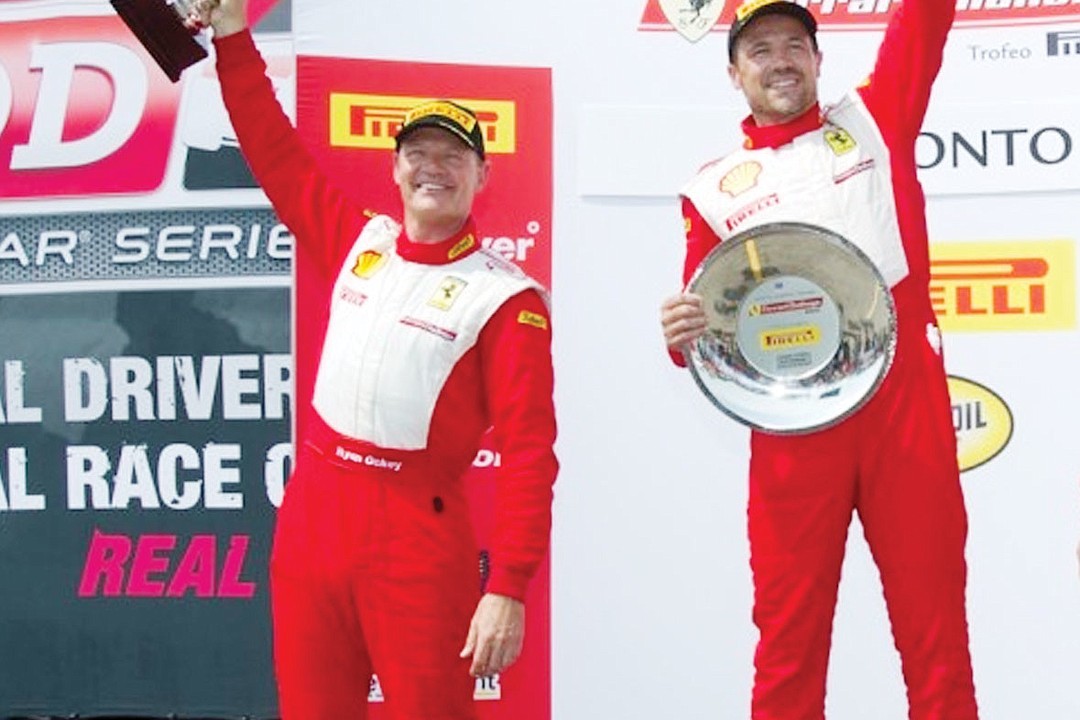
The brothers began Ferrari Challenge competition in 2010. Their first race, in Miami, delivered the full dose of uncertainty: a crash, a car on fire and two rookies wondering what they had entered. They stayed. In 2012, Damon won the North American Coppa Shell championship. At Laguna Seca that year, Ryan won one race with Damon second; another result placed Damon behind Robert Herjavec. In 2015, Damon finished third in the Trofeo Pirelli race at Circuit of the Americas.
A second championship followed in a car that required the result to be shared. In 2019, Ockey paired with Jake Eidson in the number 109 Lamborghini Vancouver Huracan Evo. The two won the Lamborghini Super Trofeo North America Pro-Am class, taking 11 victories in 12 races. Their partnership depended on both pace and choreography. Ockey noted that their similar size simplified driver changes, which they could complete in roughly 25 seconds. Eidson said the pair fed off each other's knowledge. In an endurance-format sprint, compatibility became part of the car.
The Ockey circuit / selected markers
The title could have closed the racing chapter neatly. It did not. Fourteen years later, Ockey is on a different grid in a different kind of car. He races number 09 for BSI Racing in the Mazda MX-5 Cup, a field built around identical cars and close competition. At Canadian Tire Motorsport Park in July 2026, he finished nineteenth in the first race and earned the event's Takumi Award as the highest-finishing driver over 40. The championship standings after the weekend listed him with 300 points.
There is something revealing in the move from Ferrari to Mazda. The prestige badge is no longer the point. A spec series strips the machinery toward parity and asks the driver to find time in execution. Ockey remains there because the practice itself still holds his attention.
Attention that leaves evidence
The adjustable-island detail in Clare's House also strips away branding's easy gestures. The family asked Cardel about incorporating accessibility into a new home. Cardel widened the scope, coordinated with trades and suppliers, and treated the house as a demonstration of what accessible residential design could do. Ockey's adjustable island section solved a specific problem in the room where family life tends to collect.
“At a regular island she is at face level,” he explained. The sentence is plain because the problem is plain once somebody points it out. That is the industrial designer's advantage: noticing the physical mismatch before reaching for a message. The feature let the countertop come to the user. Its meaning arrived through use.
“It's almost as much fun to see other people's reaction to the cars than it is to drive them.”Damon Ockey, on the idea behind Ride of a Lifetime
The same pattern runs through the charity laps. Ockey began with a reaction he had observed in passengers. Instead of keeping that feeling inside a car club, he and Ryan opened the passenger seat and organized around it. The experience did the communicating. The fundraising mechanism gave it a durable reason to recur.
Del and Caryl Ockey found Cardel Homes in Calgary.
Damon becomes involved in the family business.
Damon and Ryan start the Cardel Ride of a Lifetime.
Damon wins the Ferrari Challenge North America Coppa Shell title.
Clare's House demonstrates accessible residential design in Shawnee Park.
Ockey and Jake Eidson win the Lamborghini Super Trofeo North America Pro-Am championship.
Ockey competes in the Mazda MX-5 Cup with BSI Racing.
Public profiles often flatten executives into titles and years. Ockey's record resists that treatment because the interesting parts live between categories. His design education surfaces in a kitchen mechanism. His attraction to speed becomes a community event. His family's company becomes the platform that lets those projects repeat at meaningful scale.
There is also a useful distinction between visibility and authorship. A chief marketing officer is expected to create the first. Ockey's public record keeps returning to the second: helping conceive a feature, founding an event, committing to a championship season, maintaining a family brand through expansion. These are not one-day impressions. They are choices that create more choices later. A lowering counter changes how a room can be used. A recurring track day makes another year's gathering possible. A long company story gives a new market something coherent to inherit.
Homes and races run on opposite clocks. One unfolds through approvals, plans, trades and months of work. The other can turn on a fraction of a second. Ockey has stayed with both for decades. The shared discipline is not speed. It is fidelity to feedback: the room, the customer, the passenger, the tires. Each offers information. The work is to notice it soon enough to change the line.