The awkward question in Dara Parker’s career arrives before the cheque is written. Who designed the application? Who speaks the language it rewards? Who gets to decide that an idea is sensible, a community is ready, or a problem is worth the trouble? Money can look wonderfully neutral on a spreadsheet. Parker’s work keeps taking it back into the room where people make the decisions.
That room has changed considerably. She has led QMUNITY, British Columbia’s queer resource centre; worked with engaged philanthropists at Social Venture Partners Vancouver; and overseen grants and community initiatives at Vancouver Foundation. In November 2024, she became chief executive of Toniic, a global community of private asset owners pursuing impact through their wealth and influence. The journey offers an unusually concrete way to think about power: follow the person who keeps encountering its paperwork.
The scenic route had a purpose
Parker grew up in suburban Toronto. At eighteen, on a gap year, she went west and taught snowboarding at Whistler for a season. She returned east, but Vancouver had made its impression. That early chapter gives her biography a pleasingly ordinary starting point. Before the international organizations and executive appointments, there was a young person deciding where she might like to live.
Her education followed her interests. She completed an honours degree in politics at Queen’s University in 2002, then a master’s in urban planning at the University of British Columbia in 2006. Later came a nonprofit-management executive certificate at Duke. In an interview about her earlier career, she described choosing subjects that interested her, rather than studying with a future executive-director post already in mind.
The jobs ranged widely, including international development, municipal social planning and public engagement. She spent three years advising UN-Habitat on its inaugural Youth Advisory Board, helping youth participation enter the organization’s work. She has also travelled to more than fifty countries. There are plenty of stamps in this story, but the professional thread is participation: how an institution makes room for people it might otherwise overlook.

Equality needed somewhere to meet
In May 2012, Parker became QMUNITY’s executive director. By the time she left four years later, its private and public funding had risen by 61 percent. The organization had received Vancouver’s inaugural Award of Excellence for Diversity and Inclusion in 2014. She had also helped secure a $10-million partnership with the city for a new community centre, with a consultation reaching more than 750 people.
Those are institutional achievements, with colleagues and community members behind them. Parker’s own account of leaving emphasized what she had learned from others and the value of connecting people. A resource centre could help important work happen beyond its own walls. That is a useful distinction for a small organization with more demands than hours: being the place that connects people can itself be substantial work.
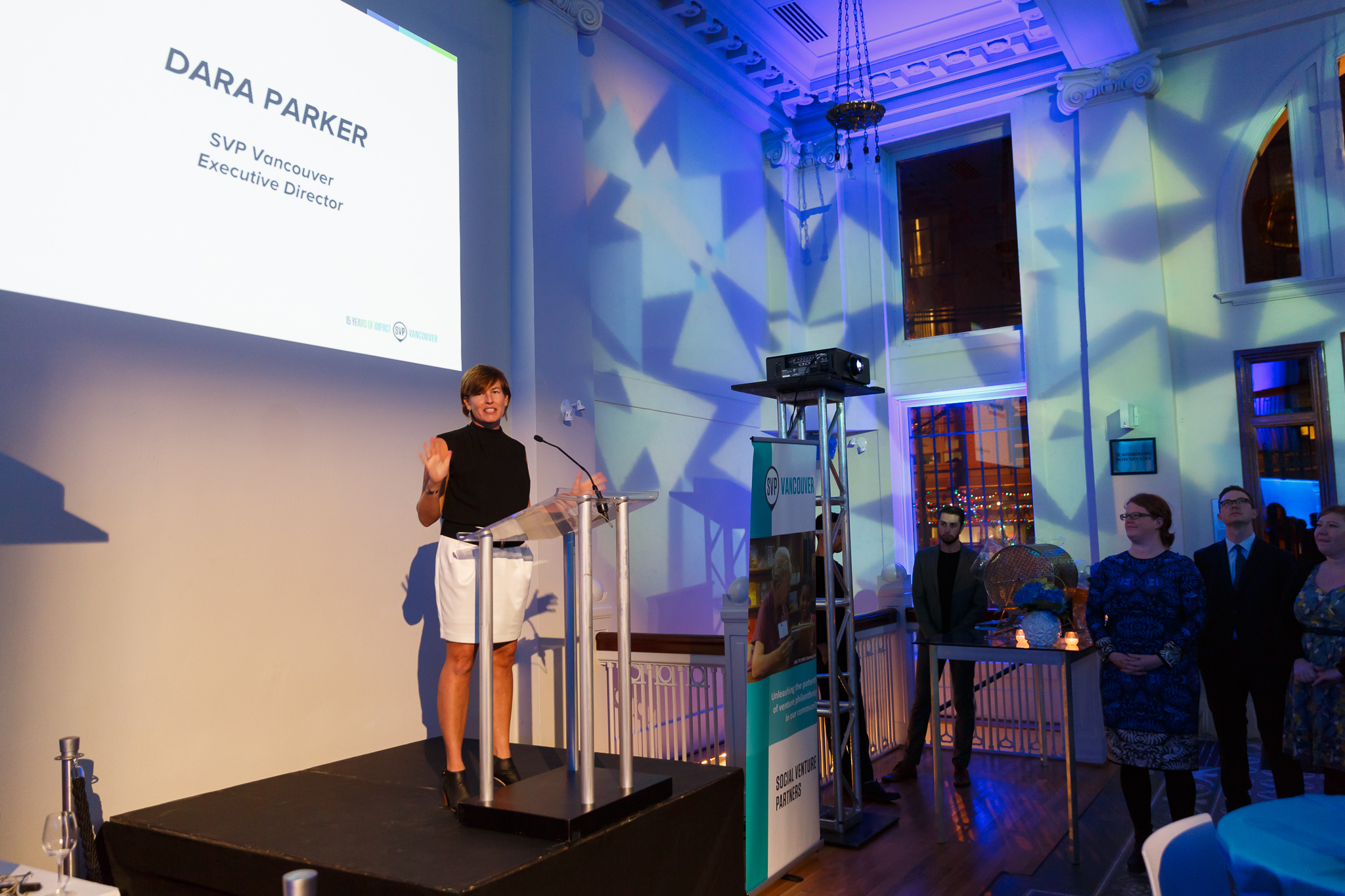
Her move to Social Venture Partners Vancouver in 2016 changed the setting. She was explicit about carrying her perspective into the new job. “We need diverse leadership,” she said. The argument had practical implications. If leadership shapes the questions an organization asks, changing who leads can change what becomes visible, fundable and possible.
“We need diverse leadership.”
Dara Parker, 2016
Representation was personal as well as professional. In a 2016 essay, she recalled growing up without seeing queer women like herself in the media. A narrow set of images had made it harder to recognize her own place in the story. Her response was to value the many voices emerging through blogs, social posts and video. A public narrative becomes more useful when people can recognize themselves inside it.
A reservation for belonging
Some of Parker’s community building came with dessert. In 2014, she and Isabelle Swiderski co-founded Lezervations, a series of networking dinners for LBTQ women. The idea grew from conversations about where women like them might meet. Restaurants became places for social connection beyond the club scene and the stiffness that can settle over a conventional networking event.
The evenings lasted three hours, with conversation before and after dinner. The project extended across Vancouver, San Francisco, New York and Toronto. The format had a local focus, supporting businesses and featuring community organizations, alongside connections across cities. It was a modest piece of social architecture: give people somewhere to sit and enough time to stay.
There is something refreshingly specific about that achievement. Community is a word that can survive almost any presentation without acquiring a shape. A long table has a shape. So does a three-hour evening. Introductions become easier to understand when they involve an actual person on the other side of the bread basket.
The funder turns the questions inward
Parker joined Vancouver Foundation in 2019, drawn by its willingness to fund systems change. At a public discussion that year, she argued for addressing the sources of problems rather than continually responding to their consequences. The ambition carried an uncomfortable corollary: a funder examining social structures also has to examine its own.
In January 2021, she wrote about what the foundation had learned through its BetaPhil work. The process included eleven co-design sessions with community organizations, bringing together successful applicants, unsuccessful applicants and groups that had never applied. A grant program could support valuable projects while still favouring English-language writing, linear explanations and familiarity with institutional language.
That observation moves the discussion beyond whether individual grant decisions are generous. An application asks people to translate their work into a particular form. The translation takes time and skill. If an institution only recognizes one kind of explanation, its assessment may begin filtering people long before a proposal reaches the decision table.
Parker’s response was to examine the foundation’s purpose and move toward more trust-based philanthropy and participatory decisions. When she left in July 2024 to build a coaching and facilitation practice, the foundation credited her five years leading its grantmaking team with helping shift its approach toward trust, justice and equity.
There were concrete budget questions too. In the living-wage conversation, she supported funding that enabled nonprofits to pay staff fairly. Community organizations cannot carry an ambitious mission indefinitely on the assumption that commitment will make up the difference. Her work also extended into teaching: she joined the instructional team for Simon Fraser University’s Climate Action Certificate, launched in 2023 with climate justice and Indigenous knowledge central to its approach.
Then the portfolio enters the room
Toniic announced Parker’s appointment on October 15, 2024. Its community then included more than 500 individuals, family offices and foundations across more than 25 countries. She arrived after Adam Bendell’s tenure, joining an organization with an existing history, research program and network. Her contribution would have to begin with that accumulated work and the people already doing it.
The financial setting widened her familiar questions. Grants involve decisions about resources; investment portfolios involve decisions about what those resources support over time. In 2025, Parker described being drawn to impact investing because capitalism is a major force shaping the world. Her interest was in engaging that force and seeing what deliberate choices about capital could make possible.
She discussed investors bringing patience, knowledge and networks alongside money. That combination matters because an investment can involve more than choosing an asset from a menu. The people providing capital can help shape the terms and support the work behind it. Parker’s earlier experience with community connections and philanthropy gives this part of her career a recognizable continuity.
Intentions meet the numbers
In April 2025, Toniic released Cruising Altitude, part of its T100 longitudinal research. The project gathers private portfolio data and publishes anonymized findings. The release described $3.5 billion in investments, with catalytic capital accounting for 19 percent. It also found investors pursuing impact across asset classes, while accepting less liquidity in pursuit of deeper impact.
These figures describe the studied portfolios. They are not Parker’s assets or a measure of her personal performance.
The research gives the conversation something firmer than a declaration of good intentions. It identifies choices, trade-offs and gaps. Toniic’s wider T100 work shares reports, case studies and a public investment database. For Parker, this is an established effort to carry forward: a way of making private decisions visible enough for other investors and researchers to learn from them.
A captain, two bulldogs, more questions
The executive biography has another field of play. Parker was a provincial rugby player and captain of her university team. In April 2025, she was elected to Rugby Canada’s board for a three-year term; she remained on its 2026/27 board. She remains a committed rugby fan whose time away from work includes chasing French bulldogs.
Their names are Mr. Bumper and Sir Waffles. Parker also offers a decidedly unpolished assessment of herself as a mediocre volleyball player. The titles belong to the dogs; the self-deprecation belongs to the human. A useful arrangement in any household containing an executive.
On her consulting site, Parker sets out beliefs about relationships, collective needs, risk and learning. One is especially plain: “Learning is as important as the doing.” It leaves room for a career that has changed institutions and scale without claiming to have finished the task. From a community centre to a global investment network, there are still people to hear, terms to question and decisions to make. Parker’s story keeps returning to the moment before the money moves.