There is a photograph of Mark Peterson standing inside a former Westinghouse factory in Pittsburgh’s Homewood neighborhood. The paint is peeling from the columns. Pipes cross the ceiling. The windows admit plenty of daylight, which is fortunate: the room has quite a lot of future to fit inside it. Peterson stands between community leader T. Rashad Byrdsong and developer Bill Krahe. All three are smiling. The building, meanwhile, looks as though it has a few questions.
The photograph belongs to the early years of Bridgeway Capital’s redevelopment of 7800 Susquehanna Street. Bridgeway bought the property in June 2013, while Peterson was president and CEO. A nonprofit lender had acquired a factory. There would be tenants to find, systems to repair, and a neighborhood to work with. Capital had become a set of rooms that people needed to be able to use.
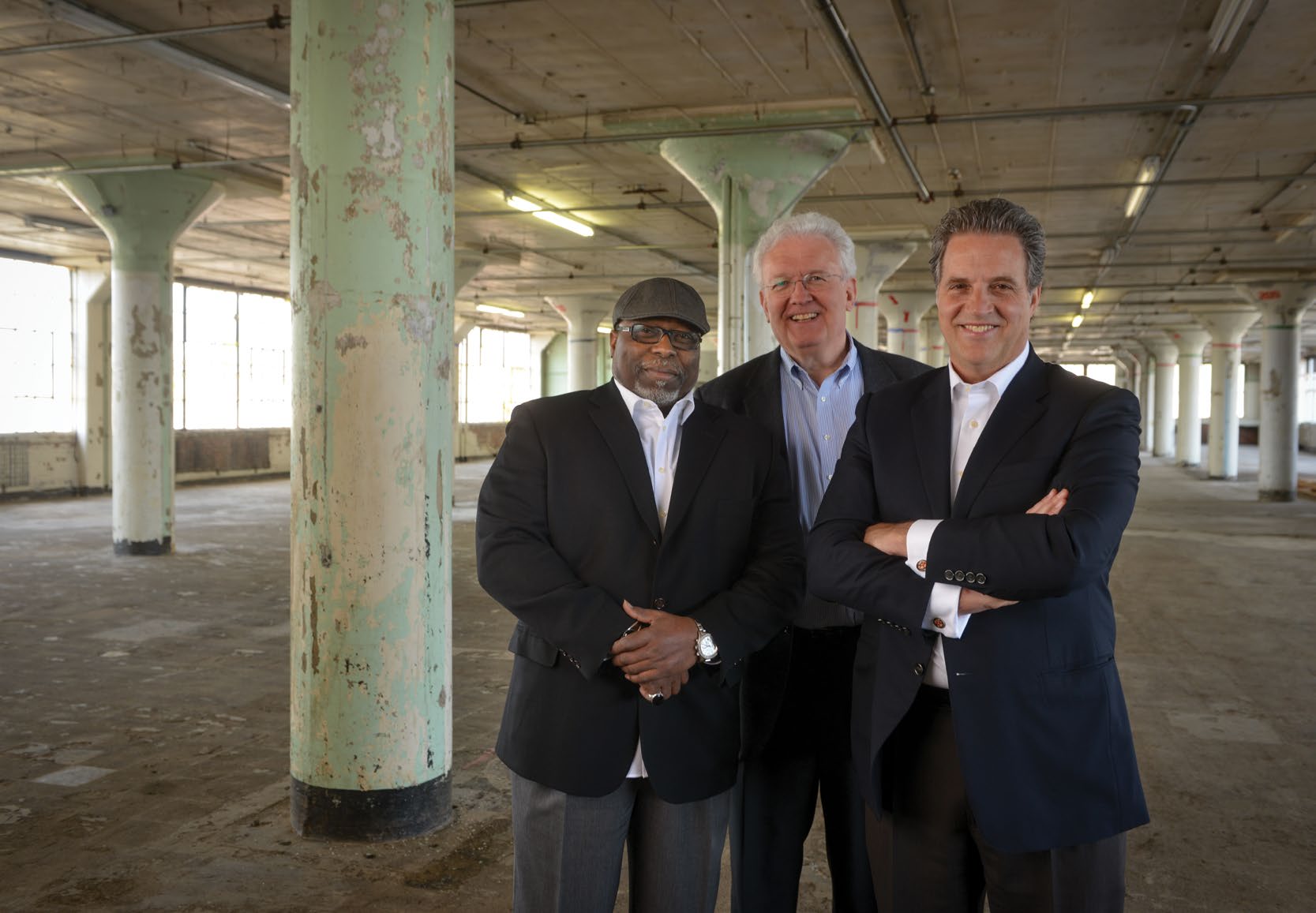
It is a useful place to begin a financial biography. Peterson founded the community loan fund that became Bridgeway in 1990 and led it for 29 years. His work involved businesses, nonprofit organizations, and real estate. Here, several parts of that career meet in one frame: money, property, expertise, and people with different jobs to do. The smiles are visible. The arrangement behind them took work.
A loan fund with an interfaith beginning
Bridgeway’s original name was the Community Loan Fund of Southwestern Pennsylvania. It began as a housing and social service lender, growing from the Religious Leadership Forum. That forum brought together Catholic diocesan leaders from Pittsburgh and Greensburg, Protestant leaders, and the Jewish community. The institution Peterson founded therefore had a collective beginning. Its roots reached into organizations already concerned with the lives of their neighbors.
In the mid-1990s, Catholic Campaign for Human Development support helped broaden the fund’s activity. Planning and operating grants, together with an initial deposit for a small business lending pool, supported that move. It is an unglamorous sequence of nouns, but an instructive one. Before a loan can reach a business, somebody has to assemble the money, the organization, and the ability to keep the arrangement working.
The fund developed into a community development financial institution, or CDFI. That designation puts a formal name around work directed toward people and places underserved by conventional finance. During Peterson’s tenure, Bridgeway expanded into small business, real estate, and nonprofit lending, with offices in Pittsburgh, Erie, and Uniontown. The geography grew. The task remained close to the ground.
Partnership was part of the method. In 2009, Bridgeway joined the Metropolitan Loan Fund of Pittsburgh initiative alongside Landmarks Community Capital Corporation, public agencies, and other organizations. The partnership began with $1.75 million committed to flexible financing and technical assistance, with an emphasis on minority entrepreneurship. Peterson was among the scheduled speakers at its Homewood launch.
That combination matters: financing and assistance, together. A business owner can have the skill to make a product or provide a service while still needing help with the financial steps around it. The partnership recognized both needs. It also distributed the work among institutions. Peterson’s career repeatedly appears in these shared arrangements, where a founder’s contribution depends on the capabilities of other people.
Learning to own the room
The Homewood property gave that approach a more demanding physical form. Built in 1925, the former Westinghouse foundry offered industrial space with a history of employment. When Bridgeway bought it, much of the building was unused. The aim was to bring enterprise back into the rooms and connect that activity with the surrounding community.
Bridgeway had no prior history of manufacturing development. Peterson’s connection to a developer experienced in spaces occupied by multiple tenants helped supply a strategic partner. The organization also added board expertise in real estate portfolios. These were practical admissions that the project needed skills beyond lending. Owning a building comes with an education, and the building sets the examination.
The early tenant mix included cabinetmakers, woodworkers, artists, and an automation supplier. Construction trainers occupied space too. A 2014 grant of $2.5 million from the Richard King Mellon Foundation supported electrical, plumbing, mechanical, and architectural improvements, along with operating costs. The work required ordinary systems to function before the larger ambition could become useful.
“The building represents a major opportunity to improve business conditions in one of the region’s most challenging markets.”
Mark Peterson, on 7800 Susquehanna Street
Bridgeway chose Ma’at Construction Group for the first stage of interior renovation. Ma’at had emerged from the Community Empowerment Association to help Homewood residents gain training and employment. That choice connected the work of repairing the property with the work of creating local opportunity. The contractor was part of the project’s purpose as well as its delivery.
In 2016, Pittsburgh Community Reinvestment Group recognized 7800 Susquehanna Street with its Community Development Award. Later that year, a $1 million state grant supported further custom spaces for manufacturers and training organizations. Peterson publicly credited Senator Jay Costa and Representative Ed Gainey for their support. The project’s progress came with a list of partners, which is usually how a building gets beyond the photograph stage.
The numbers have a neighborhood
By 2018, the building had 23 tenants employing more than 100 people from inside and outside the community. Bridgeway’s investment there exceeded $10 million. Those figures give scale to the rooms in the earlier photograph. They also show how far the organization had traveled from administering a loan pool to becoming responsible for a place where other organizations worked.
The wider institution was growing too. In 2015, Bridgeway closed 114 loans totaling more than $21 million and provided 2,600 hours of business education without charge. A $15 million investment through the federal CDFI Bond Guarantee Program added long-term capital with a fixed rate. Peterson’s leadership letter discussed the need to reach communities still facing unemployment, inequality, and disinvestment.
A borrower on that same project shows how the pieces connected. Darrell Williams, owner of Wilco Construction, received a Bridgeway entrepreneur loan and used the working capital to maintain his team as renovation at 7800 Susquehanna gained momentum. Money reached a contractor working on the property the lender owned. The building and the business each needed the other’s progress.
There is a useful discipline in reading these numbers carefully. Assets describe what the institution holds. Annual lending describes activity during a particular year. Employment belongs to the businesses doing the employing. Peterson led the organization arranging capital and space; the tenants and borrowers did their own work. Keeping those roles visible makes the achievement more intelligible.
The map of that work included places beyond Homewood. Bridgeway helped finance the restoration of the vacant Roxian Theatre in McKees Rocks as a music venue. Peterson described the project as a way to encourage local economic activity. A theater and a factory put different demands on property, but both connect finance to a place people can enter.
An award, then a handover
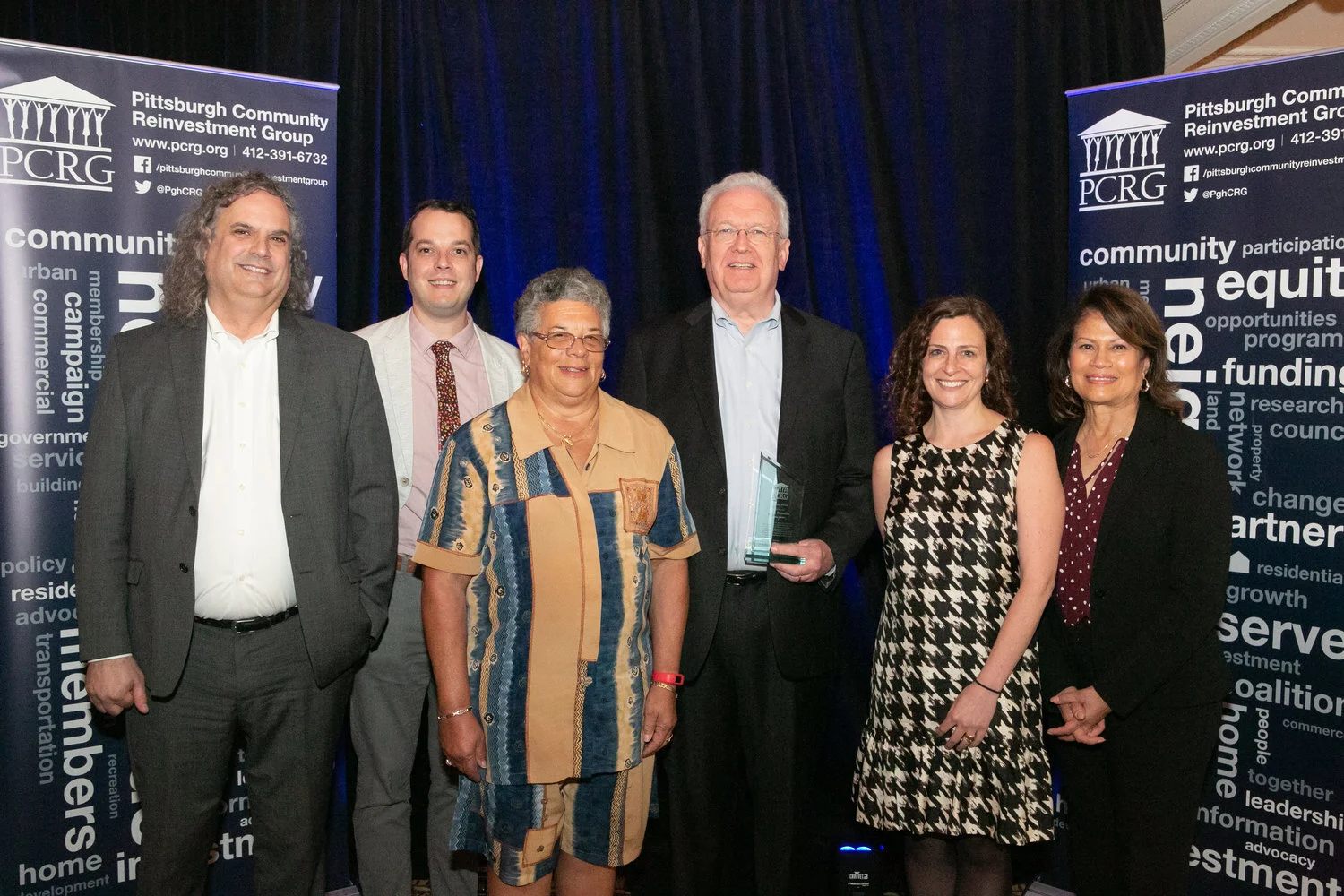
In 2019, Pittsburgh Community Reinvestment Group gave Peterson its Founder Award. A photograph from the award-winners page shows him holding a transparent trophy in a group of six. The setting is more polished than the factory: dark curtains, organizational banners, jackets suitable for a ceremony. The company is still the point. An individual award sits inside a career built through collective work.
That year also brought the executive handover. After a national search, Bridgeway chose TJ Bogdewic, its chief credit officer, as the next president and CEO. He had joined the organization in 2016. The change took effect on July 1, 2019. Peterson continued through a transition period; his retirement followed later that year.
The dates mark different kinds of completion. A successor begins running the organization. A founder finishes the remaining work of departure. After nearly three decades, continuity had to pass through someone else’s decisions. Bogdewic brought knowledge of the institution’s lending operation to the role. Bridgeway’s current board listing identifies him as president and CEO and Peterson as retired, with board emeritus status.
Useful after the title
Peterson’s later public record includes board service with Neighborhood Allies, volunteer consulting for the Hill District Federal Credit Union, and mentoring a nonprofit chief executive. By 2021, those activities were part of his post-retirement work. The scale had changed from leading a regional lender to contributing experience where another organization or person could use it.
A LinkedIn recommendation adds a personal detail to that chapter. Someone who received his volunteer consultation described empathetic, thoughtful feedback and credited him with guidance through an executive career move, including interviews and salary negotiation. It is a small account beside the factory’s square footage, but it gives the later work a human size.
Meanwhile, the institution continued. In April 2026, Bridgeway announced work with Pennsylvania Creative Industries on a statewide creative entrepreneur program. It also reported more than $300 million invested in regional communities since 1990. Those are developments under later leadership. They belong in Peterson’s story as evidence that the organization he founded has kept working beyond his executive tenure.
Look again at the old factory photograph. Three people stand in a room that needed investment, repairs, tenants, and cooperation. Peterson’s career helped assemble those ingredients, then eventually made room for another leader. The photograph catches a beginning. His longer story is in what people were able to do with the space.
Keep following the work
- Mark Peterson on LinkedIn
- Bridgeway Capital: current board
- The Homewood project and its partners
- PCRG’s 2019 award winners
- Leadership succession and later work
- Bridgeway’s 2018 financial snapshot
- The loan fund’s interfaith beginnings
- The Metropolitan Loan Fund partnership
- The Roxian Theatre redevelopment
- Bridgeway’s April 2026 creative enterprise announcement