The dump trailer is the detail that makes the story stick. Dewindt Design, a Dallas renovation business, had been paying to rent one every week. After months of financial coaching, a $30,000 loan from BCL of Texas helped the company buy equipment and cover working capital. Ownership removed a recurring rental bill and opened another way to earn income. Before any of that, BCL had rejected the application.
That sequence says more about this lender than a ribbon-cutting photograph ever could. Borrowing requires preparation, and preparation can change the answer. BCL, short for Business & Community Lenders of Texas, makes that work part of its offering: financing paired with help understanding how to use it. The relationship can begin before a borrower qualifies and continue through the life of a loan.
A “no” with something to do next
In its March 2026 account, BCL describes how Alejandro Dewindt and Jazmin Araque worked with coach Leo Pozzobon after their initial rejection. They built credit, separated personal and business finances, learned profit-and-loss tracking, and improved cash-flow management. Several months later, they received approval.
“They were the first people who trusted us.”
Jazmin Araque, Dewindt Design, in BCL’s client account
The practical lesson is pleasantly unglamorous. A business needs to show where money goes, when customers pay, and how debt will be repaid. BCL’s broader coaching program tackles those questions alongside market research, permits, collateral, and project costs. An entrepreneur can arrive with an idea, an imminent funding need, or an established operation that needs a clearer growth plan.
For someone trying to copy the approach, the useful starting point is a set of decisions: separate the accounts, understand the margin, identify the specific expense financing will address. A loan request becomes easier to evaluate when the purpose is concrete. The trailer matters because it turns a general ambition to grow into a recognizable change in the business.
- 01AssessCredit, costs, capacity
- 02PreparePlan and records
- 03ApplyUnderwriting review
- 04Keep goingOngoing coaching
The second call came a decade later
Another client story measures the relationship in years. Isaac Anzaldua started Next Concept Motorsports in 2008, drawing on a childhood spent around his grandfather’s auto body shop. Customers arrived, but equipment savings kept disappearing into other expenses. In 2011, the Luling Economic Development Corporation introduced him to BCL and founder Rosa Rios Valdez, who helped him develop a business plan and a five-year strategy.
Years later, the Gonzales property where his grandfather and uncle had operated became available. Anzaldua contacted BCL again. A USDA Community Impact Loan through the organization supported the purchase in August 2023; Next Concept opened there in May 2024. BCL’s August 2026 story describes customers returning with memories of the earlier family business.
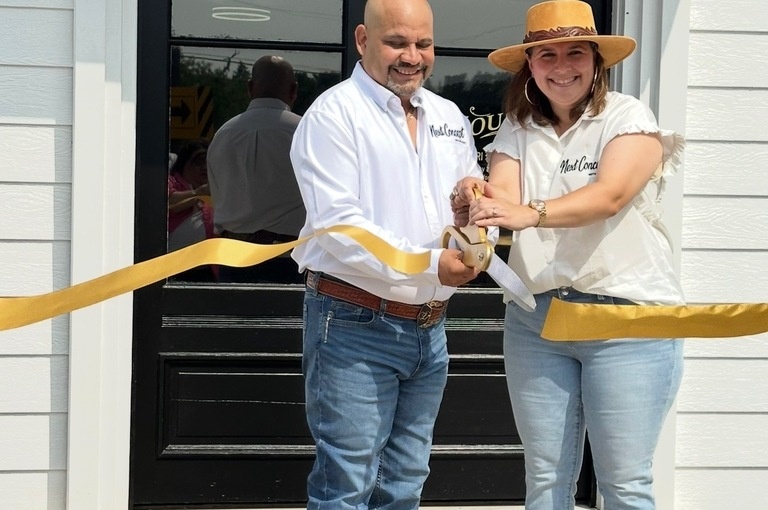
A borrower who returns after a decade presents a different measure of usefulness from a quick application. The financing has followed a changing need, from equipping a young business to owning its premises.
From one office building to a wider brief
BCL’s own origin fits that property story. It formed in 1990 at the invitation of the SBA San Antonio District Office to help established Central Texas businesses obtain commercial real estate financing. Its first borrower, Juan Portillo of Tramex Travel, bought an office building. BCL says the travel business remains in operation more than three decades later.
The organization’s history describes a subsequent realization: access to money alone did not give people enough support. The offering expanded into small-business lending, consumer loans, housing education, mortgages, and community real estate development. Today, its credentials include Treasury certification as a community development financial institution, SBA status as a Certified Development Corporation, and HUD housing counseling approval.
Leadership changed in September 2024, when former chief operating officer Raquel Valdez Sanchez became president and CEO. The appointment announcement credited her with 18 years of community and economic development experience. It also supplied a personal connection: founder Rosa Rios Valdez is her mother. The current team page recognizes Rosa as Founder Emerita.
Match the money to the job
BCL’s business lending menu reflects different stages of ownership. Its Small & Diverse Growth Fund offers $5,000 to $50,000 with coaching. The dedicated DECA fund serves eligible chamber members around Austin; published terms include three to five years and an interest-rate ceiling of Wall Street Journal Prime plus three percentage points. That is an interest-rate ceiling, not a quoted all-in borrowing cost.
For larger needs, the Business Growth Fund lists $50,000 to $300,000 for uses including machinery, working capital, and real estate. A rural program offers $50,000 to $250,000 in communities with 50,000 or fewer residents. BCL also helps package loans for bank partners and arrange financing that fills a gap between available funds and project costs.
The SBA 504 program addresses fixed assets such as commercial property and equipment. BCL describes a structure combining bank participation with SBA financing and a borrower equity contribution of 10 to 20 percent. For an owner considering a building, preserving working capital is part of the appeal; the down payment remains real money the business must supply.
This places BCL within a network of financing options. Banks and credit unions remain alternatives, and sometimes become partners. Other community lenders serve overlapping needs. BCL’s distinctive combination is the breadth of its work across businesses, households, and local development organizations, with coaching connecting those activities. It gives a customer several possible routes through one institution.
A house needs a budget after closing, too
The same preparation appears in housing. BCL offers no-cost individual counseling before and after purchase, covering credit, savings, debt, and household budgets. Post-purchase support addresses maintenance and unexpected financial shocks. Home-retention counselors can work with a borrower and lender to explore solutions when mortgage payments become difficult.
Its homebuyer education is available in English and Spanish, with live and self-paced options. The curriculum follows the purchase from loan preparation through contracts and closing. Courses may carry a fee. The counseling and classes address a common mismatch: someone can be excited about buying a home while still needing to understand the expenses around the mortgage.
BCL also administers the Dallas Homebuyer Assistance Program. The current page lists assistance of up to $50,000, or $60,000 in High Opportunity Areas, for eligible purchases. An approved lender, purchase contract, education certificate, income review, and property review are among the requirements. A readiness check does not reserve funds. The useful first task is establishing whether the household and purchase fit the program.
Some housing work reaches beyond a single buyer. The 2024-2026 Austin Community Land Trust Accelerator brings BCL together with Guadalupe Neighborhood Development Corporation, Austin Revitalization Authority, and Blackland Community Development Corporation. Its aim is to expand permanently affordable ownership near Project Connect routes, including specialized buyer education and mortgage development.
The lending department behind the fund
A town can have capital to lend without having a lending department. BCL sells the missing administrative capacity. Its revolving loan fund services include setting criteria, screening applicants, underwriting, preparing documents, closing loans, servicing payments, monitoring collateral, and reporting to development corporations.
The mechanics explain why partnerships matter. Money available for economic development has to become a workable loan, then a managed account. As principal returns, a revolving fund can lend it again. BCL lets a local organization do that work through an existing specialist team rather than assemble every role itself.
A December 2025 account offers a food-business example. Through a cohort with Kingdom Capital, JP Pancakes received capital and guidance. BCL reports that owner JP Udenenwu repaid his loan early and expanded into concessions and contracted work, including relationships with the University of Texas and Q2 Stadium. Pancakes make the financial plumbing easier to picture.
Free guidance has an operating bill
BCL’s published budget identifies several ways the organization supports itself: loan interest, processing and servicing fees, homebuyer income, contracts, and grants. Its 2021 annual report recorded a $2 million Wells Fargo Open for Business award. That funding helps explain how a lender can offer borrowers continuing services without charging for every coaching session.
The finances also deserve a sober look. For the year ended June 2025, BCL’s Form 990 figures show approximately $2.69 million in revenue and $4.53 million in expenses, a $1.84 million deficit. Year-end net assets were $12.35 million. Those figures establish financial pressure; they do not, by themselves, identify its cause or describe current cash availability.
The cost of the work
Reported deficit: $1.84 million
Rounded Form 990 figures. Bars share a zero baseline.
Results and operating revenue answer different questions. BCL’s 2021 report counted 5,315 clients, $6.46 million in small-business lending, and 202 new homeowners. Those historical service measures help describe its reach. They should not be mistaken for current annual sales or promises about the next applicant.
For a prospective borrower, the useful offer is specific: bring the financing problem and work through the preparation. Approval still depends on the program and the business. Coaching cannot make an unaffordable payment affordable. But it can make the next decision better informed, whether the next purchase is a trailer, a shop, or a home.
Start a conversation
Explore BCL’s website, lending inquiries, and the BCL Circle blog. Watch the CEO introduction on YouTube.