Craig Cohen wanted a sandwich with instructions. At Sun Microsystems, where he designed networking products and custom chips, he had a computer on his desk. Togo’s had a fax machine. Somehow, these two pieces of office equipment had failed to arrange his lunch. The restaurant used its fax for communication between locations, rather than customer orders. Cohen saw room for a connection.
That is a pleasingly modest beginning for a business. The desired outcome was edible, particular, and easy to judge. A sandwich either arrived as requested or left its customer explaining himself again. Cohen and Michael Adelberg would build World Wide Waiter around making restaurant orders travel through the web. The service went online in December 1995. A customer could choose from local menus without making a telephone call.
Three decades later, the premise requires almost no explanation. That familiarity can obscure the work. Cohen’s story belongs to the period when restaurant ordering online had to be explained to both sides of the transaction, and when the last few feet between a machine and a human being could defeat a very clever idea.
Two kinds of chips
Cohen arrived at restaurant ordering with an engineer’s résumé. He and Adelberg were graduates of MIT and Stanford’s Graduate School of Business. Their connection reached further back: they had grown up together in Merrick, New York. By the time they were building a company, they had a shared history as well as business degrees.
His engineering work also left a separate public trace. On July 12, 1994, a United States patent for variable-length string matching was issued with Craig D. Cohen among its four named inventors. The apparatus compared sequences of data to identify matching strings, work relevant to data compression. Its original assignee was Codex Corporation. It was a technical achievement in its own right, before restaurant menus became his business.
A patent names a particular contribution; it does not explain an entire career. Here, though, it supplies useful context. Cohen had worked on the machinery of moving and comparing information. His next venture would involve a different kind of precision: transmitting a customer’s choices so a restaurant could prepare the right order. The food was familiar. The route it took was changing.
Entrepreneurship had interested Cohen before either restaurant ordering or business school. In high school he developed Candy-Man, an action game for Commodore computers, and sold software. When he later explained his interest in starting a company, he pointed back to that experience. World Wide Waiter gave that interest another outlet, this time with restaurant owners and office customers on the other side of the screen.
The first yes
In February 1996, the young company had five employees, three working part-time. Savings and family money financed it. Cohen handled technology while also answering customers, helping recruit restaurants, and managing the business. Adelberg’s responsibilities included sales, marketing, and customer service. The division of work had the porous boundaries familiar to anyone who has worked in a small office.
Asked about the toughest moment, Cohen chose the initial restaurant sale.
“Getting the very first restaurant.”Craig Cohen, February 1996
The obstacle was trust. Restaurateurs were accustomed to people trying to sell them things. A new ordering channel needed a chance to be heard. The founders pitched the internet as a way to attract business; commissions on orders supplied their revenue. They also kept a map on the office wall, with tacks marking participating restaurants. Their ambition could be measured one pin at a time.
The map makes the early venture wonderfully concrete. A website might be visible from anywhere, but dinner still came from somewhere. Each restaurant represented another menu, another relationship, another place where the system had to work. Filling in Silicon Valley was an operating task. Going national was a goal beyond it.
The order needs an answer
The early workflow crossed a technological border. Customers used web pages; restaurants received faxes. The founders added a device at the restaurant that beeped and flashed until someone pressed its button. The order had to be acknowledged. Anyone who has stood beside an unattended printer will appreciate the distinction between producing a document and attracting a colleague.
A click still needed a kitchen.
- 01 / ChooseA customer selects food on the web.
- 02 / TransmitThe order reaches the restaurant by fax.
- 03 / AcknowledgeA flashing, beeping device prompts a person to respond.
A schematic of the early service, not the current ordering system.
By 1997, Cohen was explaining the convenience in terms office workers would recognize: ordering ahead, avoiding telephone queues, and specifying changes accurately. A drawer of paper menus could give way to a screen. The business addressed the small frictions that accumulate around a meal, particularly when one person is responsible for feeding several others.
The test, of course, was delivery. In December 2000, two orders placed during a newspaper’s lunch experiment in Manhattan went through Waiter.com. The first encountered a mismatch between the minimum order shown online and the amount required. A representative called from Sunnyvale to sort it out; another sandwich brought the order over the threshold. Delivery followed 35 minutes after the confusion was resolved.
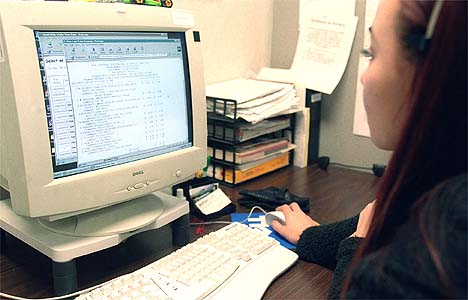
A second order went more smoothly, with photographers arranged to follow its progress. The experiment preserved a useful imperfection in the story. Even when the technology worked, the particulars of a restaurant’s policy still needed attention. The representative’s call was part of making the service useful. Software had introduced a new channel; people continued to handle its exceptions.
When the customer asks for another city
By June 2018, Cohen was describing an expansion shaped by existing clients. Waiter.com had begun moving into Puget Sound in 2016 after requests from customers in San Francisco and Silicon Valley. The completed expansion covered Seattle, Bellevue, Redmond, and Kirkland. The business had followed a relationship into a new region.
The company named Twitter, Facebook, and Electronic Arts among its corporate clients at the time. Its restaurant delivery and virtual café services could supplement a workplace cafeteria or provide an alternative to one. Cohen spoke of company-sponsored lunches and dinners as a recruiting benefit in the technology sector. Lunch had become something employers planned, rather than simply something employees interrupted work to find.
There was another form of expansion in January 2020. Waiter.com acquired Portland Pedal Power, a bicycle-based corporate food delivery company. The announcement said the staff would become Waiter.com employees and the business would operate as Portland Pedal Power by Waiter.com. A company with an early-web history was joining forces with one whose daily work involved pedaling through Portland.
Cohen described the attraction as an established business whose values aligned with Waiter.com’s. Both focused primarily on business customers and customer service. Portland Pedal Power’s CEO, Stacy Blumberg, saw an opportunity to expand its catering services using the buyer’s resources and experience. The acquisition joined two operations with a practical audience in common: workplaces expecting food.
The people beyond the screen
Cohen has also made a public statement about the employment relationship behind delivery. In a LinkedIn post opposing California Proposition 22, he objected to exemptions from employer responsibilities and said Waiter.com supported its drivers as employees. It was a specific position on how the work should be organized, attached to his own company’s practice.
Another account of his working life concerns a much less conspicuous service. In a Technology Credit Union testimonial, Cohen recalled moving to Silicon Valley as a new engineer and joining to finance his first new car. When he founded his company, he brought the credit union’s benefits to its employees. He praised the service and lower fees. His memory of being a customer had carried into a decision as an employer.
His public LinkedIn record also lists service as a Big Brother with Big Brothers Big Sisters of America from April 1990 to August 2001. It is a substantial stretch of time alongside the engineering and company-building years. The entry records the commitment without turning it into a business lesson. It deserves room on its own terms.
His early advice to other entrepreneurs was similarly practical: write down a plan and business model, research whether customers want the service, and find committed advisers who will provide a sounding board and encourage accountability. The advice came from a founder still close to the first restaurant sale. It gave the work a set of questions that could be answered before the office map filled up.
Lunch, with instructions
Waiter.com’s present menu of services still bears a family resemblance to Cohen’s original request. Custom Café lets employees make individual choices. Recurring catering addresses a schedule. On-demand service handles occasional needs. Payment can sit with the employer, the employee, or both. These are different arrangements for the same ordinary event: people at work need something to eat.
Waiter.com advertises meals from more than 1,300 restaurants across its markets, with options ranging from scheduled team dinners to office breakfasts. For a business that once measured its network with tacks, the geography has widened.
The company’s account of its early development singles out a shared shopping cart, which allowed multiple users to contribute to an order. That feature carries the idea from a particular sandwich to a group’s collection of preferences. The administrator need not become the sole keeper of everybody’s lunch instructions.
Cohen’s business has changed its reach and its delivery arrangements since the first restaurant agreed to participate. Its central problem remains easy to recognize. A customer makes a choice. A restaurant has to understand it. Someone has to get the result to the right place. In between are all the details that make a meal arrive as lunch rather than as another item on somebody’s to-do list.