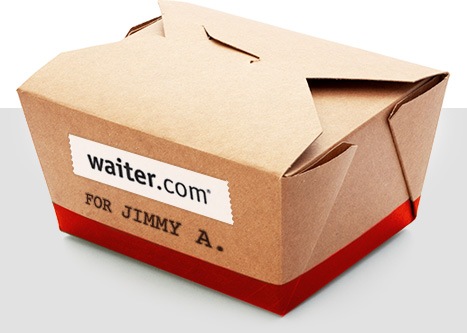
Consider the name on a lunch box. It is a tiny piece of information, scarcely worth noticing until twenty hungry colleagues start lifting lids. Then it becomes the difference between a meal and a small administrative incident. Waiter.com puts names on its Custom Café meals. The label is a useful introduction to a company whose business is making other people’s lunch less complicated.
- Employees choose their meals; a shared cutoff closes the order.
- Offices can buy individual lunches, recurring catering, or occasional delivery.
- Local availability, notice, and the payment arrangement shape the program.
Restaurant choice gets the attention. The less glamorous problem is coordination: who wants what, when everyone must decide, who pays, and how the right meal reaches the right desk. Waiter.com sells relief from that sequence. Its natural audience is the office administrator who was asked to order lunch and somehow acquired another job.
A sandwich request becomes a business
The story begins with a fairly modest ambition. Craig Cohen wanted to order a sandwich from his desk at Sun Microsystems. In a 1996 newspaper account, the restaurant had a fax machine but did not use it for customer orders or offer delivery. The equipment existed. The useful connection did not.
Cohen and Michael Adelberg launched World Wide Waiter in December 1995. A restaurant review published that month described roughly sixty Silicon Valley restaurants available through the service. Sue’s Indian Cuisine was receiving a few faxed orders a day. Online dining had arrived in the kitchen as a sheet of paper.
The founders’ February 1996 interview described a five-person business, three of them part-time, financed through savings and family money. Restaurants paid a commission; users paid no extra charge for the ordering service. The hardest early task, Cohen said, was “Getting the very first restaurant.” Selling an unfamiliar channel required somebody willing to trust it.
The founders also built an acknowledgment device for restaurant fax machines: a light flashed and a sound continued until someone pressed a button. That detail deserves attention. Sending an order and getting someone to act on it are separate achievements. Waiter.com was already working on the second.
The deadline does the organizing
Today’s Custom Café gives an employer a dedicated ordering interface. Restaurant choices are arranged around the group and its budget. Employees select their own food, save preferences, and can order ahead. Around two hours before delivery, according to the service FAQ, the group order processes automatically. Nobody has to remember to press checkout for the whole office.
That last step changes the work. Personal choice remains with each eater; the timetable belongs to the group. Employees can edit selections before the cutoff. Meals arrive labeled with names and descriptions. Reminders help people get their orders in. A useful service emerges from a series of small decisions about responsibility.
Selections can change before the cutoff. Restaurant options depend on the program.
Custom Café sits alongside two other services. Recurring Catering starts with a schedule, budget, headcount, and dietary requirements; Waiter.com proposes a plan for approval. Meals on Demand handles the occasional meeting or late-working team. It advertises delivery in as little as an hour, a possibility to check locally rather than a promise to build a large event around.
Someone still has to carry it
The company advertises access to more than 1,300 restaurants across its markets. Its group-ordering page names San Francisco, San Jose, Seattle, Dallas, and Raleigh/Durham. An office gets a local selection, rather than a nationwide menu delivered anywhere. Coverage is the first practical question.
Waiter.com also makes a specific staffing choice. Its published driver vacancies describe employees paid hourly, with tips, mileage and phone reimbursement, health insurance, and a matching retirement plan. Its corporate service page describes food-handling training and U.S.-based support. Those commitments put people behind the interface and costs behind the delivery.
Sending an order and getting someone to act on it are separate achievements.An observation from Waiter.com’s early fax workflow
Expansion has sometimes followed existing relationships. A 2018 announcement said Puget Sound service began in 2016 after requests from Bay Area clients. In January 2020, Waiter.com acquired Portland Pedal Power, a bicycle-based corporate delivery business. The seller told partners that employees would keep their jobs and immediate processes would remain in place. Local operating knowledge came with the deal.
The bill needs its own design
Payment can follow several arrangements: the employer pays everything, contributes a subsidy, or covers delivery while employees buy meals. Corporate accounts simplify company billing. The convenience reaches beyond lunch into finance, where a consolidated invoice can replace a collection of separate receipts.
For budgeting, read the examples carefully. Waiter.com illustrates Recurring Catering with forty people, ten vegetarian meals, a 6:30 dinner, and a $16-per-person budget. Multiplication gives $640. That is a sample brief, not a published all-inclusive rate. A real quote must establish the menu, delivery charges, taxes, service costs, and any other agreed charges.
Illustrative meal budget from Waiter.com’s recurring-catering example. Final charges require a quote.
The alternatives include direct restaurant catering, an on-site cafeteria, ezCater, DoorDash for Business, and Zerocater. Those platforms also offer workplace programs. Waiter.com’s case rests on its particular combination of restaurant relationships, coordinated ordering, delivery staff, and support. Buyers should compare the actual local operation and total bill.

Copy the handoff
There is a lesson here for anyone organizing meals: collect dietary requirements early, give people a clear selection process, set a cutoff, label the food, and agree who pays. Start with the handoff before expanding the menu.
The limits are equally practical. A scattered workforce may need individual meal allowances. A large gathering requires restaurant capacity and notice. Someone who misses the cutoff cannot assume an automatic order will wait. The arrangement works when a workplace can supply the coordination inputs: location, attendance, budget, and time. The satisfying part is what follows. Everyone gets a choice. Someone else handles the boxes.