The office lunch problem is usually described as a food problem. It is, more precisely, a problem of clocks. Fifty people want different things at roughly the same time. The kitchen needs a count. The driver needs a route. The office manager needs a promise that noon will not become 12:47. EAT Club was built for that small tyranny of simultaneity.
Its founders, Kevin Yang and Rodrigo Santibanez, found their model in a Stanford Business School study of Mumbai's dabbawalas, who move lunchboxes through a disciplined delivery network. Yang recalled being taught that the system was peculiar to India and could not work in America. An entrepreneur can hear “cannot” as a challenge; in 2010, the pair started EAT Club.
The short version
- Employees pick individual meals; the office receives one scheduled delivery.
- The company grew from lunch delivery into a virtual cafeteria for workplaces without kitchens.
- After the pandemic cut office demand, it moved toward a software layer and joined Compass Group USA in 2021.
- The present service is built for recurring orders of at least 50 meals per location per day.
A hundred appetites, one elevator ride
The early service let office workers choose from rotating restaurant menus and order online or by phone. In a 2013 interview, Yang described meals starting at $8.95, with no delivery fee or minimum order. That was the original consumer-facing pitch, not a current price list. The company learned that a more durable customer sat a few desks away: the employer paying to feed a group.
By 2015, EAT Club was promoting office catering. This was a change of buyer as much as a change of menu. An office could subsidize every meal or give employees a lunch allowance. Instead of making an administrator guess whether the room wanted wraps or noodles, the company gathered individual selections in advance, packed each separately and delivered the whole lot together. The person paying got a managed program. The person eating got a choice.
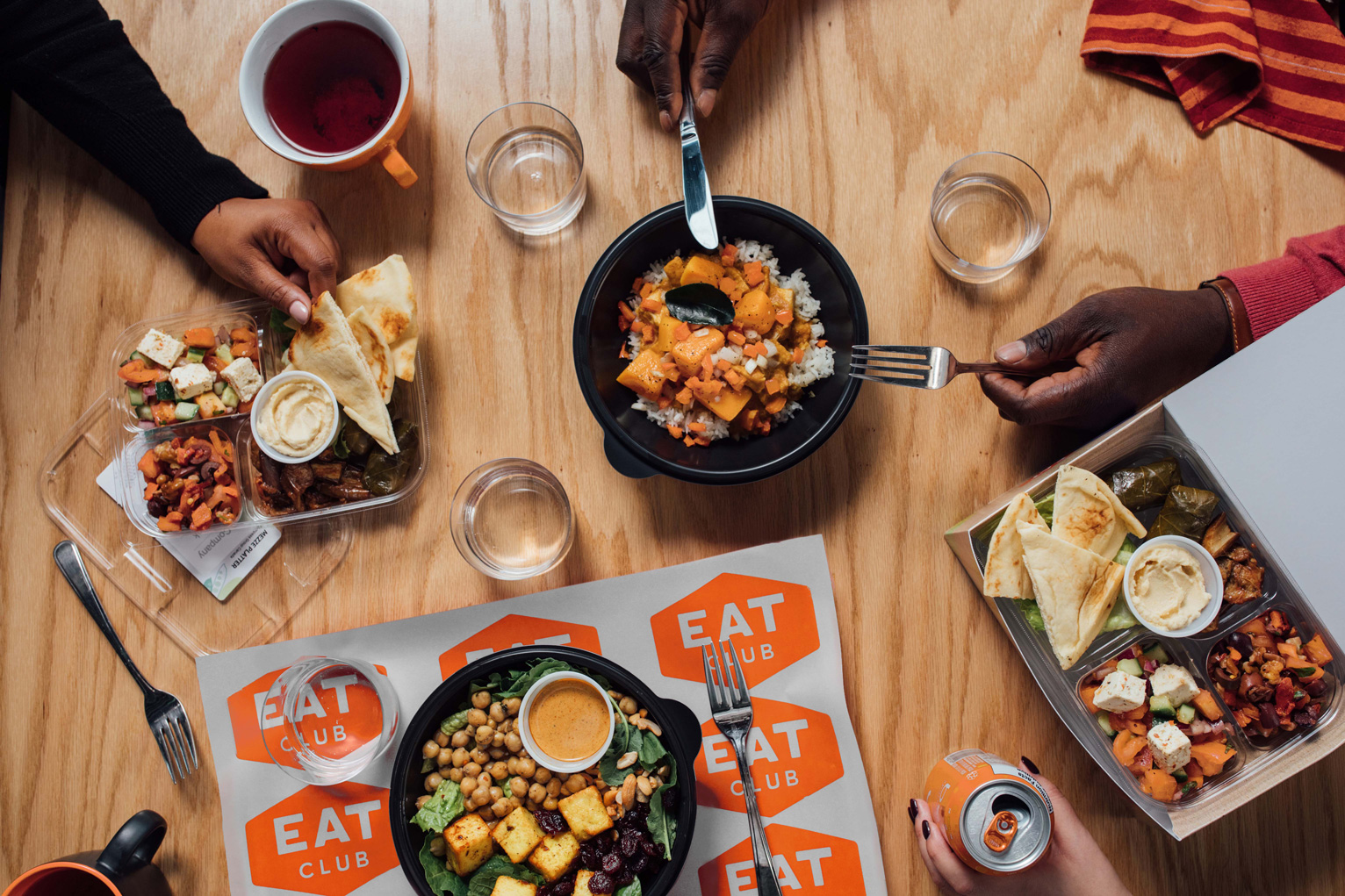
That distinction put EAT Club somewhere between a cafeteria and a delivery app. A cafeteria has a predictable destination but asks everyone to travel to the food. An on-demand app offers choice but sends separate orders and riders into the noon rush. EAT Club kept the choice and consolidated the trip. Its published service description says the meals arrive in a single 30-minute window, individually packaged and labeled for pickup.
The noon equation / how the program works
Personal choice is upstream; shared logistics is downstream.
Scale bought with very unromantic precision
The machinery grew quickly. EAT Club raised $5 million in a 2013 Series A and $30 million in a 2017 Series C led by Sodexo, the food-service company. The Series C announcement reported tens of thousands of meals a day and a 99.7 percent on-time delivery rate. These were company figures at the time, but they reveal the pitch: reliability was a product. A lunch program that arrives late is not a perk. It is a meeting with a side of resentment.
Cumulative and current figures displayed on EAT Club's website when reviewed.
Acquisitions widened the food side of the operation. EAT Club bought Farm Hill's personal-meal business in 2018, adding customers and menu options in the Bay Area. The next year it bought Taro, whose recipes, production processes, technology and people were folded into the corporate program. In 2019, the company said it had served more than 17 million meals. Facebook and Postmates were among the customers named in accounts of the service; its own website features IMVU's employee-experience team.
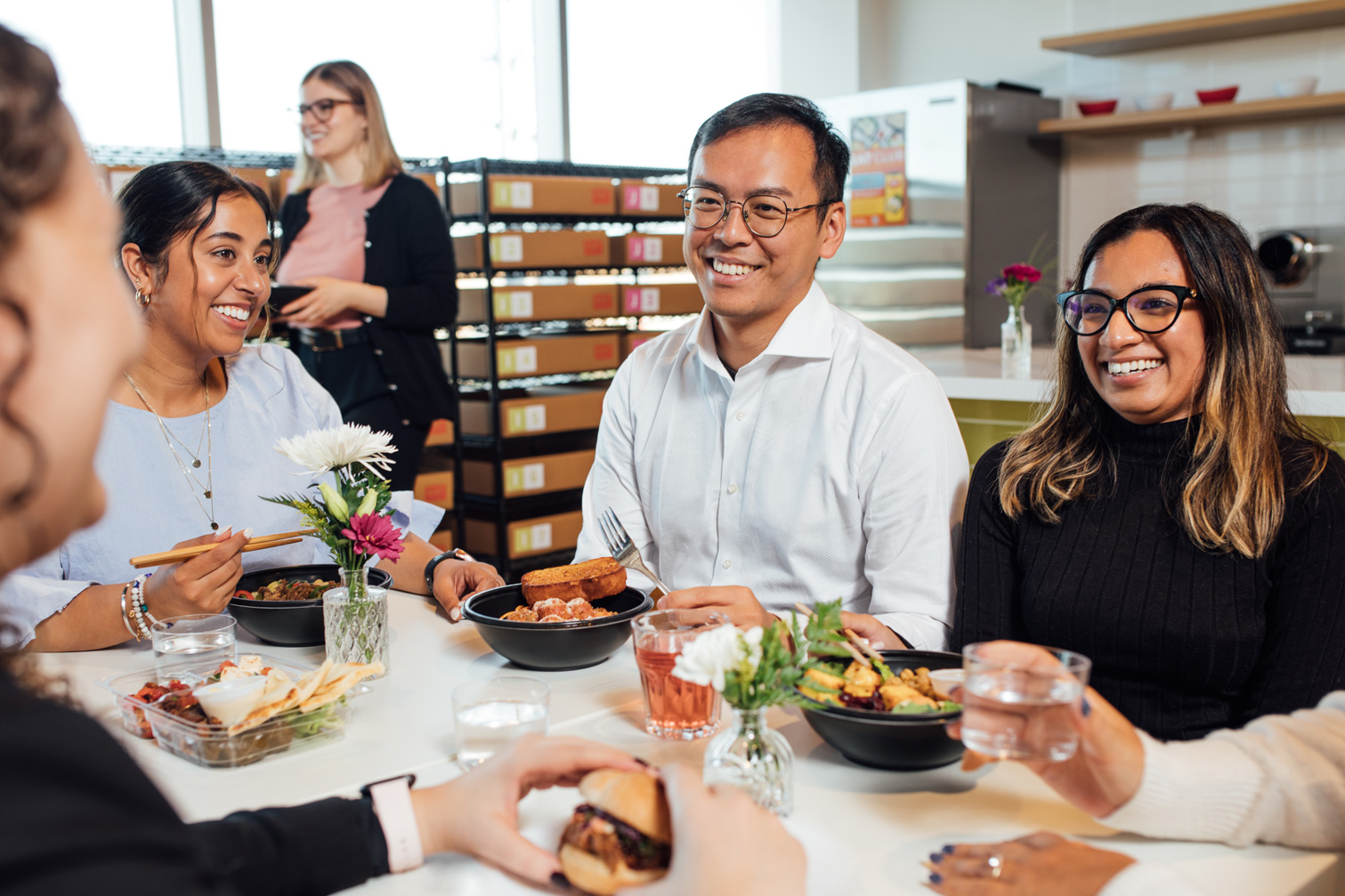
The company also sold an argument about culture. Deja Ramos, an employee-experience manager at IMVU, described staff getting time back and reinvesting it in one another. The claim deserves a little restraint: lunch will not repair a badly run office. But an agreed meal window does something an endless string of individual pickups cannot. It lets people be in the same place at the same time.
“The employees had their time back and were re-investing it in each other.”Deja Ramos / IMVU, in EAT Club's case study
Then the offices went quiet
In 2020, the model met the one thing it could not route around: empty offices. CEO Doug Leeds later told Crunchbase News that EAT Club had been a full-stack operation, making and delivering food itself. The pandemic brought a downturn and job cuts. At first, management expected workers back soon. When that return stretched out, the company changed the model and its technology.
It built a software platform to sit over other food-production and logistics systems. That was a consequential admission. The kitchens, equipment and drivers had been necessary to prove the service. They were not necessarily the part EAT Club had to own forever. Compass Group USA, with food-service operations already at national scale, acquired the company in 2021. The purchase price was not disclosed. Compass said the platform would help it serve workplaces, education and healthcare as dining needs changed.
The lesson is pleasingly specific. EAT Club's advantage was neither an unlimited menu nor a miraculous lunchbox. It was the choreography between demand, preparation, route and pickup. Compass could supply much of the physical infrastructure; EAT Club supplied a way to make that infrastructure behave like a personal cafeteria.
The fine print is the strategy
Today the company describes a recurring workplace service, not an event caterer. Its FAQ lists a minimum of 50 meals per location per day and says it does not serve residential addresses or one-off events. Meals can be filtered by dietary tags, though individual dishes generally cannot be customized. The site lists selected US metro areas rather than a blanket nationwide promise. These limits are useful: they show where pooled delivery has enough density to work.
An office manager can copy the underlying idea without copying the company. Ask employees to choose early. Aggregate orders into a predictable kitchen count. Promise one narrow delivery window. Label the handoff so the lunch rush is orderly. Measure wasted meals and late arrivals rather than only menu variety. The system works best when enough people share a place and schedule; a scattered team of ten will find the same machinery heavy for its purpose.
The dabbawalas' genius was never that every lunchbox contained the same food. It was that every lunchbox reached the right person. EAT Club translated that thought into office software, with detours through venture funding, food acquisitions and a deserted workplace. The sandwich was always the visible part. The arrangement behind it was the business.