Some companies begin with a technical insight. WeBox began with dinner. Fred Ming, a software architect who had moved from China to Silicon Valley, took his wife to a restaurant where a dish reminded her of home. The meal brought on homesickness. Ming wondered whether chefs could cook food from far away for people living far from it. The idea became Saltalk, a virtual-kitchen business built around cooks, kitchens and delivery. The contemporary WeBox is a more prosaic, and perhaps more interesting, creature: a system for the office manager who needs lunch for 60 people by noon.
- WeBox combines individual meals, event catering and pantry restocking in one workplace account.
- Employees choose meals; administrators control rosters, budgets and billing.
- Its current site says it serves 500-plus workspaces in the Bay Area.
- Basic costs no membership fee but carries a 14% service fee; paid plans reduce the fee.
The move from Saltalk to WeBox tells you what the company learned. A good meal can win a customer once. Feeding an office week after week takes scheduling, labeling, budget rules, dietary filters, account support and a delivery route that survives traffic. In a post announcing the new name, Ming framed the business around three products: individual meals, group catering and office pantry. The word “box” may sound humble. In practice it is an attempt to make dozens of preferences behave like one order.
One order, dozens of opinions
The familiar office-lunch choices are unsatisfactory in different ways. A buffet asks everybody to agree on a menu. Individual restaurant orders let everybody choose, then create a parade of couriers, receipts and uncertain arrival times. WeBox’s Box Meal product combines employee-level selection with a company-level delivery. Its current homepage advertises more than 1,500 daily options from over 70 restaurants across 17 cuisines. Each meal is boxed and labeled with a name and allergens. The claim is the company’s, and the available selection depends on the delivery address and day.
For the employee, the front end is choice: select a lunch, save food preferences, or use automatic ordering. For the office administrator, the product is control: set a per-meal cap, add or remove employees, review spending and collect one invoice. A guest link can feed a visitor without asking the visitor to join the company account. This is an unromantic kind of delight. Nobody praises the spreadsheet that never had to be made.

The kitchen was the beginning, not the whole plan
In 2022, Saltalk announced an $8 million Series A financing round involving Foothill Ventures, GrubMarket and Celtic House Asia Partners. Its pitch then combined virtual kitchens, food entrepreneurs, e-commerce and logistics. The company reported fivefold growth over the preceding eight months. That was a company announcement, not an audited performance figure, but the strategic direction is plain: Ming was trying to join the supply of distinctive food to the recurring demand of corporate customers.
“My wife told me the meal made her homesick, which gave me an idea to cure it.”
Fred Ming, speaking to TechCrunch in 2022
A former product designer describes a 2023 platform overhaul as part of a broader shift to an all-in-one corporate delivery service. The new name followed. There is no public account of one catastrophic failure that forced the change. What the record does show is a founder who started with authentic cooking and later emphasized the repeatable office order. The restaurant remains essential; the customer’s recurring headache has changed.
This is where WeBox differs from a general delivery app or a conventional caterer. The company says it operates its own fleet and scheduled office routes. It also says boxed meals travel in temperature-controlled containers and arrive sorted by name. In its original Saltalk era, Ming described an algorithm-based route-planning system as a source of delivery efficiency. The useful point is not that an algorithm cooks lunch. It is that a marketplace serving dense office routes can coordinate many kitchens without treating each meal as a separate trip.
Lunch, the party, and the shelf
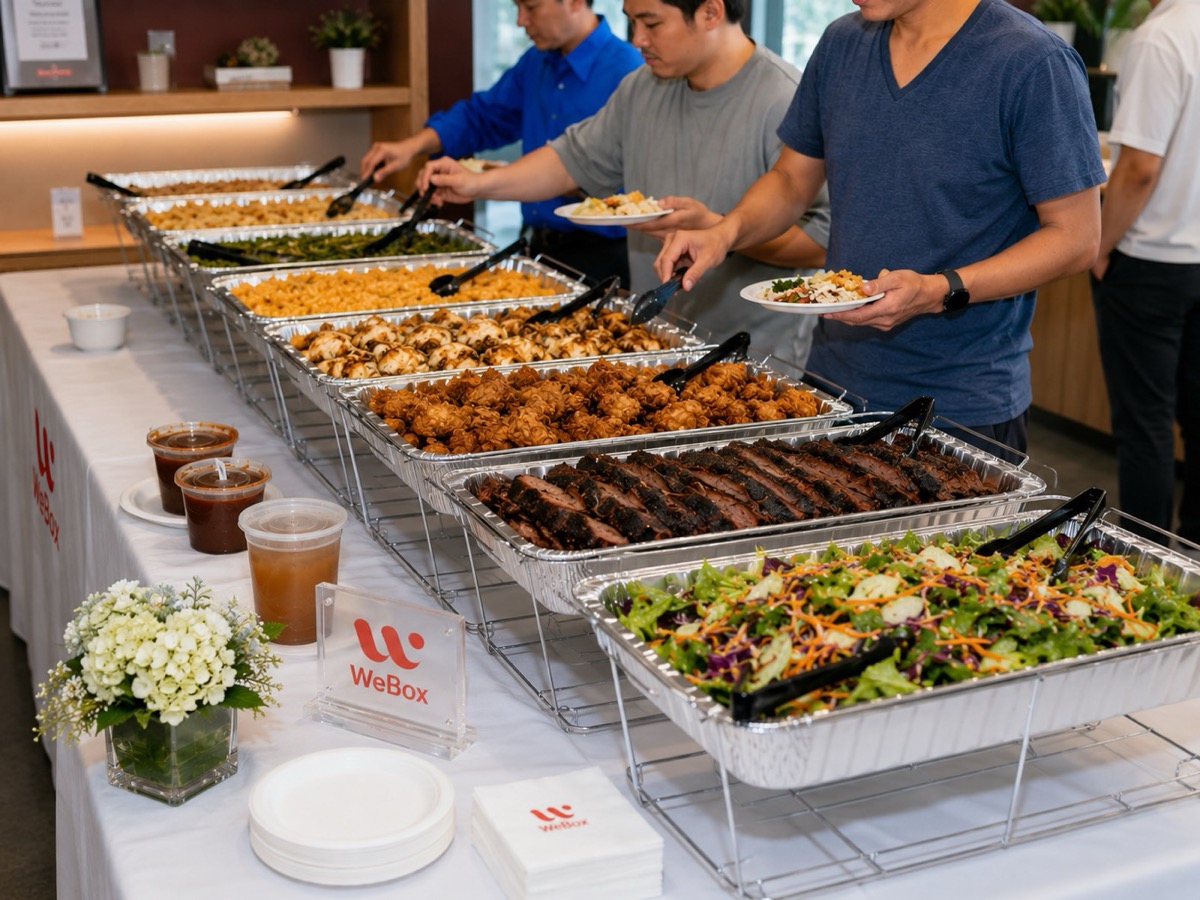
WeBox’s second product, Event Catering, handles the food that cannot be put in a single-name box. Organizers can choose buffet-style dishes, request a proposal before committing, and pick a 30-minute arrival window. The site advertises more than 30 curated themes and the ability to combine dishes from partner kitchens. Drop-off, setup and staffed service are different options. The system is designed for all-hands meetings, launches and celebrations, where the last-minute question is often less “what tastes good?” than “who is bringing the serving utensils?”
Office Pantry moves further from the restaurant order. WeBox offers snacks, drinks and fresh essentials with inventory counts, restock suggestions and budget controls. The company says an office can consolidate products from stores including Costco, Trader Joe’s and Safeway into one delivery. After a two-to-four-week setup period, it says restocking can become largely routine, subject to an administrator’s approval. The service is an answer to a mundane but persistent question: who notices that the oat milk is gone before the entire office does?
There is a fourth, quieter side to the model. WeBox rents commercial-kitchen space to food entrepreneurs and invites restaurants onto the marketplace. The office provides recurring weekday demand; the restaurant gets a channel to that demand without running its own corporate delivery program. That arrangement helps explain why the company speaks of itself as a marketplace even as it runs a very physical operation.
The price of making lunch disappear
Convenience is not free. WeBox publishes a Basic plan with no membership charge, a 14% service fee and free delivery above $199.99. Its Business plan is listed at $29.99 per month, or $25.99 a month with a one-year contract, with a 12% or 11% service fee respectively and free delivery above $99.99. Enterprise terms are negotiated. Food, tax and optional on-site staffing add to the bill; WeBox lists staffing at $25 per half-hour. The exact economics for a workplace therefore depend on its order size, frequency and plan.
Those published fees also clarify the company’s place in the market. WeBox is neither a software-only office perk nor merely a caterer with a website. It is a local food-commerce operator collecting fees to coordinate procurement, software, support and delivery. Its competitors include office-focused marketplaces such as ezCater and Foodja, local caterers, and ordinary delivery apps. The more a customer wants one vendor for daily meals, events and pantry, the more WeBox’s combined model matters. For an occasional pizza Friday, a simple local order may be enough.
Local density is part of the proposition. WeBox’s public materials focus on Bay Area cities, including San Jose, San Francisco, San Carlos and Sunnyvale. It operates from San Jose and describes kitchen facilities in Santa Clara and Fremont. A route-based service gets stronger when offices, partner kitchens and drivers are close enough to make a combined run sensible. The same model would be harder to copy in a thinly spread market, or in an office whose headcount changes so unpredictably that recurring orders offer little advantage.
What the office manager is really buying
Recent product updates are full of small, revealing repairs. In July 2026, WeBox extended advance meal scheduling to 14 days, improved recommendations, and added clearer warnings for sold-out items and duplicate time slots. In August it described an AI customer-service chat with handoff to human staff. None of these is a grand reinvention of lunch. Each attacks a point where an office meal can turn into an awkward apology.
The copyable lesson is operational: bundle demand, give individuals choice, and then remove the administrative friction that choice creates. WeBox’s own story has moved from the romance of a remembered dish to the discipline of a named box on the right rack. That may be less poetic than dinner in a beloved hometown. It is also the sort of detail that gets a company invited back next Tuesday.