A vacant office looks simple from the pavement. There are windows, a lobby, perhaps a broker’s sign. Now try answering the questions that matter: what did the tenant next door actually pay? When does its lease expire? Who owns the building behind the holding company? The bricks are visible. The business is largely hidden. CoStar sells a way into that second building, the one made of facts.
Its product is commercial real estate information, analytics and news, sold to people whose mistakes can be expensive: brokers, lenders, investors, appraisers and corporate property teams. The promise is practical. Spend less time assembling evidence and more time deciding what to do with it. That sounds modest until you consider how much of a property professional’s working day can disappear into assembling evidence.
- The job: connect buildings to rents, owners, tenants and deals.
- The edge: researched evidence you can filter around a real assignment.
- The test: useful local comparables, not just a large record count.
The invisible building
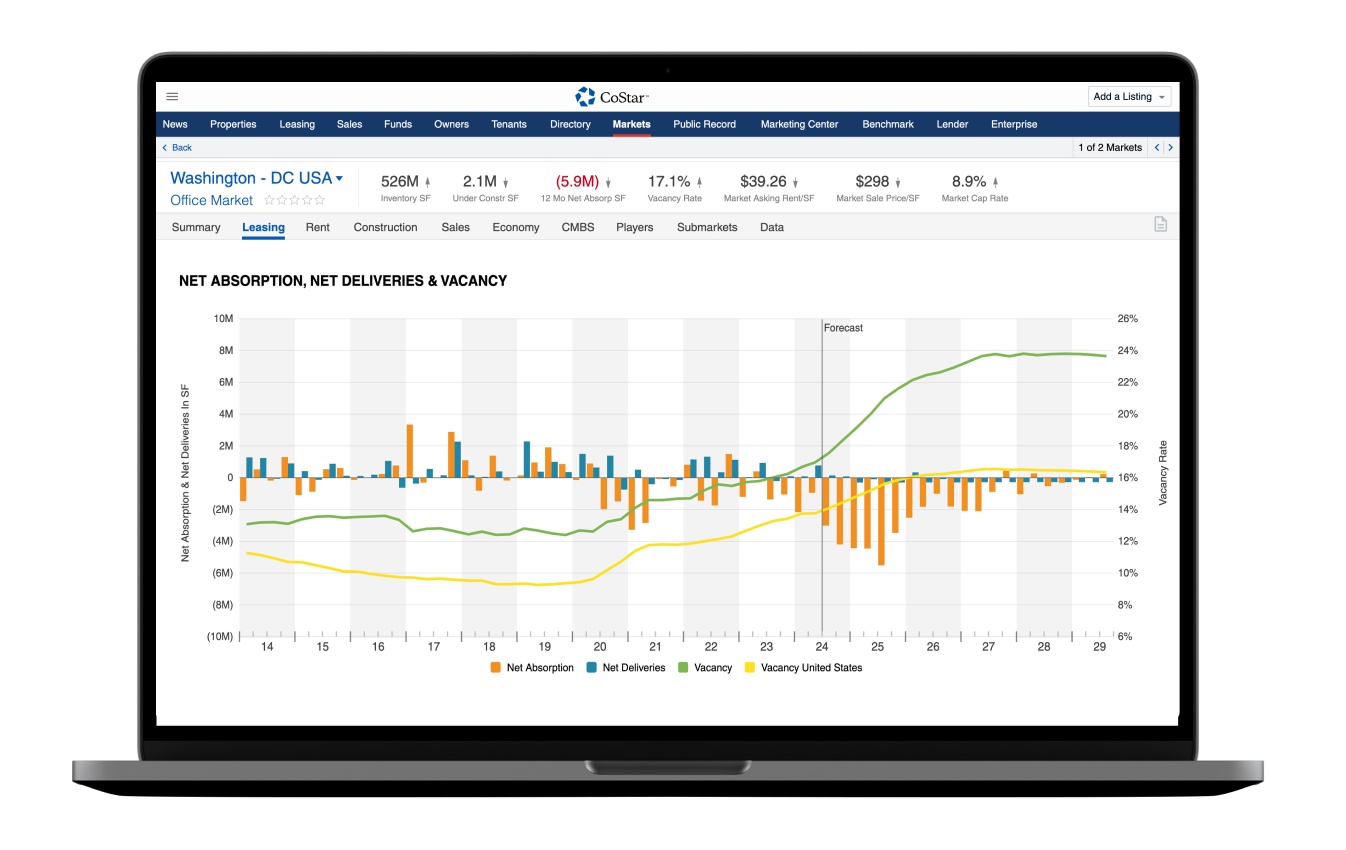
The platform links property records with tenants, ownership, available space and completed transactions. Sale comparables reveal who bought, who sold and what changed hands. Lease activity adds rents, dates and expiration information. Market analytics puts an individual asset beside its neighborhood, with vacancy, construction and rent trends. A warehouse stops being an isolated listing and becomes one observation in a larger market.
Consider an investor evaluating an industrial building. A useful workflow is to select genuinely comparable sales, examine competing space and test the local rent outlook before accepting the seller’s assumptions. This is an illustrative use, not a promised return. CoStar can supply evidence for the argument. It cannot decide whether the roof leaks, the tenant will renew or the buyer has paid too much.
Somebody still has to check
Andrew Florance began the business in the 1980s, long before searching for a building on a screen felt ordinary. The parent went public in 1998. Its persistence has a commercial logic: yesterday’s checked facts give today’s research somewhere to start.
The interesting technology sits behind the screen. CoStar describes more than 1,600 market researchers, supplemented by field, aerial and drone research, data feeds and public records. The intellectual work is deciding whether records describe the same property, whether a transaction belongs in a comparison and whether yesterday’s information still holds. A polished chart is the last step in a surprisingly physical process.
That accumulated effort is its competitive proposition. The parent’s investor overview says it has invested more than $5 billion in its proprietary database over four decades. Treat that as a company-reported cumulative investment, not the price of building a competing website. The useful lesson for another information business is smaller: pick a fact customers struggle to verify, check it repeatedly, then connect it to a decision they already make.
- 01CollectRecords + fieldwork
- 02VerifyCheck the details
- 03ConnectProperty + market
- 04DecideHuman judgment
A customer’s smaller revolution
In a CoStar-published case study, Cresa Toronto described its earlier routine: collect broker flyers and information from landlords, then call the parties involved. It began using CoStar Suite in 2014. The change was a reduction in the distance between a question and usable evidence. A small brokerage can buy access to a research operation it could hardly reproduce on its own.
Another company case study follows Michael Le Coche at Fiera Real Estate. His complaint about a quarterly spreadsheet from another provider was specific: he could not slice the information into the property segments he needed. He described moving from monthly CoStar use to daily use. That is a revealing adoption story. Frequency follows the ability to ask a better question, not simply the arrival of more rows in a database.
“I quickly evolved into a daily user of the product.”Michael Le Coche · Fiera Real Estate
CoStar-published customer case study
The subscription and the shop window
CoStar belongs to CoStar Group, the publicly traded parent behind LoopNet, Apartments.com and Homes.com, among other brands. The distinction matters. CoStar is a professional research workspace. LoopNet is a commercial property marketing marketplace. They can serve the same broker at different moments: one helps establish the case for a property; the other helps put it in front of prospective customers.
The wider group earns subscription and advertising revenue. Its 2025 filing puts subscription-based contracts at roughly 93% of total revenue. CoStar’s public product pages direct buyers toward a demo and sales conversation; a buyer should request a quote for the intended coverage and users. For a one-off search, public records and local expertise may suffice. For repeated underwriting or prospecting, the subscription’s value depends on time saved and evidence actually used.
Group revenue
The deal that did not happen
Scale also creates resistance. In 2020, the parent agreed to buy apartment-listing competitor RentPath for $587.5 million. The Federal Trade Commission challenged the transaction, alleging it would reduce competition in advertising for large apartment complexes across 49 metropolitan areas. The deal was abandoned. CoStar later recorded a $52 million termination fee and a $7.5 million extension payment.
The obstacle arrived before integration: regulatory clearance. This was a marketplace acquisition, not a failure of the CoStar research product, but it exposes a limit to the parent’s expansion strategy. Buying another audience can run into competition law. The alternative for a research customer is more ordinary: compare coverage and workflow with services such as Crexi Intelligence, which also offers property records and transaction comparables. Count relevant answers, rather than headline database totals.

Now the building gets another dimension
The parent completed its Matterport acquisition in February 2025, adding technology that turns physical spaces into navigable 3D digital twins. Microsoft separately describes its work with CoStar Group on conversational property search using Azure AI. Those are different extensions of the same ambition: make property easier to inspect and interrogate. Neither removes the need to know where a number came from.
The next test is already visible. In July 2026, the group reported the launch of CoStar Rent Benchmark, built from four million AI-abstracted lease agreements, alongside CoStar’s entry into France. The parent reported $925 million in second-quarter revenue and $55 million in net income. Those are group results, not a revenue figure for the CoStar platform alone.
The sensible buyer’s test remains wonderfully unglamorous. Bring a real assignment to the demo. Check the buildings you know, inspect the comparables you would use and see whether the workflow improves your next recommendation. Thin local evidence, an unusual asset or a forecast built on assumptions you reject can all weaken the answer. The building still has secrets. CoStar’s business is making fewer of them a surprise.