Stand outside an office building and count the windows. You have learned something about the building. You have learned almost nothing about the investment. Which tenants are leaving? What did the landlord concede on the last lease? How much competing space is coming down the road? CoStar Group has built its business in the distance between those two kinds of knowledge.
- Professional customers pay for property research, analytics and software.
- Owners and agents pay to reach people through its marketplaces.
- The Homes.com expansion tests how much audience growth is worth.
Its familiar names are a clue: Apartments.com, LoopNet, Homes.com. Behind them sit commercial research, hotel benchmarking and Matterport’s digital twins. The company’s real subject is the uncertainty attached to a physical place. Its commercial proposition is that somebody will pay to reduce it.
01 Somebody has to walk past the building
Consider an unusually revealing document: a CoStar research photographer’s job description in Munich. The equipment includes a Canon R6, tilt-shift lens, iPad and, where applicable, a drone. The assignment includes inspecting properties, recording tenants and finding buildings or listings missing from the database.
This is software with a substantial outdoor component. A database of buildings becomes less useful whenever a tenant moves, construction advances or a vacancy appears. CoStar’s research methods combine fieldwork with calls, public records and updates from market participants. Collecting information once creates a record. Collecting it repeatedly creates something a professional can use.
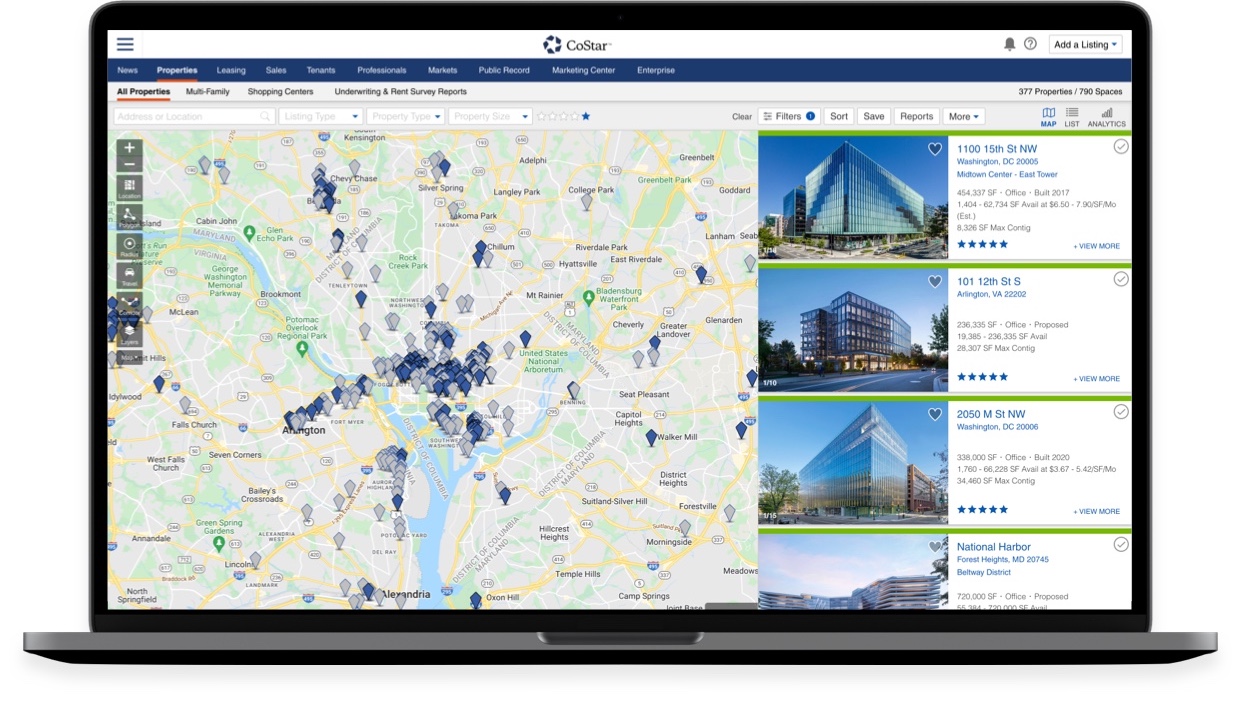
A broker can compare available space. A lender can examine a market before underwriting a loan. An investor or appraiser can investigate comparable transactions. The value lies in bringing those questions into one working environment, with research behind the screen.
02 Research finds an audience
Andy Florance, the founder and chief executive, took CoStar public in 1998. Expansion brought the company into adjacent businesses. The approximately $585 million Apartments.com acquisition in 2014 put it deeper into rental discovery. The purchase bought a different relationship with the customer: a renter searching freely, and a property manager willing to pay for attention.
CoStar and LoopNet illustrate the distinction. The former helps professionals investigate a property and its market. The latter helps people discover commercial space and gives advertisers a way to promote it. One sells knowledge for a decision; the other sells visibility while that decision is forming.
That combination helps explain the portfolio. STR provides hotel performance benchmarks. Lease software handles enterprise administration and accounting. Ten-X supports commercial auctions. These products serve different customers, but each attaches a paid service to a property decision.

03 A tour becomes a dataset
Matterport adds another way of knowing a building: walk through its digital counterpart. Its spatial capture technology produces interactive 3D models that can help people inspect layouts remotely and support documentation or operations. A listing photograph offers a view. A digital twin gives the viewer room to move.
CoStar completed the acquisition in February 2025. The announced deal carried an estimated $1.6 billion enterprise value; accounting purchase consideration at completion was about $1.93 billion. Those are different measurements, not interchangeable price tags. The intended connection is straightforward: put richer property information into the places where buyers and renters already search.
Homes AI, launched in February 2026 using Microsoft Azure OpenAI, adds voice and text conversations to home shopping. It draws on listings, imagery, neighborhood information and Matterport tours. The interface can change quickly. The underlying information still has to describe the property correctly.
04 The expensive part is being chosen
Homes.com makes the strategy harder. Residential search already has established competitors, including Zillow and Realtor.com. CoStar pitches agents on “Your Listing, Your Lead”: inquiries go to the listing agent. Memberships promote agents and their listings. That gives the company a specific commercial argument, but an argument still needs an audience.
The bill became substantial. In January 2026, CoStar said Homes.com’s net investment had been $850 million in 2025. This measure compares revenue with attributable and allocated costs. It announced plans to reduce that figure by more than $300 million in 2026, following a board review and engagement with shareholders.
2025 company figure versus January 2026 plan. The second bar is a target, not a reported result.
The first assumption under strain was that expansion justified the pace of spending. Shareholder pressure helped produce a more explicit financial timetable. CoStar retained Homes.com, while setting a goal of positive adjusted EBITDA in 2030. The change was in spending discipline and accountability; it was not a declaration that the residential project had already paid off.
05 Copy the work behind the screen
By the second quarter of 2026, group revenue reached $925 million, up 18% year over year. GAAP net income was $55 million. Those figures describe the whole company. They do not settle the separate question of Homes.com’s eventual return.
“We have a zero-tolerance policy for jerks.”
CoStar Group’s published core values
The blunt line in its values sits alongside commitments to learning, customer focus and collaboration. Such statements describe an aspiration. The observable operating requirement is more prosaic: researchers, photographers, engineers and salespeople must make their work useful to one another.

The transferable lesson is to choose an information problem that keeps returning, then build the means to answer it repeatedly. The limits matter. This approach needs customers willing to pay, reliable access to information and enough revenue to support constant maintenance. A free alternative that answers the question adequately can weaken the case for a subscription.
The August 2026 Zonda acquisition extends the idea to new-home data and builder marketplaces. CoStar keeps moving into neighboring property decisions. For the customer, the useful test remains small and practical: does this product help me understand this building, find the right prospect or make a better decision? Every expansion eventually has to answer that question.