Before Andy Florance could sell anyone a better view of a building, he had to persuade them to buy a computer. This was an awkward prerequisite. In the 1980s, a real estate broker could appreciate useful information while remaining quite attached to the desk on which no expensive new machine sat. Florance had found a problem worth solving. His prospective customers had found a reason to postpone the solution.
He had been studying economics at Princeton, watching financial markets produce fresh numbers while commercial property remained stubbornly difficult to compare. Buildings had addresses, owners, rents and vacancies. Getting those facts into one usable place was another matter. For someone interested in both architecture and computing, the gap was hard to leave alone.
Forty years later, Florance still runs CoStar Group. The company went public in 1998; its businesses now include commercial property information, apartment searches, home listings, hotel benchmarking and digital models of buildings. The range can look like a collection of acquisitions. Follow his career backward, though, and a recurring question appears: what would someone need to know before choosing this particular piece of real estate?
The customers needed a machine first
Florance’s interest in property began close to home. His father, Coke Florance, was an architect. His mother worked as a real estate agent, as did his brother. Andy obtained his own real estate license during his sophomore year at college. He encountered the business through family work before he encountered it as an industry awaiting a software presentation.
The early technical work required a willingness to do things in the wrong order. In his account of the project, Florance bought a backup tape containing Washington building records for $30, then worked out how to read it. He ordered a reel-to-reel machine and soldered chips onto a PC card to move the information onto a personal computer. A useful city was trapped inside an inconvenient format.
Making it accessible did not guarantee a sale. Few potential customers had the equipment. Florance turned to print, producing Cornerstone, a monthly leasing directory with the heft of a telephone book. A young computer entrepreneur had become a publisher because paper was the interface his customers already understood. There are less glamorous ways to discover a market, but this one comes with binding.
The distinction matters when reading the rest of his career. Florance’s original proposition required more than writing a program. Someone had to assemble records, make them comparable and deliver them in a form a broker would use. A spreadsheet without reliable entries is a very tidy collection of unanswered questions.
A family business, on a different scale
In Austin in 2024, Florance sat down with Keller Williams co-founder Gary Keller before an audience of agents. He talked about the pleasure of making a new product work and about the relationships accumulated over decades. His explanation of the company’s name was particularly suited to the room: CoStar meant appearing alongside the agent.
That is a business position as well as an appealing bit of etymology. A property platform needs professionals to supply listings and pay for exposure. Those professionals have reason to ask whether the platform will eventually become their competitor. Keller put those anxieties to him. Florance presented his company as a facilitator, with Homes.com intended to support agents in marketing properties.
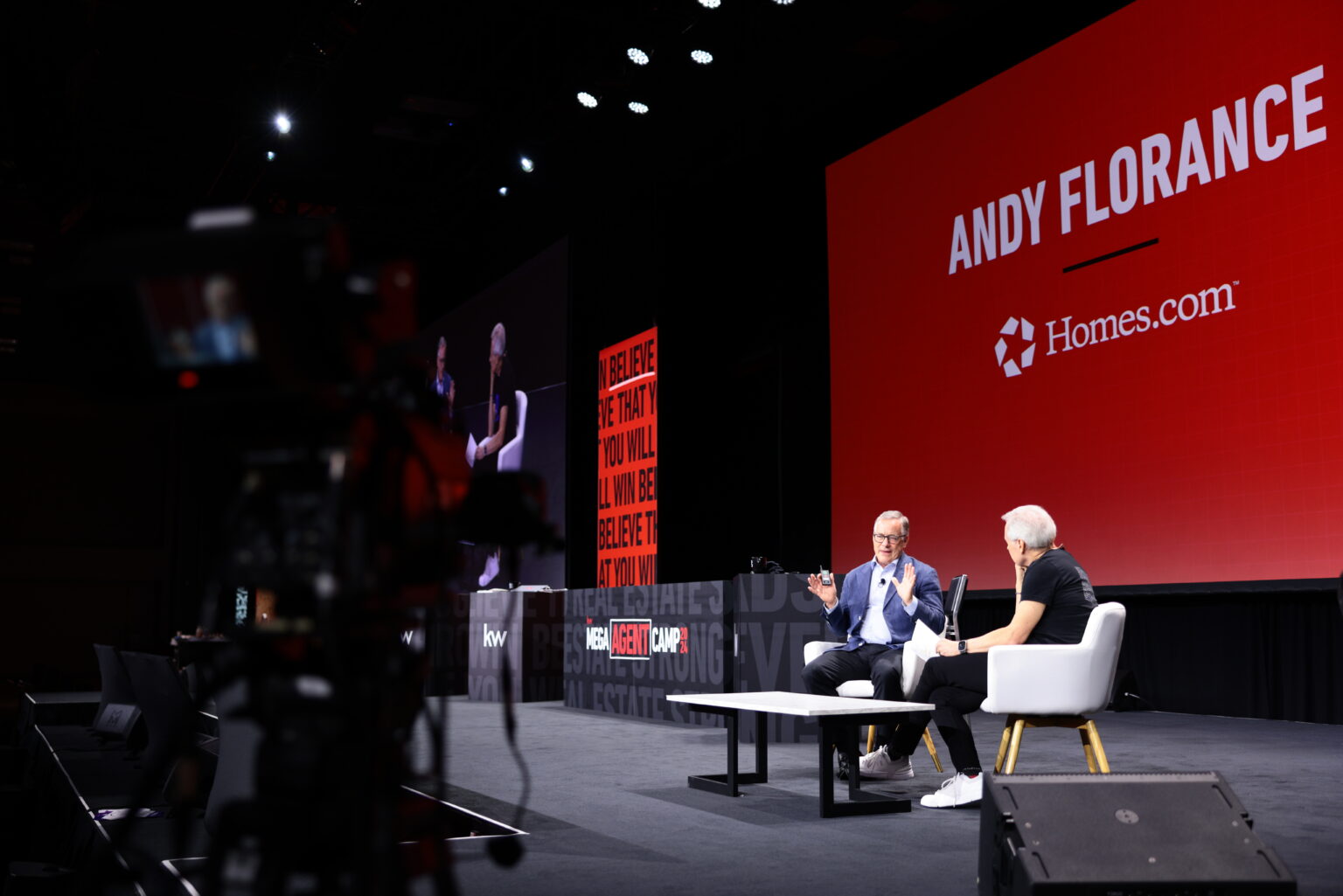
His pitch rests on a specific routing decision. Homes.com prominently identifies the listing agent and directs inquiries about the property to that agent. Florance argues that the professional entrusted with selling the house should receive the interest the listing attracts. The slogan is brief enough to fit on a sign: “Your Listing, Your Lead.”
In a 2024 essay, he connected that approach to agents’ reputations. A sign in a front yard tells the neighborhood who won the seller’s confidence. Online, the identity attached to a property can perform a similar function. Florance’s argument concerns who receives recognition, who answers the question and who gets the chance to turn an inquiry into business. Those are consequential choices concealed inside a small contact button.
The work behind the window
Florance has spent much of his career making information visible; collecting it remains an enormous part of the job. CoStar built its commercial research operation through calls, building visits and repeated checking. The polished search screen sits at the end of that work. The building itself does not obligingly send a correction when a tenant moves.
His residential push carries the same appetite for original material into neighborhoods. Homes.com has invested in photography, video and local information that help a shopper consider the area around a house. The practical question expands from the dimensions of a room to the character of the place outside its windows.
There is a personal stubbornness in the duration of this undertaking. Asked about his background in 2023, Florance reduced it to “37 years of doing this.” He also remembered washing dishes at Princeton; a fellow dishwasher, Tommy Chambers, later worked in technical services at CoStar. The company’s history includes people who knew its founder before the investor presentations.
“37 years of doing this.”
Andy Florance, describing his background in 2023
Persistence is easy to admire after the business succeeds. During the waiting, it looks rather less photogenic. Florance recalls his then-girlfriend’s parents suggesting that he find a real job. The recollection is funny because the enterprise eventually became large. At the time, an unfinished database was asking to be taken seriously.
Buying the next piece of the map
The acquisitions of 2025 show how far his definition of property information now extends. CoStar completed its purchase of Matterport in February. Matterport makes three-dimensional digital representations of physical spaces. A prospective visitor can move through a model of a building before traveling to its front door. The underlying information gains shape and depth.
A digital twin is still a representation, with all the responsibility that word implies. Its appeal is straightforward: a person choosing between spaces can inspect their arrangement in ways a conventional listing cannot provide. For Florance, it extends a career spent trying to put more of the building within reach of the screen.
In August 2025, CoStar completed its acquisition of Australia’s Domain. Florance described a plan to invest in content, tools and the customer experience while competing on cost. That was an ambition for the combined business, rather than a result to declare on arrival. Crossing an ocean brings a different market, established competitors and local relationships that must be earned.
Another purchase followed in August 2026: Zonda, acquired for $800 million in cash. Its information covers new-home communities, development activity, construction and builder operations; its marketplaces include NewHomeSource and Livabl. The reach now stretches toward homes still being built. The old question about an existing building has acquired a companion: what is coming next?
From a record to a room
- Property recordsWho owns it? What is available?
- MarketplacesWho is searching? Who should answer?
- Digital twinsHow does the space fit together?
- New-home intelligenceWhat is being developed?
An editorial map of the businesses, not a measure of revenue or market share.
Patience has shareholders
A founder can stay interested in a problem for decades. Public investors can reasonably ask how much each additional chapter will cost. In 2026, Florance faced criticism over spending on Homes.com. The disagreement exposed a familiar tension in his approach: the research, marketing and product investment arrives before anyone can know whether the eventual returns will justify it.
The 2025 financial results make the tension concrete. CoStar reported approximately $3.25 billion in revenue, up 19%, and $7 million in net income. Acquisition-related costs accompanied the expansion. Growing the business and producing substantial current profit are separate tests, and the difference becomes particularly visible when a company is financing several ambitions at once.
Florance’s next product argument concerned the way people search. Homes AI launched in February 2026, offering a conversational way to explore homes using natural language. His enthusiasm is consistent with the early computer work: another attempt to close the distance between a person’s question and the property information that might answer it. Whether people keep using it is a harder test than whether the demonstration impresses them.
Back to the campus, farther into the future
Education has remained part of Florance’s life beyond his original degree. He delivered Virginia Commonwealth University’s spring commencement address in 2019 and received an honorary doctorate. CoStar’s $2.5 million gift established an endowed chair in real estate analytics at VCU’s business school, joining the company’s practical concerns to academic research.
Princeton elected him a trustee in 2025. In April 2026, the university announced a major gift from Andy and Heather Florance for its Quantum Initiative. The program brings together researchers in engineering, chemistry and physics. The announcement did not put a price on the gift. Its subject was a long way from a property listing, while remaining close to Florance’s interest in what computers might eventually make possible.
There is a pleasing circularity to that choice. A student once worked to get the facts about a city onto a personal computer. Decades later, he is helping his university explore a different frontier of computation. Between those points lie paper directories, databases, marketplaces and buildings reproduced in three dimensions. Florance is still occupied by the possibilities of a better view.
Keep the conversation going
- CoStar Group
- Florance on LinkedIn
- His writing on agents
- The early years
- The original data experiment
- VCU and real estate analytics
- The Matterport acquisition
- The Domain acquisition
- The Zonda acquisition
- Princeton’s quantum announcement
- The Homes.com investment debate
- Watch: Glennda Baker interview
- Watch: 2019 VCU commencement
- Watch: Baron Investment Conference
Related company accounts: CoStar on X · Facebook · LinkedIn