Imagine a commercial real estate advisor approaching the next deal with an unusual question: has the brokerage already collected enough? At eXp Commercial, that question has a numerical answer. Under its standard U.S. arrangement, the company takes 20 percent of an advisor’s commission until its share reaches $20,000 in an anniversary year. Then the split stops. The buildings keep changing hands.
- The work: commercial sales, leasing, advisory and business brokerage.
- The offer: shared technology and support, an independent brand and a capped brokerage split.
- The catch: recurring fees, transaction costs and a pipeline the advisor must still build.
There is a small theory of professional life hiding in that arrangement. A productive broker needs infrastructure, but does every additional dollar of production require another dollar’s worth of brokerage? eXp Commercial has built a business around answering that question with a ceiling.
The $100,000 turning point
The arithmetic is straightforward. At an unmodified 80/20 split, $100,000 in eligible commission produces the $20,000 brokerage contribution. After that point, the advisor retains the commission split for the rest of that anniversary year. This is commission income, not the value of properties sold.
The cap is only one line on the bill. The published U.S. offer lists a $500 monthly cloud fee, a $250 transaction review fee and a $100 risk management fee, with the latter capped at $1,000 annually. Twelve monthly fees amount to $6,000 before the advisor pays for the rest of a personal practice. Mentoring and post-cap transaction terms also matter.
Once the cap is reached, the split contribution stops for that anniversary year. Other charges continue.
This favors an advisor who can produce. Someone with an established book can spread fixed costs over more business. Someone waiting for a first closing cannot. Commercial transactions can take a long time, while a monthly bill arrives with admirable punctuality.
The client still needs a local expert
Glenn Sanford brought the virtual model he had used in residential real estate into commercial brokerage in 2020. The parent’s 2020 annual report dates the launch to November and identifies James Huang as the president hired to build the operation. By the end of 2021, it was open in all 50 states, with 571 commercial advisors, up from 23 the previous year.
For clients, the work is reassuringly tangible. An owner wants to sell a building. A tenant needs space with workable lease terms. An investor needs help assessing an acquisition. Advisors provide investment sales, buyer and seller representation, and landlord and tenant services across properties including offices, industrial facilities, retail and multifamily buildings.
The Business Broker Division widens the assignment beyond real estate. It supports company acquisitions and sales, valuations, franchise resales, mergers and acquisitions, and succession planning. A business owner’s exit can involve more than handing over the keys.
Clients can search listings or look for an advisor by specialty. They should still examine that person’s relevant experience. A nationwide platform supplies reach; knowing the tenant down the road remains a different kind of knowledge.

Buy the plumbing together
The platform’s practical appeal becomes clearer in its software bundle. CoStar supplies property intelligence. Buildout handles commercial marketing and customer relationships. Canva Enterprise supports presentations; AIR CRE supplies contract templates; SkySlope manages transactions. These are tools for different jobs that an independent practitioner would otherwise have to assemble.
A CoStar enterprise agreement was announced in December 2024. The expanded bundle became available in February 2025, alongside LoopNet listing discounts. The company’s subsequent review also described a refreshed brand, new team structures and an on-demand university covering subjects such as underwriting and business development.
The direction is instructive. Removing office overhead leaves a question about what the brokerage provides in exchange. Data, transaction support and education give the fee a concrete job. Advisors can retain their own brand while sharing that infrastructure.
“Our business grew 150% in our first year with eXp Commercial.”Holly Carver and Lisa Earnhardt, Rocket City Commercial, in a company-published testimonial. An individual result.
The introduction is the product
Then there is the neighboring business: eXp Realty. Residential agents encounter clients with commercial needs, from business owners to investors. A referral system connects those agents with commercial advisors, with a referral fee payable when a deal closes.
In a July 2026 account, eXp Commercial reported more than 185 deals closed through that residential referral network during the second quarter. That is a company-reported result for one channel, rather than the brokerage’s total transaction count.
The useful detail is that access does not distribute trust automatically. Advisors must become people the residential agents remember and recommend. The copyable lesson for another service company is specific: connect adjacent customer needs, make introductions easy, and attach an incentive to a completed outcome.
Revenue sharing adds another incentive, rewarding eligible advisors for the sales activity of productive people they sponsor. Equity opportunities add ownership exposure. Neither replaces the client work that generates the underlying commission.
A cloud with a conference badge
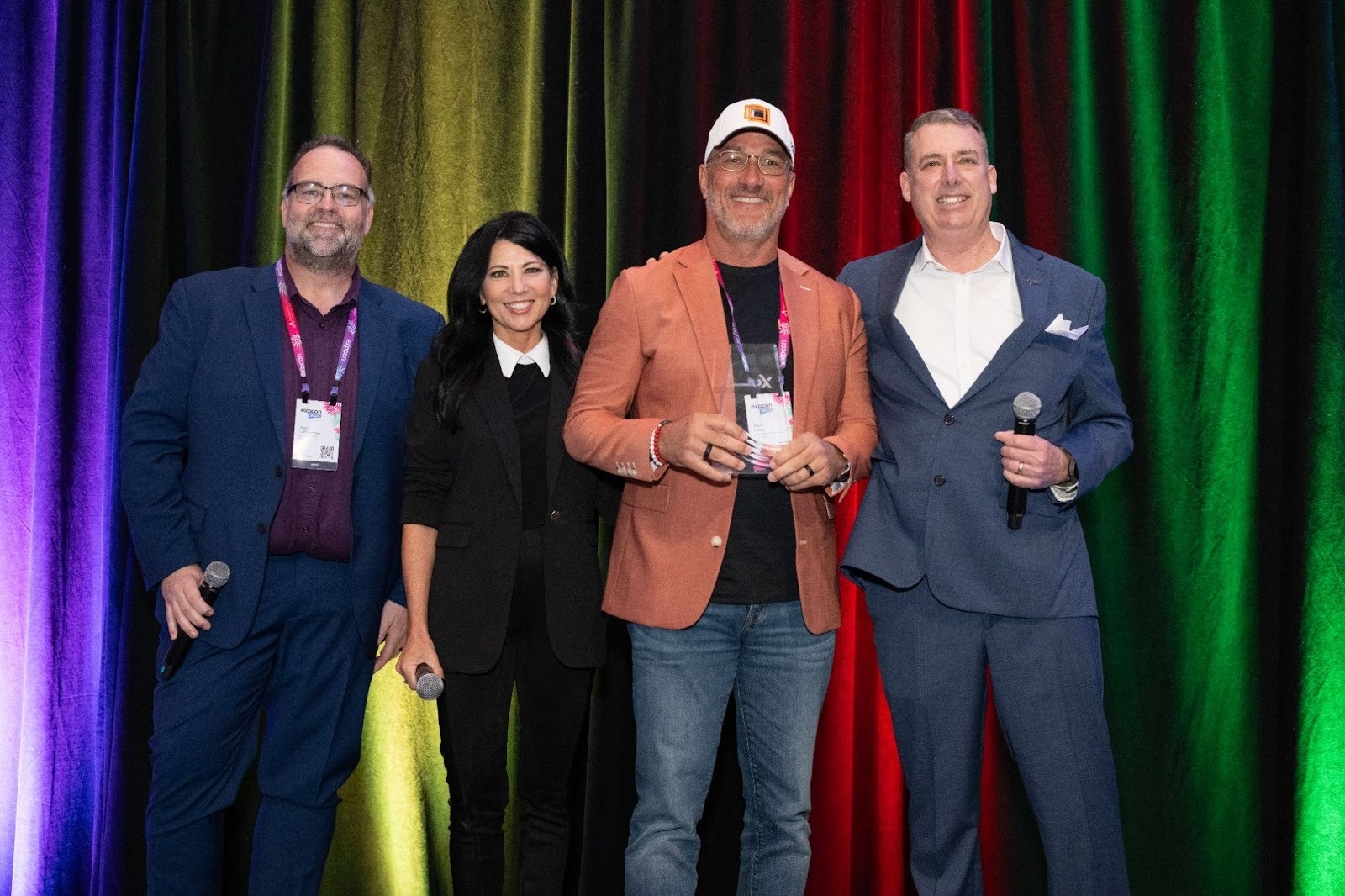
The virtual brokerage also gathers in person. Its first full-day eXpCOMMCON took place in Miami in October 2025, with market analysis, specialty discussions and recognition for producers. The same month brought a UK commercial launch and an Ontario expansion announcement. Local compensation arrangements differ; the U.S. split should not be carried overseas by assumption.
Against alternatives such as an independent shop, SVN or RE/MAX Commercial, eXp’s pitch centers on portable infrastructure and advisor economics. The fit depends on how someone works. A practitioner who needs daily supervision or a supplied pipeline may find autonomy less useful. A client should choose for assignment expertise, regardless of the commission arrangement backstage.
The experiment is easy to understand: pool the expensive tools, cap the brokerage’s split and let advisors build relationships under their own names. Its test happens at the next introduction, the next lease negotiation, and the next closing.