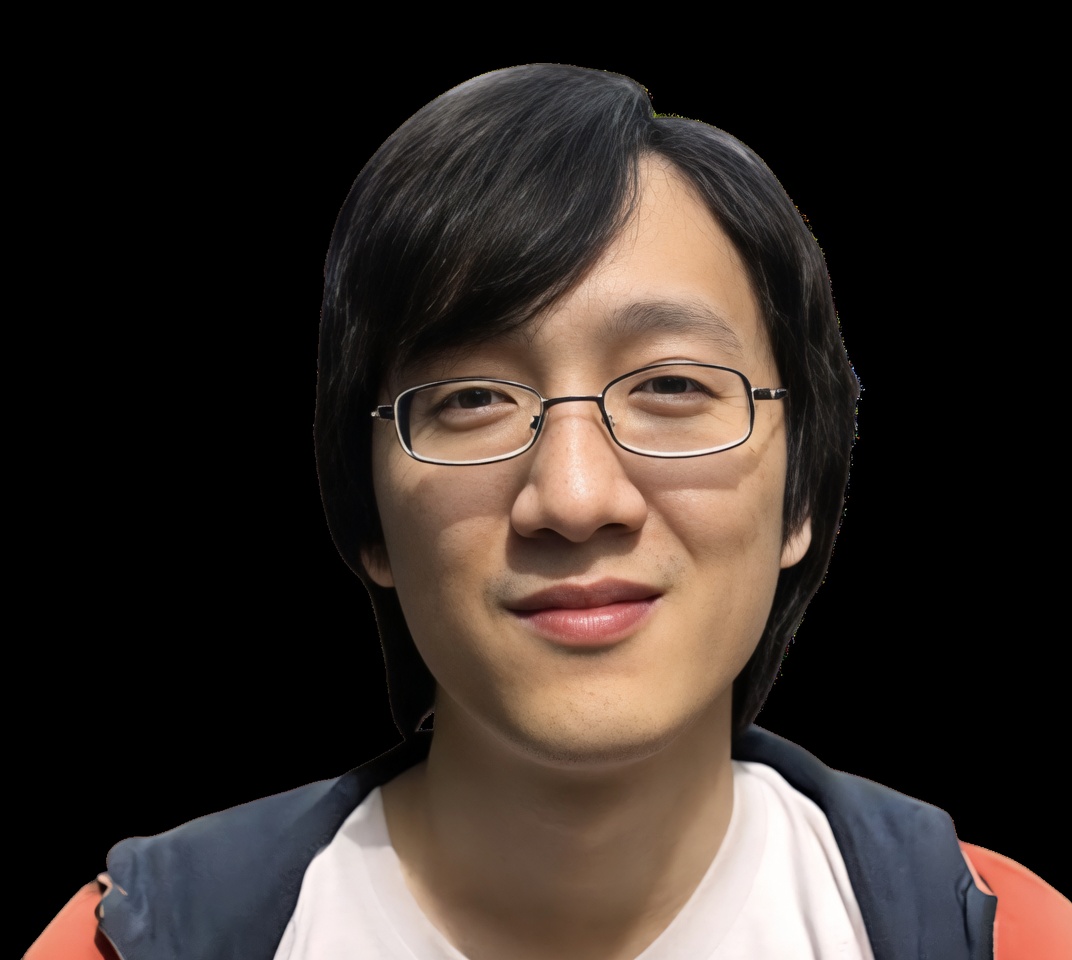
From Gene Sequencing
to Anime AI
Before Cory Li was training neural networks to render anime portraits, he was studying phage display - a method for engineering proteins by letting viruses do the selection work. He published on it in 2012. He patented an automated DNA assembly process the same year. The math of both fields is the same: you define a search space, you constrain it with signal, and you let the system find something interesting. The domain just changed.
MIT's course numbering tells you something. Li took Course 6 (EECS) and Course 20 (Biology and Bioengineering) - not sequentially, but together. That dual identity - the engineer who thinks in organisms, the biologist who thinks in code - shaped everything that followed. When he co-founded Benchling in 2012 straight out of school, he wasn't building biotech software as an outsider. He understood what scientists needed at the bench level, and he built tools that eventually became the standard for life science R&D globally.
The Second Founding
Benchling (YC S12) was the proof of concept: you could take a gnarly scientific domain, apply serious software thinking, and build something that became genuinely indispensable. By 2015, Li had stepped back from the company he'd co-founded. The next problem he was looking for had to be harder. He found it in a place that had no obvious overlap with synthetic biology: anime.
In 2017, Li co-founded Spellbrush with Haitao Mao and Ruwen Liu. The premise was almost conspicuously non-commercial: make anime real. Not market research. Not a validated beachhead. Just an obsession with a medium, and a conviction that AI could unlock creative possibilities inside it that no human studio could match at scale.
WaifuLabs was the first product - a GAN-based anime portrait generator that arrived years before the generative AI boom made such things unremarkable. This was 2018. The attention this is getting now? It was Spellbrush doing this work years earlier, in relative obscurity, on a budget that started with a $130,000 seed round from Y Combinator.
The Midjourney Partnership
The moment that changed everything came with niji-journey. Spellbrush partnered with Midjourney - the dominant AI image platform of the early 2020s - to build an anime-specialized fork of their model. The collaboration put Spellbrush's deep anime AI research into the hands of millions of users who had no idea a 31-person San Francisco studio was powering their art.
niji-journey is not a reskin. The V7 release runs approximately 23 billion parameters, fine-tuned specifically for the distinct aesthetic requirements of anime: clean lineart, character consistency, the particular color palette logic of the medium. Getting a general-purpose image model to produce convincing anime is one problem. Getting it to maintain stylistic coherence across generations, at that scale, is a different problem entirely. Li's team solved both.
What makes this genuinely unusual is that Spellbrush is, at its core, a games company. The AI research arm exists to power the games. Arrowmancer - an anime gacha RPG built on the WaifuLabs engine - was the first major proof: a game where players design their own characters using generative AI, with vector decomposition on GAN latent space driving the character creation system. The AI isn't a feature. It's the game.
The Quiet Infrastructure Play
The Silicon Valley version of this story would be louder. There would be a Series B deck. A re-branding. A "platform" announcement. Li runs things differently. His personal website, cory.li, is four pages. His primary contact is his Twitter handle, @Cixelyn - an old gaming alias that predates the company by years. The studio's legal entity is SIZIGI Inc., a name that doesn't appear in any of the marketing.
This is not modesty for its own sake. It's a particular kind of focus: the work is the thing. Spellbrush's niji-journey mobile app was still receiving active updates in April 2026. The hiring page lists openings for LLM engineers, Unity engineers, AI infrastructure engineers, and AI researchers - across San Francisco, Tokyo, and remote. The studio is actively scaling the infrastructure required to make anime real, not the brand required to announce it.
Li is also a resident at Stochastic Labs, the San Francisco residency program for high-risk technical projects. The overlap with Spellbrush is not accidental - the work Spellbrush does on large-scale GPU clusters for generative anime models is exactly the kind of hard infrastructure problem Stochastic Labs was built for.
Academic Record
Li published three peer-reviewed works at MIT: phage-displayed peptide library diversity research (Molecules, 2012), identification of parasitic sequences in phage display screening (Nucleic Acids Research, 2013), and a WIPO patent for automated BioBrick assembly using bead-based purification (2012). He was a research scientist before he was a startup founder.
The Long Game on Anime
The operative question is why anime specifically. Not generative art broadly. Not character design broadly. Anime - with its specific visual grammar, its fandom infrastructure, its unique relationship between studios, artists, and global audiences.
The answer is probably the same one that explains why Benchling built for scientists rather than some adjacent category: Li works inside communities he understands from the inside. Spellbrush's description of its games - "a no-compromise approach to well-balanced gameplay married to a truthful love of visual arts" - is not a marketing line. It's a constraint specification. The word "truthful" is doing real work in that sentence.
The bet is that anime, as a medium, is structurally underserved by existing game production tools. Character creation, visual consistency across large rosters, localization of art styles across markets - these are hard, expensive, slow problems for traditional studios. Spellbrush is building the infrastructure to make them cheap and fast, from the inside of the medium, not from the outside looking in.
From phage display to neural networks. From Benchling's pipettes to Spellbrush's GPU clusters. The through-line is the same: find the domain where the hard technical problem and the genuine human need intersect, and build something that the domain couldn't have had before. Cory Li has done it twice. The second attempt runs on 23 billion parameters and draws anime for millions of people who have probably never heard his name.