Rosie Bristow had found the farmers. That ought to have been the difficult part. Studying fashion and textile management at Heriot-Watt University, she wanted to make linen from locally grown flax. An Instagram conversation brought an offer of a hectare’s harvest in Essex. Then came the less photogenic discovery: Britain lacked the small and medium-scale processing infrastructure her idea needed. A field full of raw material could still leave her with nothing to sell.
- Converge helps Scottish university founders turn ideas into business propositions.
- Training is free; its competitive prizes take no equity.
- The homework covers customers, costs, intellectual property and routes to market.
01A field of flax, a missing factory
Bristow and co-founder Nick Evans began building flax-processing machines, consulting Victorian textbooks. An Innovate UK grant and Converge prize money helped establish their East Lothian micro-mill. Bristow won the 2023 Create Change Challenge. The business, Fantasy Fibre Mill, offers a pleasingly unfashionable lesson about fashion: sometimes the obstacle is an actual missing machine.

This is a good place to meet Converge. Its work happens where an attractive idea encounters the awkward requirements of a business. Those requirements might involve equipment. They might involve finding a customer, negotiating intellectual property rights or learning what a financial forecast is supposed to forecast.
02The invention is only half the job
Dr Olga Kozlova founded Converge in 2011 to help academics make that transition. Operated by Heriot-Watt University, the programme works across Scotland’s universities. Its users are staff, students and recent graduates, including people whose qualifications prepare them superbly to invent something and less thoroughly to sell it.
The distinction matters. A research result establishes that something can work. A business proposition must explain who needs it, why they would pay, how it reaches them and what delivering it costs. Converge puts those questions into a structured course of training, peer contact and competitive assessment.
It occupies an early part of the startup support market, alongside university enterprise teams and technology-transfer offices. Its partner network includes Scottish Enterprise and Techscaler. Founders can move between these services as their needs change; the relationship is often cooperative. Converge’s particular advantage is assembling academic founders across institutions around a shared commercial learning process.
03Four doors into the same difficult room
The main challenge pathways distinguish stages and purposes. KickStart helps founders test early ideas. The flagship Converge Challenge expects stronger intellectual property foundations and commercial validation. Create Change welcomes creative, cultural and social-impact projects. Net Zero’s 2026 focus is energy-transition innovation. A linen mill can therefore enter the conversation without pretending to be a software company.
The process imposes deadlines. In the 2026 flagship pathway, founders received online modules, regional sessions and intensive training before submitting a business plan, financial forecast and one-minute video pitch. Finalists then undertook investment training and pitched to investors and business experts. Entrepreneur Business School delivers training; professional partners bring legal, accounting, intellectual property, software and product-design expertise.
There are practical conditions. The flagship applicant needs a qualifying university connection, commercial rights to the relevant intellectual property and a plan to headquarter the business in Scotland. Attendance is mandatory. A capable scientist with no time for the sessions, or no permission to commercialise the research, has work to do before entering.
04Free to enter, expensive to build
Converge’s programme is free and takes no equity. Its model draws on university and public support, with commercial partners contributing expertise. In October 2025, it announced a £1.26 million Scottish Funding Council commitment for 2026-2028. That finances programme support; it is distinct from the money founders win.
Prizes can unlock another step. Bioliberty, developing robotic hand rehabilitation technology, used its £30,000 cash award from the 2021 Impact Challenge as part of the match funding for a Scottish Enterprise grant. Conversations with clinicians also revealed a stroke-rehabilitation application beyond the founders’ initial interest in helping people with neurodegenerative conditions.
“You don’t know what you don’t know”
Conan Bradley, Bioliberty · on learning through Converge
The lesson is specific: ask people who will use the product, then let their answers alter the plan. Training cannot manufacture demand. Prize money can finance an experiment, but a larger grant still brings its own application, criteria and obligations.
05A nose for the next chapter
In October 2026, Scensai won the flagship award with a handheld “electronic nose”. The University of Aberdeen venture is developing a sensor to detect chemical changes in drinks, giving producers a quicker way to spot quality problems. It received £50,000 cash plus business support. Across the awards, 20 innovators from 12 institutions shared a prize fund exceeding £410,000.
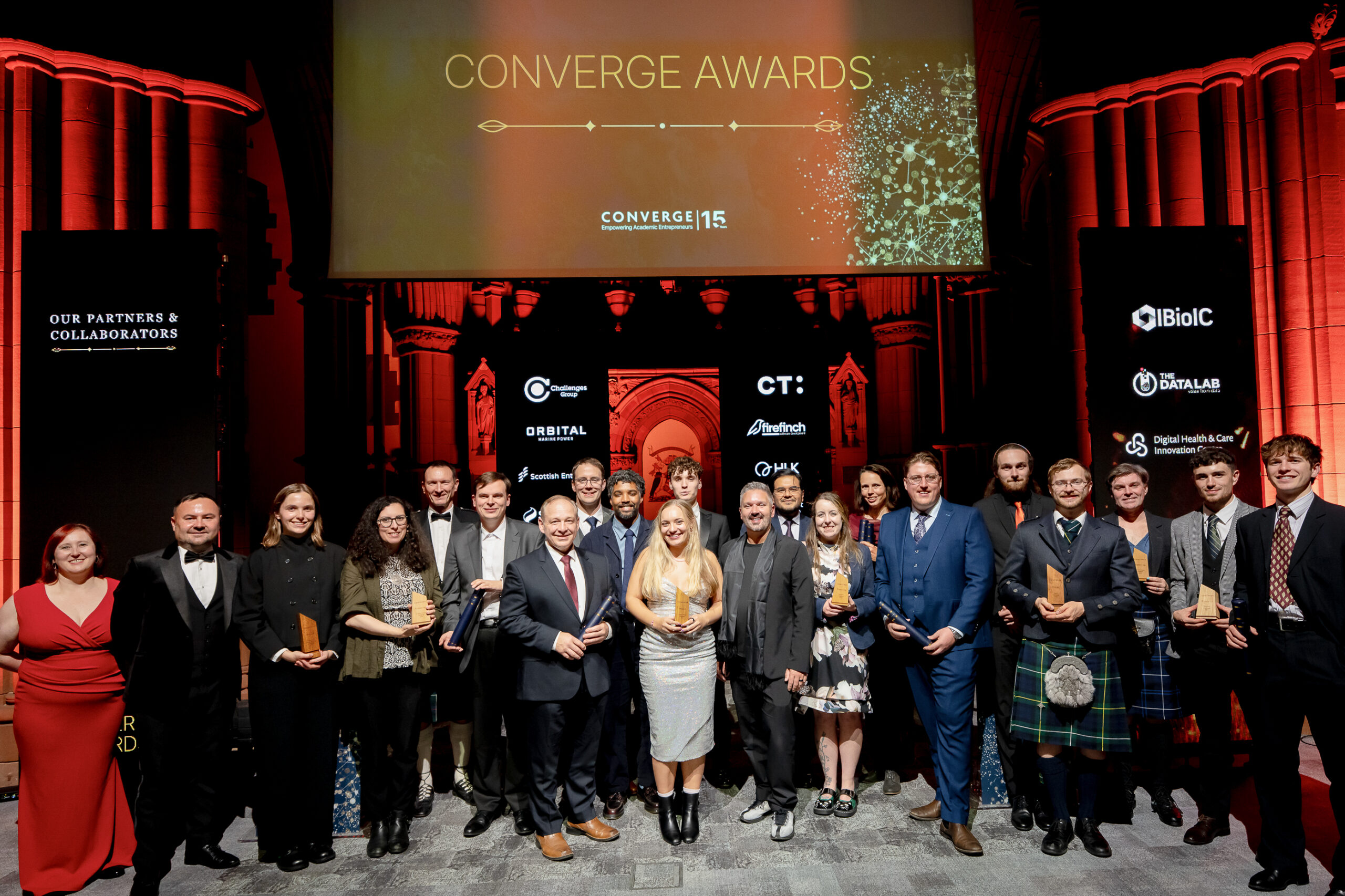
The programme’s reach is widening. Its first Space Challenge, with Space Scotland, welcomed ten projects in July 2026. Separate microfinance activity awarded £125,000 to 70 university and college innovators in March. Converge also plans a 2027 offering with more tailored pathways for ventures further along in development.
06Find the obstacle before the investor
A reader can borrow the sequence even without qualifying for Converge. Identify the customer. Test the route from invention to use. Name the missing resource. Build a forecast around that reality. Seek money for the next necessary step.
The sequence needs honest feedback and permission to change direction. It becomes less useful when a founder treats a prize as proof of demand, or when the cost of reaching market exceeds the resources available. Bristow’s missing machinery is the memorable detail because it makes the principle visible. Before a founder can sell the future, somebody may have to build the mill.
Explore Converge, its on-demand business workshops, microfinance news and professional partner network. Follow LinkedIn, Instagram, Bluesky, X or Facebook. Watch the 2018 social-enterprise finalists film.