A laboratory result can survive peer review and still have no customer. The experiment works. The business remains a hypothesis. Science & Startups operates in that awkward space, where a researcher must decide whether years of specialist knowledge could become something another person will actually buy.
Its opening offer is unusually plain: startup advice that costs nothing and takes no equity. Freie Universität Berlin, Humboldt-Universität zu Berlin and Technische Universität Berlin provide the joint service, in partnership with Charité. Together, they give founders a route into university facilities, mentoring, entrepreneurship training and public funding. A first conversation can begin before there is a company to introduce.
The proposition becomes more interesting when the technology is difficult. A chemistry venture needs somewhere to work with chemistry. A quantum founder needs people who understand quantum technology. Both also need to discuss prices, customers and who on the team is doing the selling. Science & Startups tries to put those conversations within reach of the same founder.
Consulting fees / equity taken for startup advice.
Public funding pays for the service.
A shared front door to three universities
The organisation grew from cooperation between existing startup services. Freie Universität’s sustainability report traces closer collaboration to 2016, the shared name to 2019 and a merger under joint management to 2024. Science & Startups lists 2020 as its founding year. This was a gradual assembly of institutions, expertise and support programmes.
That history matters because the network inherited resources that a newly opened accelerator would have to acquire or negotiate. The Berlin University Alliance describes access to approximately 1,700 potential scientific mentors and a community of roughly 130,000 potential co-founders. Those are pools of people across the universities, rather than a count of active startup participants. The opportunity lies in making a useful introduction within them.
Students, graduates, researchers and university staff form the natural audience. External founding teams can also find routes in. The programme matters more than the umbrella: the Berliner Startup Stipendium, for example, explicitly says a university degree is not required. Demonstrable skills and a suitable project still matter.
The first obstacle was thinking like a business
Early reporting on the network offers a less glamorous diagnosis of science entrepreneurship than a shortage of brilliant inventions. In 2021, Adlershof’s WISTA magazine described researchers spending too long optimising technology, overlooking team dynamics and struggling to focus on customers. Science & Startups representatives agreed that coaching and changes in working habits could address those problems.
The same report identified actual ventures receiving support: QoD Technologies, bringing AI and quantum simulation to chemistry researchers; Oculid, developing smartphone eye-tracking software; and Kopfsachen, working on young people’s mental health. These examples show the breadth of the service’s early constituency. They are historical examples, not a claim about those organisations’ current performance.
The response was practical: shared workshops, coordinated advice and help finding complementary co-founders. The lesson for a researcher is uncomfortable but useful. Technical progress alone cannot answer questions about demand or whether a team can work together. Those questions deserve experiments of their own.
Free advice has a public bill
Science & Startups’ business model starts with public support. Founders receive free, equity-free consulting; the service helps them identify grants and later meet business angels or venture investors. It also offers businesses and institutions research connections, events, training and access to entrepreneurial talent.
Two funding announcements reveal the scale of particular programmes. In June 2021, the federal economics ministry committed €6.85 million to a four-year AI entrepreneurship model project. It covered the sequence from finding commercial potential in research through feasibility work to acceleration, with industry involvement along the way.
In March 2026, the Berlin University Alliance announced approximately €8 million for a new Berlin Startup Scholarship funding period focused on democratic resilience, social stability and sustainable development. Berlin and the European Social Fund supplied the money. The previous round, running from July 2023 to November 2025, supported 38 teams and 137 recipients.
These are programme allocations, not venture rounds valuing Science & Startups. For a selected scholarship recipient, the more immediate number is €2,500 gross per month for up to 12 months. That can create time to develop a prototype and prepare for market entry. Funding buys an opportunity to do the work; the customer still has to be persuaded.
Programme budgets. These figures are not annual revenue or an investment valuation.
Learn to sell before polishing the pitch
The Science & Startups Academy gives the founder’s education an order. Its published sequence puts validation in months one to four, investor readiness in months five and six, and access to business and finance in months seven to twelve. Business-model refinement and market strategy precede the serious preparation for investors.
The 2026 workshop calendar makes that sequence tangible. Sessions address moving from a pilot to payment, usability testing, pricing, tax basics and financial planning. There are also workshops on conflict management and entrepreneurial wellbeing. The curriculum recognises that a founder can understand the product and still struggle with the company being built around it.
For someone using the service, the first move is a consultation. An adviser assesses the idea and possible support, then helps prepare the relevant application. Incubation includes business-model evaluation, a financing strategy and work toward pilot customers and follow-on funding. Match’em adds a way to look for collaborators. No single workshop supplies all of that; the value is in connecting the steps.
ValidateMonths 1-4 · Model, market, team
Prepare for investorsMonths 5-6 · Legal work and pitching
Build the businessMonths 7-12 · Pricing, compliance, deals
“We turn science into startups”
Science & Startups · its opening promise
A quantum company needs a different room
The network’s specialist programmes are its most persuasive answer to generic startup support. Leap brings quantum founders, researchers, companies and investors together in Berlin Adlershof, with workspace, events and the BERLIN QUANTUM Pioneer programme. The subject determines the people a founder needs nearby.
The xG-Incubator works with next-generation communications teams and the 6G Research and Innovation Cluster. Its offer connects business development and mentoring with technical expertise and laboratory access. A wireless-network venture has questions that a room full of generalist entrepreneurs may struggle to answer.
GreenCHEM addresses another set of physical requirements. Its work includes chemistry-specific infrastructure and analytics, alongside links between research, industry and startups. Shared expertise and suitable equipment make the idea of a university support network concrete. They help founders reach resources relevant to the technology they are trying to commercialise.
AI support has developed its own institutional geography. AI NATION combines the experience of Berlin’s K.I.E.Z. and AI+MUNICH. It separates a grant route before company formation from an accelerator after incorporation. That distinction lets founders seek help matched to their stage, whether they are testing a possible product or trying to grow an existing business.
Space joins the prospectus
A further connection was announced at ILA Berlin 2026: plans to expand ESA Business Incubation Centre Northern Germany into Berlin, with Science & Startups handling the local startup relationship. The announced expansion would connect the city’s research base with ESA technical expertise, business support and European networks.
The status is worth getting right: public regional reporting describes a planned expansion. Its significance is the direction of travel. The shared university service is adding another specialist route through which a research team might reach partners and a market.
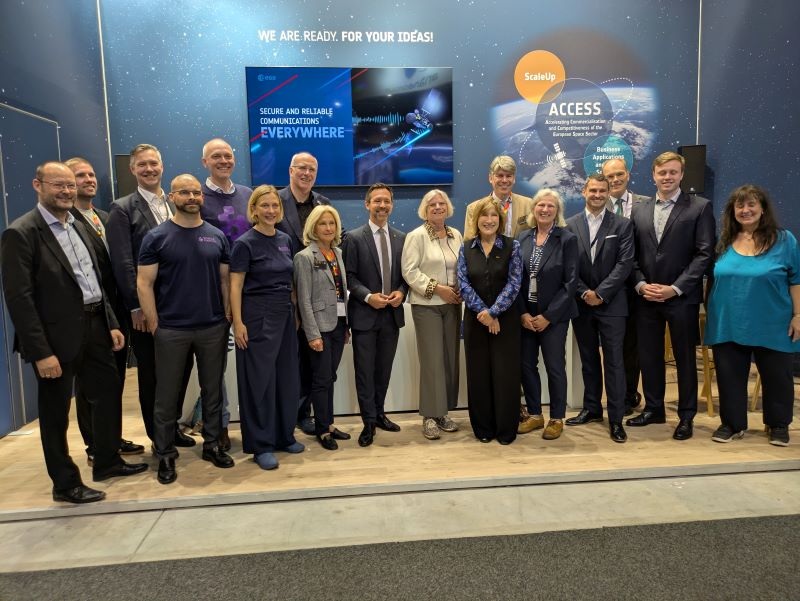
Science & Startups also reports placing twelfth in Europe in the Financial Times, Statista and Sifted startup-hub ranking for 2026. That offers visibility in a crowded market for founder attention. An applicant’s more useful test remains specific: can this network provide the adviser, facility, collaborator or funding route needed for the next stage?
The small print is part of the product
Free support has conditions. The Berlin Startup Scholarship requires a team of two to four founders, a registered main residence in Berlin and substantial participation on site. Its published FAQ specifies 35 hours a week. The stipend is personal support, not an employment contract. A founder who wants to remain elsewhere and participate casually should examine another route.
Stage matters too. AI NATION’s accelerator is intended for incorporated AI startups, while other programmes support earlier work. Research-heavy projects may fit EXIST Transfer of Research; life-science projects have a separate route through GO-Bio next. The useful service is matching a project to a programme before a team spends weeks pursuing an unsuitable application.
Alternatives include another university transfer office, a specialist accelerator or direct engagement with investors. These can be complementary. Science & Startups makes particular sense when the business depends on research knowledge and university resources. A founder principally seeking immediate growth capital should judge the available investor connections separately from the free advice.
A hundred words is a start
There is a modest entry point beneath the institutional machinery. The network’s 100 to 100 competition asks for a 100-word idea; five monthly winners receive €100 each. The invitation gives someone with an early thought a reason to write it down before attempting a full business plan.
The staff page supplies another small antidote to grant-language fatigue. Pepper, a dog described as a New York native, appears with the title “Senior Pawtnership Manager.” His responsibilities include morale and well-timed interruptions. Even an organisation connecting quantum science with entrepreneurship has room for a colleague whose main contribution is being pleased to see you.

For other universities, the copyable choices are specific: share access to existing resources, coordinate advice, teach customer discovery early and preserve specialist technical support. Those choices depend on participating institutions, sustained funding and founders willing to test their assumptions. For a scientist in Berlin, the immediate task is smaller: describe the idea, identify the next unanswered business question and book the conversation.