On a November day in 2010, Coleman Fung walked across a Berkeley auditorium stage without a podium or PowerPoint slides. He had discarded his prepared remarks. The occasion was the launch of an engineering leadership program, and its benefactor was making a confession. “Trust me - I’m not a people person!” he told the room. Then he urged the engineers to learn to communicate.
It was an appealingly awkward sales pitch. Here was someone who had built a software business telling technically accomplished people to get better at the part of work that resists a specification sheet: other people. The joke came with a substantial down payment. Fung had given Berkeley $15 million to establish an institute devoted to widening the engineer’s education.
Today, as co-founder and CEO of Blue Goji, he works with games, machines and the reasons people choose to participate. The distance from trading software to game controllers looks considerable. His public life offers a more interesting connection: a recurring willingness to leave the familiar room, followed by an urge to open a door for someone else.
A useful education in changing your mind
Fung arrived in New York from Hong Kong at 16, joining his father. English presented a challenge. His subsequent route through American education included physics at Rensselaer, an internship in a General Electric laboratory, and a discovery that a laboratory career did not appeal to him. So he left college and traveled across the United States.
The Army followed. He served three years on active duty, including work as a supply sergeant. His travels took him through Europe, Egypt and Israel. Before engineering became his profession, he had spent time among people whose lives had little to do with a university’s preferred sequence of prerequisites.
He eventually reached Berkeley, graduating in 1987 in industrial engineering and operations research. Stanford followed, with a master’s degree in 1989. On a résumé, these institutions can make the route look inevitable. Put the abandoned physics course and Army years back in, and the picture becomes less tidy and more useful. A change of mind had been part of his education.
- 1987Berkeley
IEOR degree - 1992OpenLink
Software founder - 2010Fung Institute
Leadership education - 2013Blue Goji
Public introduction
The trader who wanted the parts to talk
Wall Street supplied a different kind of classroom. Fung’s work included Salomon Brothers’ Bond Portfolio Analysis Group and Chemical Bank’s product development and derivatives trading groups. At Fuji Capital Markets, he helped establish the trading team and build its infrastructure. He was close enough to the work to know where the software disappointed.
He spent five months looking unsuccessfully for a single product that met his requirements. In 1992, he founded OpenLink. The business addressed trading and risk management across markets, bringing together functions that were commonly separated. For a trader trying to understand an interconnected set of positions, software boundaries could become practical obstacles.
A customer crisis tested that premise. After the 1996 Sumitomo copper trading scandal, JP Morgan needed changes to its credit-risk software. OpenLink adapted. Fung later recalled the imbalance of scale: “We were a small company working with a giant.” The description contains much of the early software business in one sentence. The giant has requirements. The small company has a calendar and an incentive to answer the telephone.
When Chase bought JP Morgan in 2000, OpenLink faced the possibility of losing that relationship. Instead, JP Morgan demonstrated the software, and Chase adopted it for commodities. By 2004, OpenLink had 280 employees and more than 90 installations serving 50 clients. Those figures belong to that moment, before the company’s later expansion. They show how far a trader’s unsatisfactory software search had traveled.
Fung remained CEO until April 2007, then continued as executive chairman and led research and development. The company won Platts’ inaugural Risk Management Innovator of the Year award that year. The history gives his later educational interests a practical foundation: technical work, customers and organizational decisions had occupied the same working day.
Fifteen million dollars for the space between subjects
By 2006, Fung had put $18 million into his foundation to support education and environmental causes. He wanted his children to become involved when they were older, and hoped his example would encourage other prosperous Asian Americans to give. Philanthropy, in his telling, had a social dimension as well as a financial one: participation could spread.
His Berkeley commitments ranged across fields. He supported East Asian studies, economics research and endowed engineering chairs. In 2011, he received the UC Berkeley Foundation’s Chancellor’s Award. A photograph accompanying a later account of his giving shows him in a suit and hat, holding his dog Pearl. University benefaction rarely gets a better accessory.
The institute bearing his name launched in January 2010. Its educational proposition joined technical depth with communication, teamwork and project management. The Master of Engineering program was designed to put leadership study beside specialized engineering, with a team capstone bringing students into contact with practical problems and mentors.
There is a recognizable OpenLink concern here, although the institution and the business do very different work. Specialization produces useful expertise; boundaries can make applying it difficult. An engineer may understand the mechanism perfectly and still need to persuade a colleague, weigh a budget or explain a consequence. Fung was spending money on the connective tissue.
“Imagine you are the ladder, and you are helping people get up there.”
Coleman Fung, 2025 alumni leadership remarks
The homework gets a vote
In fall 2016, the Fung Fellowship extended his educational experiment to undergraduates. Its founding ambition was to make learning resemble the world students would enter: interdisciplinary teams, community partners, open questions and a meaningful role for students in shaping their own experience.
The program’s own history calls Fung a “resident troublemaker.” It is a useful title for a benefactor who wanted to alter the student experience. The fellowship asks participants to help design their learning, giving them responsibility before the course has supplied every answer. A conventional assignment arrives with instructions. This arrangement requires students to help decide what the assignment ought to be.
In 2020, a conservation track joined the program through a partnership with Berkeley’s Rausser College of Natural Resources and Blue Oak Ranch Reserve. Different disciplines could meet around a shared problem. The underlying aspiration remained legible: give students practice working with people who possess different knowledge, and let that difference affect the result.
A controller attached to a new problem
Blue Goji brought Fung into another collaboration. His fellow founders, Kai and Charles Huang, had co-founded RedOctane, the company behind Guitar Hero. Where Fung’s earlier company connected trading functions, this venture would connect software with physical controls and an activity beyond the screen.
The company was publicly introduced in July 2013, with Kai Huang serving as CEO at the time. The founders’ backgrounds mattered: they brought experience making a specialized interface understandable and enjoyable. A plastic guitar had already demonstrated that the object in your hands could change your relationship with a game.
Goji Play arrived commercially that December at $99. Wireless controllers could attach to existing machines; a movement sensor and an Apple mobile device completed the arrangement. A dozen games were available at launch. Players’ movement influenced what happened onscreen. Ordinary equipment acquired a second occupation as a game interface.
In April 2022, Blue Goji acquired the assets and intellectual property of Interactive Fitness Holdings, adding Expresso and CyberCycle bikes. Fung was CEO by then. The deal brought steering, shifting, changing resistance and community tournaments further into the company’s product world. His responsibilities now included an existing population of customers and machines, along with the software that connected them.
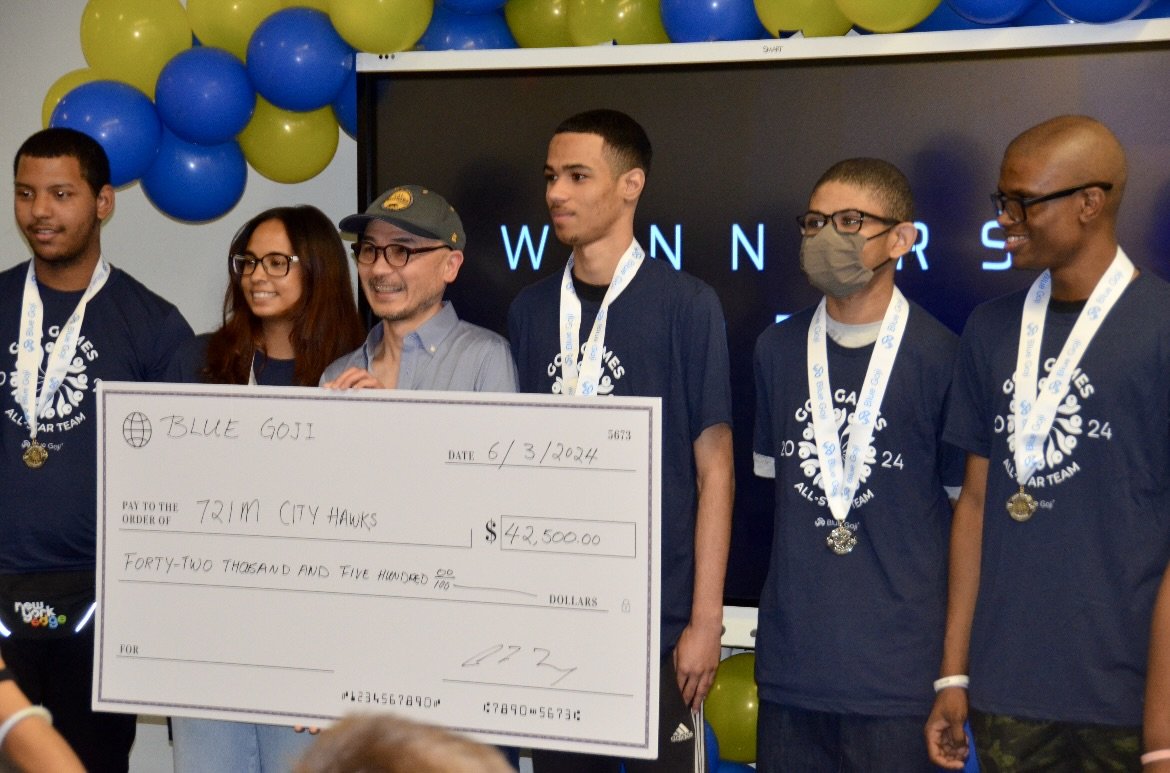
In June 2024, he visited the City Hawks in New York to celebrate their win in the inaugural Goji Games. The team had earned $42,500 for its school. The photograph is pleasingly concrete: medals, balloons, competitors and a check too large to slip into a pocket. The founder is standing among the people using the system.
The company’s 2026 Rally materials describe more than $1.8 million raised across the YMCA campaign’s history and over 48,000 rider participants. These are community campaign totals, rather than a measure of Fung’s personal giving. They extend the same practical question into another setting: what happens when participation can contribute to something shared?
The technologist who keeps an eye on the exit
There is an intriguing tension in Fung’s work. He helps build engaging virtual experiences and has also questioned the attention demanded by online platforms. In 2019, he reached for The Matrix to describe users feeding systems that profit from their activity. He wanted engineers to consider what their inventions did to people’s freedom to experience the world.
He described meditation as a practice he sometimes turned to when a difficult problem resisted an answer. He also connected it with storytelling: absorption in a good story could leave little room for distraction. His concern was the intention behind a technology and the consequences of building it. He explicitly said he did not have all the answers.
By 2025, his leadership advice at a Berkeley alumni gathering had taken the form of a ladder: imagine helping other people climb. It is a modest image for someone whose career has included financial infrastructure, game systems and an engineering institute. It also assigns a job. A ladder is useful because somebody else can go somewhere.
The young immigrant who left physics did eventually build a substantial technical career. He also kept making room for another subject, another collaborator, another way to learn. His story leaves an unusually practical invitation: become good at something, then remain interested in what your expertise leaves out.
Follow the next question
- Blue Goji / company website
- Coleman Fung / Berkeley profile
- Watch: Preparing Engineers for Leadership
- Watch: Coleman Fung’s leadership spotlight
- A conversation about engineering and attention
- The City Hawks celebration / Blue Goji blog
- Fung’s early philanthropy / Inc.