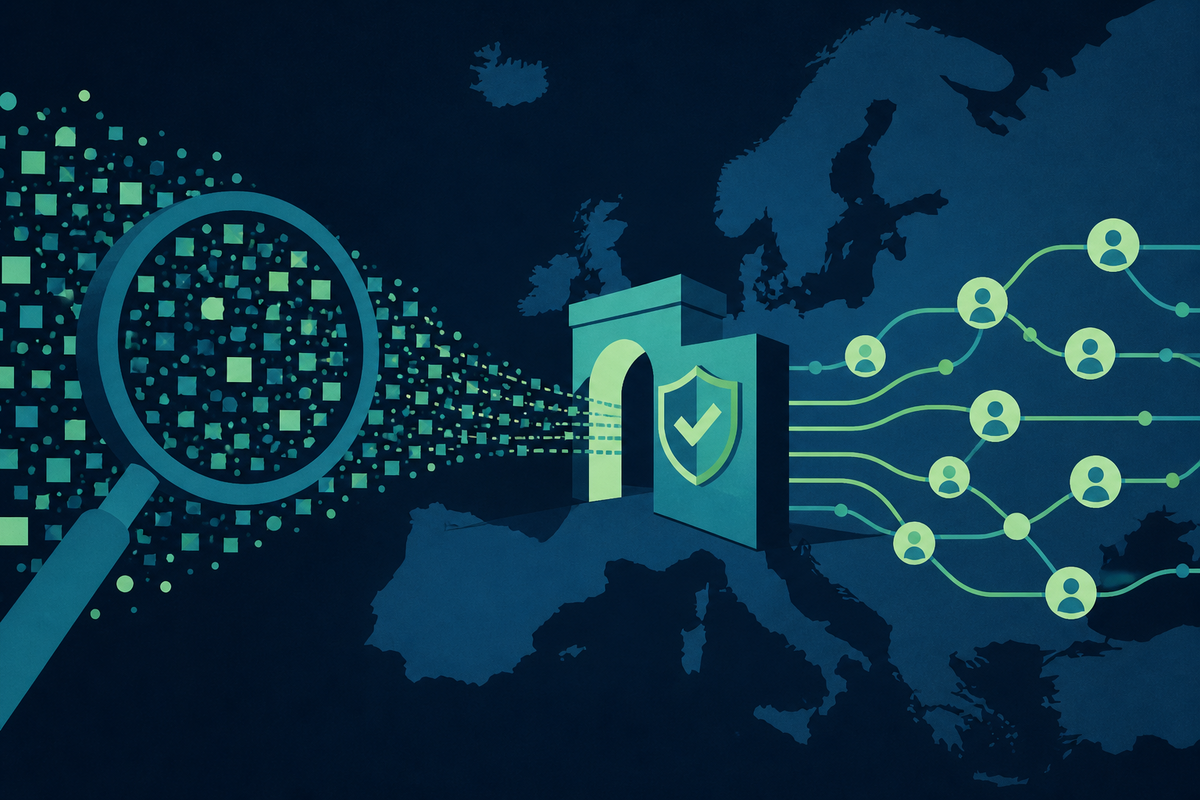
The easiest way to understand Cognism is to borrow the category leader’s name. It is ZoomInfo for companies that look at Europe and see more than another sales territory. They see GDPR notices, national do-not-call registers, language differences, local expectations and a legal team asking where every mobile number came from.
That shorthand is blunt, and Cognism has earned it. The London company sells the familiar machinery of B2B sales intelligence: search for a company, identify decision-makers, reveal business emails and mobile numbers, enrich a CRM and watch for signs that an account may be ready to buy. ZoomInfo does those jobs too, wrapped in a broader go-to-market suite with deep North American roots.
The difference is the center of gravity. Cognism was founded in Britain in 2015 and made Europe’s fragmented data environment its wedge. Its product language begins with accurate, usable EMEA contacts and moves quickly to Article 14 notifications, opt-outs and screening against national calling-suppression lists. The pitch, stated without varnish, is “ZoomInfo, but compliant for Europe.”
Compliance is a workflow, not a sticker
There is an important correction hiding inside that pitch. ZoomInfo does not claim exemption from Europe’s rules. Its privacy policy says it complies with applicable international privacy laws and addresses rights for people in the European Economic Area, Britain and Switzerland. A buyer should be suspicious of any comparison that turns this into compliant versus illegal.
Cognism’s sharper argument concerns defaults. The company says it notifies people when they enter its database, offers a privacy center for access and deletion requests, and screens phone data against national do-not-call lists in 15 countries. Its own comparison page says ZoomInfo checks eight. Those figures come from Cognism, so procurement teams should verify current coverage and contract language with both vendors. Still, they reveal the strategic split: Cognism treats country-level governance as a headline feature.
A contact record is useful only when a rep can act on it and the company can defend how it got there.
This matters because GDPR is only one part of outreach. A lawful basis for processing personal data does not automatically settle whether a particular cold call or email is allowed in every market. Channel rules, national law, suppression registers and the specifics of the message still count. Software can reduce the surface area for mistakes. It cannot outsource judgment.
That limitation is also why Cognism’s design makes commercial sense. Compliance rarely wins a product demo on its own. It wins when it shortens a security review, keeps a suppressed number away from a rep, or gives a sales manager a credible answer after a prospect asks, “Where did you get my details?”
The database is only half the purchase
Sales-intelligence vendors tempt buyers into counting records. A larger database feels safer because every empty result resembles a missed deal. But the useful denominator is not records stored. It is records that match your ideal customer profile, remain current and can be used through the channels your team actually works.
Cognism pushes phone-verified mobile numbers, which it brands Diamond Data, as an answer to that problem. Human verification is expensive and narrower than indiscriminate collection, but a correct direct dial can be worth more than a dozen stale contacts. ZoomInfo takes a broader platform approach, pairing contact data with intent, marketing and workflow products. The right trade depends on whether a company wants a focused data layer inside its existing stack or a larger set of go-to-market capabilities from one vendor.
Conceptual map, not a performance score: ZoomInfo emphasizes suite breadth; Cognism emphasizes a focused European data layer; local rules shape both buying decisions.
There is a second cost hiding downstream. Bad contact data does not stay in the prospecting tab. It enters Salesforce or HubSpot, triggers sequences, distorts routing, creates duplicates and gives forecasting systems a false picture of the market. Data quality is operational hygiene. Cognism’s integrations with major CRM and sales-engagement tools matter because enrichment is valuable only when it improves the system of record rather than creating another island.
The company itself has changed with that insight. Its early backers described a machine-learning platform that connected company news with lead data. In 2022 it acquired Kaspr, a French prospecting tool, and raised Series C funding. Dominic Allon replaced founder James Isilay as chief executive in 2024. By 2026, Cognism was talking about “data fluency,” a phrase meant to move the story beyond possessing records toward knowing which ones to trust and when to use them.
That evolution also explains why a comparison based only on a browser extension misses the point. The extension may be where a rep experiences the product, but procurement buys the machinery behind it: refresh cycles, source documentation, administrator controls, API access, field mapping and deletion handling. One incorrect record is annoying. A process that repeatedly creates incorrect records is infrastructure debt.
Europe makes that debt visible early. A record can move through several systems and countries before the first message is sent. Marketing may build the audience, an enrichment service may append a phone number, the CRM may assign an owner, and a sales-engagement tool may launch the sequence. Each handoff needs an owner. The most valuable compliance feature is often the dull one that preserves an opt-out or provenance field across those handoffs.
Make the vendors compete on your map
A generic feature grid will not settle this choice. A team selling cybersecurity into Germany faces a different verification and calling problem from a recruiter covering Texas. Even within Europe, British, French and German campaigns can produce different answers. The sensible evaluation is a controlled test using the same accounts, people and success criteria.
A buyer’s bake-off worth stealing
- Build a blind list of target accounts across the countries and segments that produce revenue.
- Ask each vendor to return the same roles, then measure verified mobiles, valid emails and stale employment records.
- Check how national suppression, opt-outs and data-subject requests flow into daily rep behavior.
- Import a small sample into the CRM and count duplicates, field conflicts and manual cleanup.
- Price the real workflow, including regional data, integrations, verification and expected usage.
Insist on evidence at each step. Cognism publishes customer accuracy claims and geographic comparisons, but they are vendor marketing, not universal benchmarks. ZoomInfo’s scale and product breadth are equally unhelpful if the contacts a particular team needs are missing. A live sample exposes both kinds of abstraction.
Legal and privacy teams should join before the shortlist is complete. Ask who acts as controller, how records are sourced and refreshed, what notice a data subject receives, how quickly deletion propagates, where data is stored, and what the contract requires the customer to do. No platform can supply a lawful basis for a campaign that has not been designed with one.
Then talk to the people who will use it at 4:30 on a Thursday afternoon. Can a rep tell why the system trusts a number? Can an administrator hide suppressed contacts by default? Does enrichment overwrite a carefully researched field? Can revenue operations audit which vendor changed which record? A polished demo can conceal these ordinary moments, yet ordinary moments determine whether the promised governance survives contact with a quota.
Europe is the product decision
For a North America-heavy enterprise that wants a wide go-to-market suite, ZoomInfo may remain the natural choice. For a team whose growth plan runs through Britain, DACH, Benelux, France, the Nordics or Southern Europe, Cognism’s origin and operating assumptions become more attractive. The company is selling fewer moments of hesitation: fewer questionable calls, fewer empty records, fewer conversations in which legal and sales talk past each other.
That promise should not be confused with automatic safety. Cognism’s privacy policy still describes legitimate interests for B2B marketing, customers still control their campaigns, and a screened number does not make every outreach message appropriate. Compliance software is a set of guardrails. The driver remains responsible for the route.
What Cognism has understood is that Europe’s friction can be packaged as utility. The rules force better provenance, cleaner suppression and more deliberate data handling. Those constraints can produce a more trustworthy sales system. ZoomInfo made the digital B2B address book familiar. Cognism’s bet is that European teams now want an address book that comes with a convincing explanation for every entry.
Frequently asked questions
Is Cognism basically ZoomInfo for Europe?
That is the clearest shorthand. Both provide B2B sales intelligence, while Cognism differentiates through EMEA coverage, verified mobile data and controls built around European privacy and calling rules.
Is ZoomInfo GDPR compliant?
ZoomInfo says it complies with applicable international privacy laws and provides rights for people in the EEA, Britain and Switzerland. Cognism’s claim is about making Europe-first governance more central, not about ZoomInfo having no GDPR program.
What can teams do with Cognism?
Teams can search for business contacts, reveal verified emails and mobile numbers, enrich CRM records, use intent and company signals, and move data into established sales workflows.
Does Cognism make cold outreach legal?
No tool can guarantee that. Customers remain responsible for lawful basis, channel rules, campaign content, suppression and local legal requirements. Cognism supplies controls intended to reduce risk.
How should buyers compare the platforms?
Run both against the same real target accounts. Compare accuracy, stale records, suppression coverage, integrations, support and total pricing for the regions and channels your team uses.