At Dell Medical School, the problem was not a shortage of work-tracking software. Teams were already using Jira. The trouble appeared when leadership wanted to see how all that activity added up. A story belonged to an epic, an epic belonged somewhere else, and the executive view depended on those relationships behaving themselves. Some did not. Inconsistent hierarchies and mismatched workflows made a bigger dashboard a surprisingly complicated proposition.
- Clovity configures, migrates, and runs Atlassian systems for enterprises and government teams.
- Its work joins technical cleanup with training, governance, and ongoing support.
- Its own Pulse AI app gives Jira administrators another way to find configuration and delivery risks.
Clovity’s published account describes initial synchronization attempts exposing duplication risks, incomplete reporting roll-ups, and validation conflicts. Its response was painstaking: repair the underlying Jira structure, map fields, test the connector in a sandbox, then introduce it into production. Only after that could portfolio reporting become useful. The interesting part of this story happens before the attractive charts.
The business hiding inside the handoff
That is a good entrance into Clovity. The company is an Atlassian Platinum Solution Partner, working with Jira, Confluence, Jira Service Management, and related tools. It sells implementation, cloud migration, service management, software delivery integration, and the people needed to keep those systems useful. Its customers include commercial technology businesses and public institutions with considerably more to worry about than a tidy task board.
Consider the distinction between buying a tool and operating it. Someone must decide who can see a request, which approval comes next, how an asset record stays current, and whether an old automation still has an owner. Those decisions accumulate. Clovity’s managed-services page gives the situation a wonderfully recognizable heading: “Nobody was Hired to Administer Jira.” An accidental responsibility becomes an enterprise dependency.
“Nobody was Hired to Administer Jira.”
Clovity’s managed-services page
Clovity offers recurring administration, access reviews, license checks, integration maintenance, and monitoring. Its workforce service offers a different arrangement: engineers join a team the customer continues to lead. Under managed services, Clovity takes responsibility for running the platform. Under augmentation, the client owns the backlog and decisions. For a buyer, that ownership question is more revealing than the number of specialists on a slide.
Rehearse the move. Then move.
Forcepoint, the cybersecurity company, supplies another concrete example. According to Clovity’s case study, its on-premises Jira environment brought maintenance costs, scaling difficulties, remote-access friction, and plugin compatibility concerns. The attraction of cloud was practical. More projects and distributed teams made the existing arrangement harder to live with.
Clovity assessed workflows and permissions, established a test environment, ran trial migrations, and validated data. The trials identified duplicate records, security inconsistencies, and missing elements. Compatible cloud alternatives were configured for necessary plugins. Training and post-migration support accompanied the move. Clovity reports zero downtime and a 50% reduction in infrastructure expenses.
The lesson a reader can copy is the sequence. Inventory the awkward dependencies before committing to the final transfer. Rehearse against realistic data. Make a person responsible for validating permissions and reports. Budget for teaching people the new arrangement. The percentage belongs to Forcepoint’s reported experience; the discipline can travel.
For buyers, the arithmetic should include several different bills: the migration project, ongoing software licenses, administration, training, and the infrastructure being retired. A reduction in one category does not automatically describe the total. The sensible comparison is between operating models over time. Who patches the servers? Who maintains the integrations? Who answers when a department’s approval chain stops working? Clovity’s combination of project work and ongoing support addresses both the transfer and its aftermath. That makes the scope of the agreement consequential: a successful launch and a well-run system are related outcomes, with different work attached.
A sensor company’s family resemblance
There is an earlier chapter. In May 2017, Clovity announced CSensorNet, a hardware-agnostic framework connecting devices, sensor information, cloud systems, and enterprise applications. Its public language then emphasized healthcare, retail, banking, and connected infrastructure. Today, its homepage leads with Atlassian, AI, and enterprise operations.
Calling this a single dramatic pivot would flatten the record. The family resemblance is integration: make different systems exchange information in a form somebody can act on. At Hashgraph, Clovity describes connecting Jira Service Management, Jira Software, and Confluence, with asset synchronization involving Kandji and Intune and collaboration links involving Slack. A connected device and a service-desk request are different objects. Both become more useful when their context follows them.
Jira gets a checkup
Pulse AI gives that integration practice a product of its own. The Jira Cloud app scans an instance for governance gaps, configuration risks, and delivery anomalies. Its documentation describes a Pulse Score from zero to 100, calculated as an equally weighted average of five pillar scores. Dashboards expose the findings; a conversational assistant helps users investigate them.
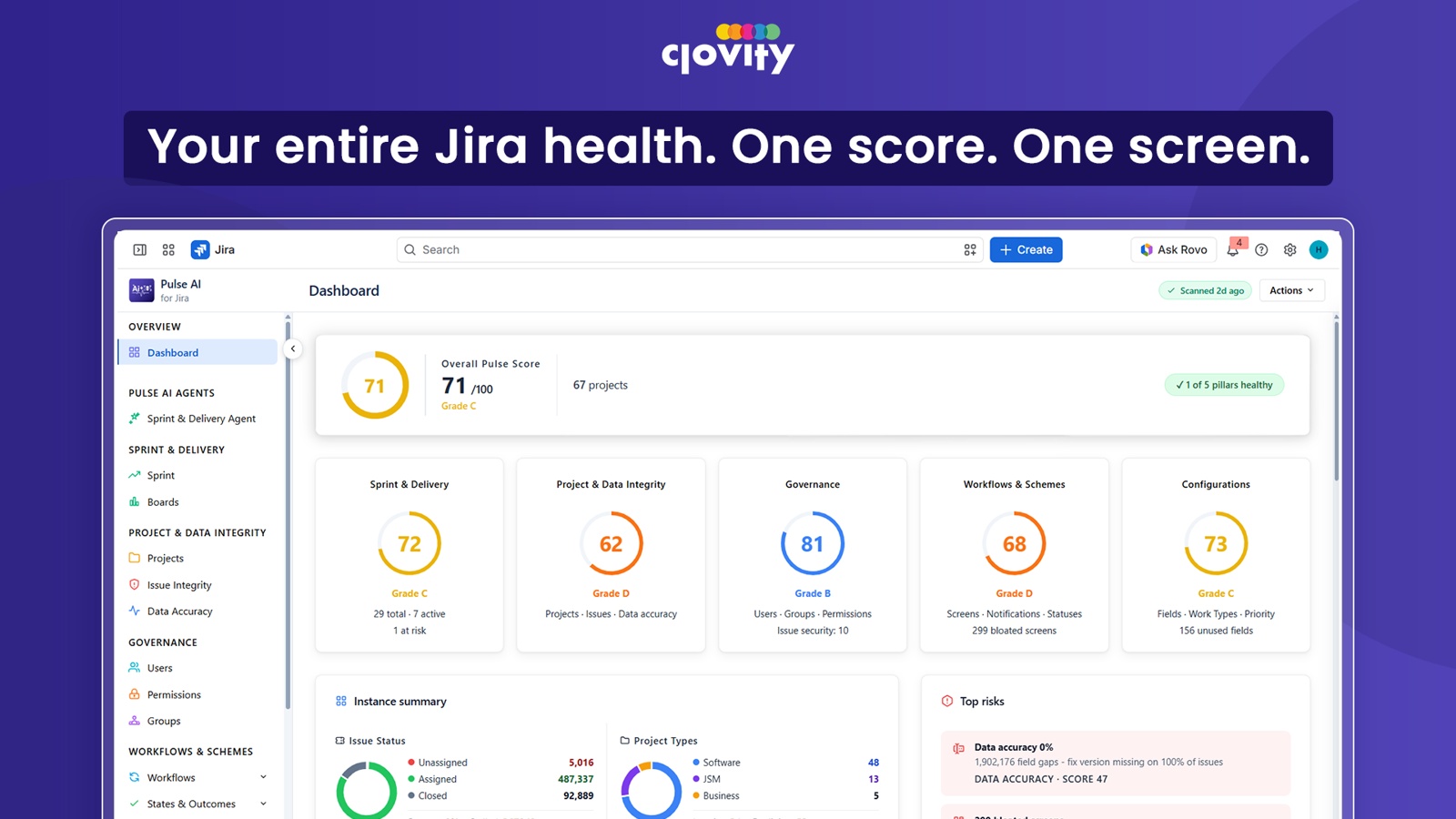
The distinction matters: the documented score starts with analytical methods, while language-model summaries help explain what the scan found. A number organizes attention; it does not supply organizational judgment. Administrators still need to understand why a field exists or whether an unusual permission is justified. As of October 2026, the Marketplace lists Pulse AI as free. It supports Jira Cloud; Server and Data Center are outside its documented compatibility.
Where the details earn their keep
Clovity’s public-sector emphasis gives those details extra weight. It identifies work with federal and state organizations, alongside Dell Medical School and California’s Department of State Hospitals. Sourcewell lists it as an awarded supplier for services including staffing, Atlassian licensing, migration, and managed services. Procurement access sits beside technical delivery in the offer.
Other Atlassian specialists and internal platform teams can address similar problems. Clovity’s particular combination is a consulting practice, embedded talent, ongoing operations, and its own apps, with regulated organizations prominent in its positioning. Inc. records six consecutive Inc. 5000 appearances from 2021 through 2026. The company has also brought in former CoreTrust CEO Mahesh Shah as an operating advisor.
The fit depends on the customer’s problem. An organization committed to another software stack may need different expertise. A dashboard will disappoint if nobody repairs the data beneath it. Clovity’s most instructive cases show people doing that repair: mapping, checking, training, and returning after launch. The useful question is what happens to the work once the new software arrives.