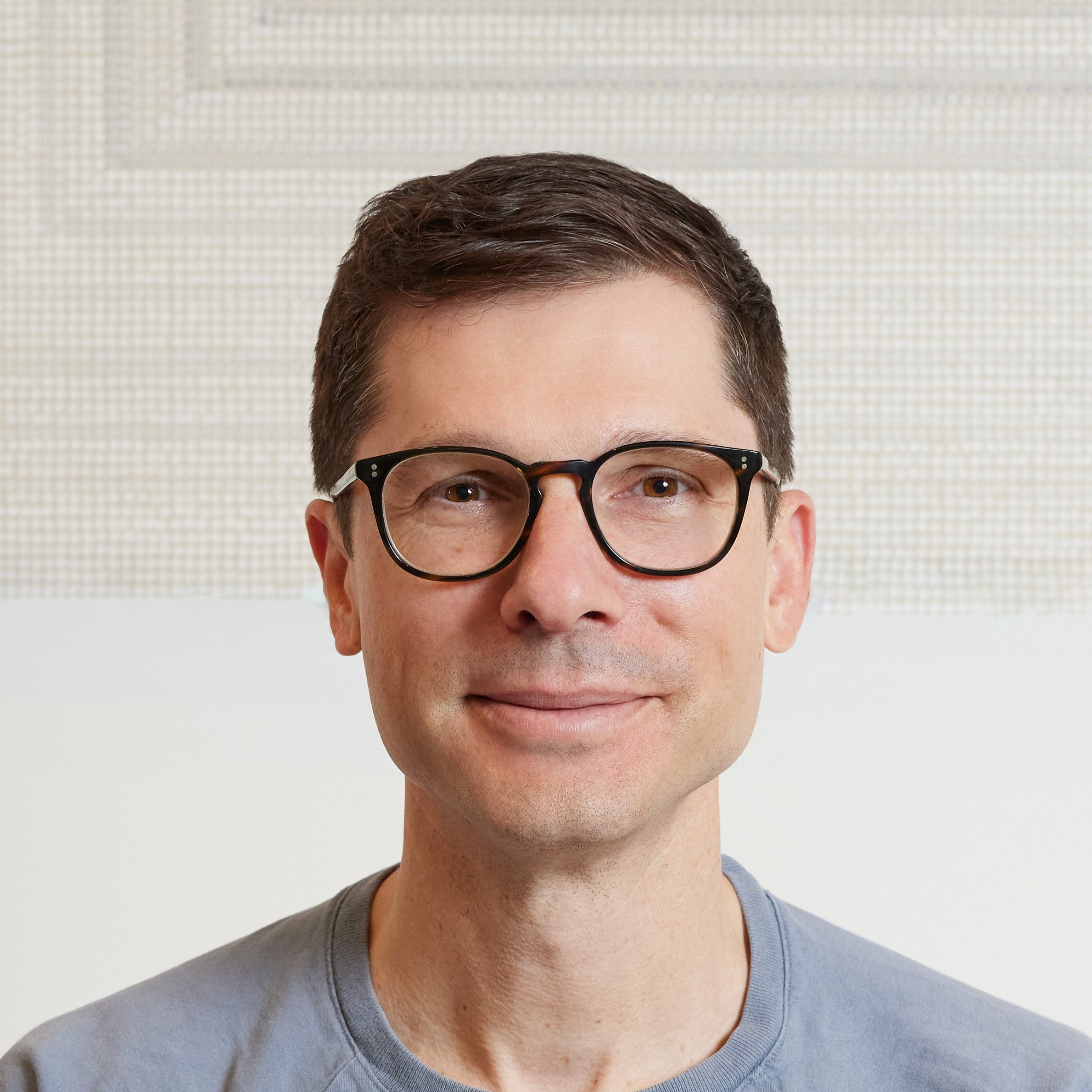
Profile
The meeting room at Google's Mountain View campus where Clay Bavor first held a Cardboard VR headset and thought, this is not a toy - that moment is long gone. What followed it: seven years steering Google's AR and VR efforts, a stint running the sprawling experimental portfolio called Google Labs, and then, in February 2023, a single LinkedIn post that announced both his departure from a company he had called home for 18 years and the launch of something new. The something new now employs 350 people and carries a $15.8 billion valuation.
Bavor graduated from Princeton with a computer science degree in 2005 and walked almost directly into Google, which at the time was a search company still figuring out what else it wanted to be. He figured it out alongside them. For the first decade, he ran product and design for Gmail, Google Drive, Google Docs, and what became Google Workspace - the suite of cloud tools that ultimately moved hundreds of millions of people and entire enterprises off desktop software. The job was about friction. Remove it, systematically, at scale.
Then came a pivot that looked, at the time, like a detour.
The AR/VR Years - A Different Kind of Scale
In 2015, Bavor moved into virtual reality with a title that didn't yet fully exist: VP of Virtual Reality at Google. The role crystallized around Google Cardboard, a $15 piece of folded cardboard that Google started handing out at I/O and that turned smartphones into VR headsets. Bavor oversaw its evolution into Daydream, a more polished Android-powered VR platform, and then into the broader ecosystem of ARCore - the software development kit that brought augmented reality to millions of Android devices and powered Google Lens and Google Maps Live View.
Customer service is hands down the first killer app of generative AI for businesses.
- Clay Bavor, Sierra Co-FounderThe VR effort was a genuine swing. Daydream was ultimately wound down in 2019 as standalone headsets like Oculus pulled ahead in the market. But Bavor wasn't done in the spatial computing space. He kept pushing on the more radical end of the possibility space: Project Starline, a holographic videoconferencing booth that made the person on the other end of a call look three-dimensional and physically present. In eye-tracking studies with Google employees, people focused roughly 15 percent more on their conversation partner via Starline than on a standard video call, and memory recall of conversation details was nearly 30 percent better. This was not a product demo. This was a data point about how humans communicate when you remove the flatness of a screen.
In 2021, Bavor became VP of Google Labs, a role that put him in charge of an increasingly unusual collection of long-bets - AR/VR, Starline, Area 120, and other forward-looking projects - reporting directly to CEO Sundar Pichai. It was the closest thing Google had to an internal skunkworks, and Bavor ran it for two years. Then the large language model moment arrived, and something in him recognized it as the thing he had been waiting to build for.
Sierra - Building AI That Behaves
Bavor and Bret Taylor - Taylor being the co-creator of Google Maps, former CTO of Facebook, former co-CEO of Salesforce, and, at the time of Sierra's founding, the incoming Chair of OpenAI's board - had been friends for years. When the right moment came, they moved together. Sierra was incorporated in early 2023. It built an AI platform designed to let enterprises deploy customer-facing agents: systems that handle inquiries, resolve issues, process requests, and do it in a way that feels less like interacting with a chatbot and more like interacting with a well-informed, empathetic representative.
The pitch was specific. Bavor identified customer service as "hands down the first killer app of generative AI for businesses" - a claim backed by Sierra's early performance data. The agents Sierra deploys typically resolve between 50 and 90 percent of incoming customer inquiries without human involvement. At around 70 percent resolution rates, companies have reduced contact center headcount by roughly half. Bavor frames this not as displacement but as redeployment: people who used to schedule appointments can instead make revenue-generating calls. The rote gets handled by the machine. The human does the human part.
Sierra
An AI customer experience platform purpose-built for enterprise. Sierra's agents handle the full customer journey - inquiries, troubleshooting, account management, order tracking - with a voice that matches each company's brand. The company's name was chosen to evoke the natural world and "humanistic overtones" - an unusual way to name an AI company, and entirely intentional.
sierra.ai
The Mountain and the Machine
Sierra's name is not an accident. Bavor chose it to "reflect the natural world, have humanistic overtones." In an industry where every company name is either a made-up word that sounds technical or a borrowed proper noun that sounds aspirational, naming your AI company after a mountain range is a quiet declaration of values. The technology exists in service of something more fundamental: better human experiences.
That thread runs through his career. At Google, the projects he led - Gmail, Drive, Lens, Starline - were all fundamentally about reducing friction between people and information, or between people and other people. VR was a bet on presence. Starline was a bet on depth. Sierra is a bet on relationship: that the interface between a customer and a company can feel less transactional and more like a conversation with someone who actually knows you and wants to help.
"I've been obsessed with computers all of my life," Bavor has said. "Over the past five years I've been seeing science-fiction books come alive in the real world." The books he's referencing are not hard to guess: the ones where the machine talks back and understands what you mean, not just what you typed.
On Hype and Substance
Bavor is not a hype man. He watches for signals of overextension and in late 2025 he described his personal bubble indicator: the frequency with which the word "agentic" appeared on billboards near his Mountain View home. "It's pretty high right now," he said - but he was quick to follow that with a distinction. The hype is real. So is the underlying technology. The trick is not confusing the two.
His benchmark for what's overhyped: products that simply attach "AI" as a label without genuine transformation. His benchmark for what's underhyped: the cumulative effect of having multiple "thinking machines" available simultaneously - for research, for coding, for analysis. Sierra's agents can hold a conversation in 20 languages. They can schedule an appointment entirely in Mandarin. They can detect when a customer's frustration level warrants a different kind of response. These are not feature announcements. These are engineering decisions that required hard thinking about what the machine should and should not do.
The phrase Bavor returns to is: "more AI is the solution to many problems with AI." Large language models, he argues, are better at detecting errors in their own outputs than at not making them in the first place. Build the detection layer. Trust but verify the machine. It is not a naive endorsement of AI capability - it is a precise description of where the leverage actually is.
The $950M Bet on What Comes Next
In May 2026, Sierra announced a $950 million Series E led by GV and Tiger Global, with Benchmark, Sequoia, and Greenoaks participating. The round valued the company at $15.8 billion - up from $10 billion just eight months earlier. Total funding crossed $1.585 billion. The capital is earmarked for Agent OS development, easier deployment for non-technical teams, AI-driven agent improvement, and expansion into sales and engagement workflows.
Put differently: Sierra is not staying in its lane. Customer service was the proving ground. The next version of the product handles more of the customer relationship - outreach, retention, loyalty. The playbook from Bavor's Google years - start with one product, understand the user deeply, expand systematically - is visible in the architecture of Sierra's ambitions.
There is an opportunity to help the great companies of the world build better, even more human experiences using AI across all parts of the customer journey.
- Clay BavorWhat 18 Years Buys You
Bavor is a rare type in the startup world: a founder who spent nearly two decades at one of the most consequential companies in history before going independent. That is not a liability. It is an education in scale - in how many people a product can touch, how fast a well-resourced team can move, and how hard it is to build something that users actually want to come back to. The people who survive long careers at Google tend to develop either operational precision or product instinct. Bavor appears to have both.
He announced his departure and his new company in the same sentence. There was no gap, no sabbatical, no "taking time to think." The next thing was already decided. That tells you something about the kind of founder he is: not the person who leaves and then figures out what to build, but the person who already knows and is waiting for the right moment to go.
The moment, apparently, was the large language model. The partner was Bret Taylor. The company is Sierra. And the mountain, it turns out, was always the destination.
Achievements
In His Own Words
"The solution to many problems with AI is more AI."
Clay Bavor"I've been obsessed with computers all of my life. Over the past five years I've been seeing science-fiction books come alive in the real world."
Clay Bavor"After 18 wonderful years at Google, today is when - and I'm incredibly excited to share that I am cofounding that company with my longtime friend Bret Taylor."
LinkedIn, February 2023"We think of AI as another tool you have to optimize how you're delivering an amazing experience by soaking up a lot of the rote routine stuff."
Clay BavorFurther Reading