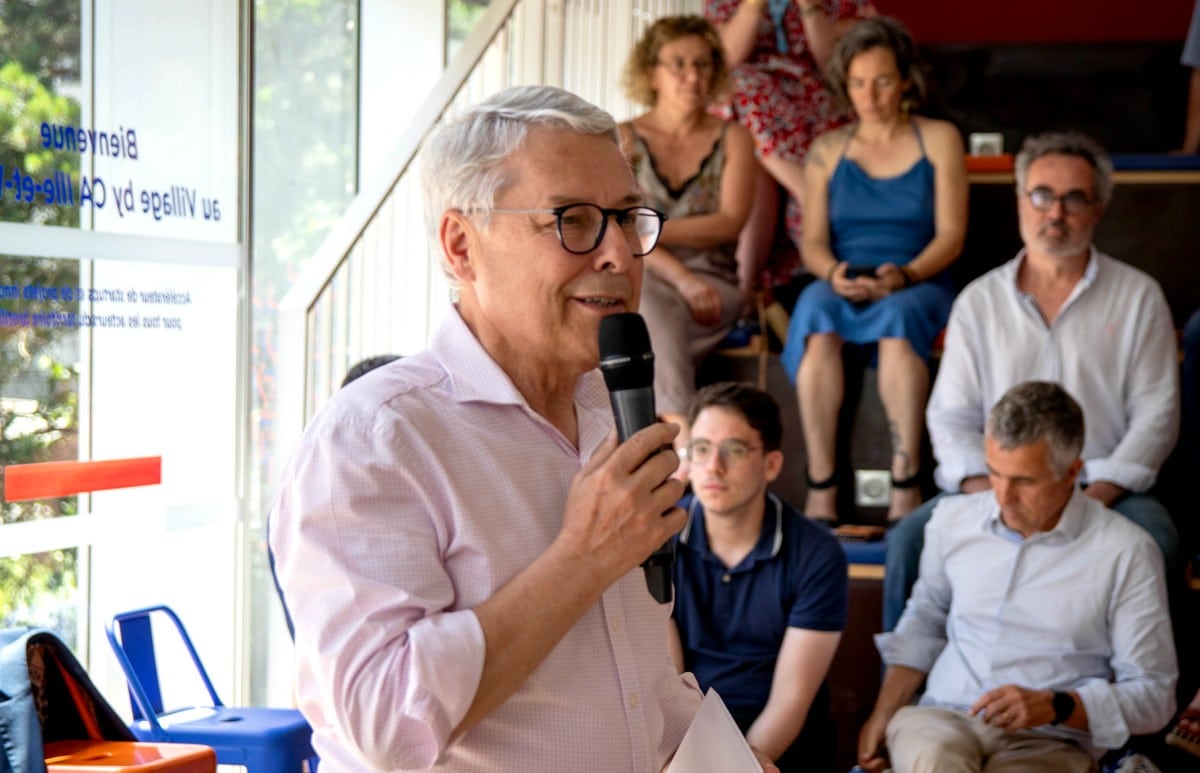
On May 27, 2026, Claude Guillemot presided over a ceremony for people whose businesses were still taking shape. Around twenty project owners were present at Village by CA for the 34th Passeport Armorique ceremony. Guillemot had helped found Ubisoft four decades earlier. Here, the subject was somebody else’s beginning.
A passport is an appealing name for what the association offered. There was no border guard and no guarantee of arrival. There was a connection to an experienced businessperson: someone who might know which question to ask, which introduction would help, or which apparent disaster could wait until Monday.
Guillemot had led the association since 2009. Alongside an international career in gaming hardware, he kept returning to this smaller scale of work. A student, an idea, a mentor. The arrangement gave an entrepreneur something difficult to buy from a catalogue: access to another person’s experience.
Less than a month after that ceremony, on June 19, Guillemot died in an aviation accident at La Baule. He was 69. His career connected a family enterprise in Brittany with Ubisoft, Hercules and Thrustmaster. His work with students adds another dimension to those names: an interest in how people acquire the nerve and the company to begin.
The family business changes its stock
The family’s original trade was agricultural supplies. Computer games were some distance from the starting point. Claude, the eldest of five brothers, studied economics in Rennes, completing his degree in 1981, then specialized in industrial computing at ICAM in Lille before joining the family business.
In 1984, Claude and Michel directed the business toward distributing IT products. The following year came a more specific commitment to video games, under the Guillemot International Software name. These were successive commercial decisions, made before the family name became familiar to players.
In 1986, Claude, Michel, Yves, Gérard and Christian founded Ubisoft. Five brothers make a memorable origin story, although the family photograph can obscure the division of work. Claude’s later place at Ubisoft was in operations. His other substantial responsibility was Guillemot Corporation, the business behind the Hercules and Thrustmaster hardware brands.
The distinction helps when following his career. Games, equipment and distribution belong in the same industry, but they involve different daily problems. A developer needs a game to run. A hardware company needs the device to work with it, reach a shop and survive the user’s enthusiasm. Racing games, in particular, invite a certain amount of enthusiasm.
Guillemot Corporation became publicly listed in 1998. Claude had begun serving as its chairman in 1997, a position he would hold for the rest of his life. The family’s move into computing had become a business with investors, international operations and the continuing obligation to make useful things.
- 1984IT distribution
with Michel - 1986Ubisoft
with five brothers - 1998Guillemot Corporation
stock-market listing - 2009Passeport Armorique
mentoring leadership
What happens between the hand and the screen
Ubisoft’s biography of Claude emphasized a particular combination: knowledge of PC and console technology, accessories, and international experience in Asia, where he had lived. It placed him among the people concerned with the machinery around a game’s release, including the changing hardware on which it would be played.
That work carried him beyond Brittany. The company’s development, commercial and logistics activities stretched across Europe, Canada and China. Research, supply and selling had to fit together. The finished object on a desk conceals a great many conversations held elsewhere.
A 2001 interview offers a useful glimpse of his attention to detail. He described how Maxi sound-card drivers had failed when Windows 95 arrived because they had been built for an earlier beta. A North American development presence brought the team closer to partners such as Microsoft. The lesson had a practical address.
He also described fitting the offices with LCD monitors and discovering that reflections from the windows were less troublesome. It was an endearingly ordinary test of a technology company’s wares: put the thing on a colleague’s desk and see whether the working day improves.
Thrustmaster’s history gives this hardware career a physical shape. Guillemot acquired its Peripherals and Accessories division in 1999. The brand’s experiments included a board for surfing and snowboarding games, a bike peripheral and equipment for combat games at E3 in 2001. A living room could become surprisingly crowded in pursuit of interactivity.
Later came the T.16000M joystick, introduced in 2009 with magnetic sensors, and the HOTAS WARTHOG, which received a CES innovation award in 2011. These were company products made by teams. In Claude’s biography, they locate his executive work in a world of grips, pedals, sensors and the small tolerances that decide whether an illusion feels convincing.
The hardware business Claude led at Guillemot Corporation.
Someone useful on the other end of the phone
Back in western France, the gap between an idea and a working business interested him in a different way. Passeport Armorique paired students with business leaders during their studies. Guillemot’s explanation began with an observation that is easy to overlook: young people already had ideas. Confidence and access could be harder to come by.
He wanted business leaders to describe their own beginnings. An established company can look as though it arrived complete, with departments, customers and a person who knows where the invoices go. Hearing how it was assembled makes the distance from a student project seem less forbidding.
There was a benefit for the mentor, too. Guillemot argued that working with a student could refresh a businessperson’s view of young people and their ambitions. Experience travelled in one direction; curiosity could travel back. The relationship gave both participants something to do beyond admiring each other’s job titles.
Young people have always had ideas.
Claude Guillemot on entrepreneurship
Translated from French
By 2012, the association was extending its reach into Pays de la Loire, working with the Centre des Jeunes Dirigeants as it moved beyond its Breton base. The mechanism remained personal. Students needed people willing to meet them; business networks could help make those meetings happen.
In 2019, Guillemot described one particularly apt introduction. A student wanted to establish a telecoms network in Senegal. Her proposed mentor was working on a network in Morocco. The match brought relevant experience to a live question, rather than attaching an impressive name to an application form.
He described mentors as people who could explain how a company was organized, listen to problems and offer a point of resistance against which to test an idea. Some relationships lasted months; others continued through years of study. The timetable followed the person and the project.
An unfinished idea was allowed in
In 2020, Passeport Armorique described supporting more than 250 students over the preceding decade. In 2019 alone, its intake had included 31 students working on 16 projects. Those are human-sized numbers. They suggest introductions that have to be made individually and relationships that require someone to answer.
Guillemot said willingness and commitment mattered more in selection than a polished business idea. An idea could change. Students could pivot. Every applicant was received by a jury, with at least one business leader present. The unfinished nature of the work was part of the arrangement.
He also spoke about students whose parents did not come from the business world. They might lack an obvious person to ask about starting a company. His account of the association’s purpose was concrete: help them build a network while developing the project during their studies.
That concern gives the mentoring work its weight. Advice becomes more useful when it is attached to someone who can be contacted again. A single conversation can clarify a question. A continuing relationship lets the next question arrive, including the one the student was too embarrassed to ask the first time.
Making room for the next person
In July 2025, succession became part of Guillemot’s own company story. The board separated its chairman and chief executive roles. Claude remained chairman; Valentin Guillemot became CEO on July 1, after joining the group in 2022 and taking on responsibilities in its Canadian business.
The separation gave the next executive a defined job while Claude continued working on the company’s direction. It also changed the familiar description of him as chairman and CEO. For his final year, chairman was the accurate title.
After his death, the board appointed Christian Guillemot chairman on June 23, 2026. Valentin continued as CEO. Victoria Guillemot joined the board in Claude’s place. The company’s September interim results restated those arrangements. His family’s business carried on through people taking up specific responsibilities.
A colleague, Will D., remembered Claude stopping to greet employees, asking how things were going and showing enthusiasm for racing and flight simulation. That recollection sits comfortably beside the mentoring work: someone interested enough to ask a question and stay for the answer.
The May ceremony offers a fitting place to leave him. After decades in business, Claude Guillemot was still turning up for people near the beginning. They had projects to explain and decisions to make. He had experience to share, and a room in which the introductions could begin.
Follow the connections
- Guillemot Corporation
- Passeport Armorique
- Ubisoft’s biography of Claude
- The 2001 hardware interview
- His approach to student mentoring
- The 2025 CEO handover
- June 2026 governance update
Interviews, company documents and the mentoring network connected with his work.