In March 2026, Clare McGee went to a business lunch in Philadelphia and bumped into Kevin Malecek. When he heard she was from Derry, he assumed she must know Mark Owens, another Derry person working in Ohio. It was the sort of geographical shortcut that can make the Irish diaspora feel like a village with an unusually expensive taxi home.
McGee followed it up. She arranged to meet Owens during the St Patrick’s Day business engagements in Washington. By April, a delegation from Ohio was in Derry, with a reception at the Guildhall. A conversation over lunch had acquired an itinerary.
There is a useful introduction to McGee in that sequence. She co-founded AwakenHub, the all-island community supporting women founders, and is also co-founder and CEO of AwakenAngels, its sister investment organisation. Her work involves programmes, partnerships and funding. But watch the Philadelphia-to-Derry connection and the job becomes easier to picture: notice who ought to know whom, then do the work that gets them together.
A Derry girl with an operational streak
Derry is a recurring point of reference in McGee’s public life. She describes herself as a proud Derry girl; her business interests have taken her well beyond the city without displacing it. Her career has included enterprise support, social innovation and local governance, with a particular interest in what smaller businesses need to get moving.
From 2003 to 2016, she worked at the Northern Ireland Business and Innovation Centre as operations manager and senior business consultant. Part of the job was developing grant and European funding to support entrepreneurship, creativity, international expansion and the growth of local businesses. This was a long apprenticeship in the mechanics behind a promising idea.
Those mechanics matter in her story. A founder may have something people want to buy and still need help finding the appropriate programme, specialist or route to finance. McGee’s work sat among those practical questions. The glamour content of a funding application is limited. Its usefulness can be considerable.
In 2016 she co-founded Innovate-NI with Dr Barney Toal. Based in Derry, the consultancy worked on small-business development, entrepreneurship, digital projects and social innovation. The move placed her on the founder’s side of a relationship she had spent years supporting.
She has spoken candidly about the redundancy that prompted her to consider building her own business. Her first reaction was to cry. As a single parent with a mortgage, she initially applied for jobs, then saw that her redundancy payment offered roughly a year in which to try working for herself. Her account leaves the uncertainty intact. There was a household to support before there was a founder story to tell.
The introduction is only the first step
Her earlier projects show how she approached business support. iFactory, which she lists among her work from 2009 to 2014, combined specialist mentoring, innovation support and access to research and development help for more than 150 small and medium-sized businesses in Northern Ireland and the border region.
She also designed and managed a Tech for Good pre-accelerator involving 35 third-sector organisations. It paired organisations facing social challenges with technology companies that could help develop solutions. That required translation in both directions: an organisation had to articulate its problem, while a technical team had to understand the setting in which its solution would be used.
Her professional qualifications include project management, business assessment and collaborative-network facilitation. The last of those is particularly apt. People do not automatically collaborate because someone has put their names on the same invitation. The connection needs a purpose, and somebody usually has to keep it moving.
That practical orientation helps explain the range of her roles. Alongside her companies, her public record includes board work with Derry Chamber, Pennyburn Credit Union and Brook Hall CIC. Her North West Regional College governing-body biography brings enterprise, education and inclusive economic development into the same frame. The organisations differ, but the questions about participation and opportunity keep returning.
160 people joined the call
AwakenHub began in 2020, when women running businesses were telling McGee and her colleagues that customers were disappearing and they did not know where to turn. The response was an online event. Some 160 women attended. The need was larger than a single meeting could answer.
McGee’s description of the organisation centres on continuing support: founders should be able to ask for help when the problem arises. That has consequences for how a community is built. A course can end on Friday. A difficult decision about a customer or a co-founder may arrive on Monday morning.
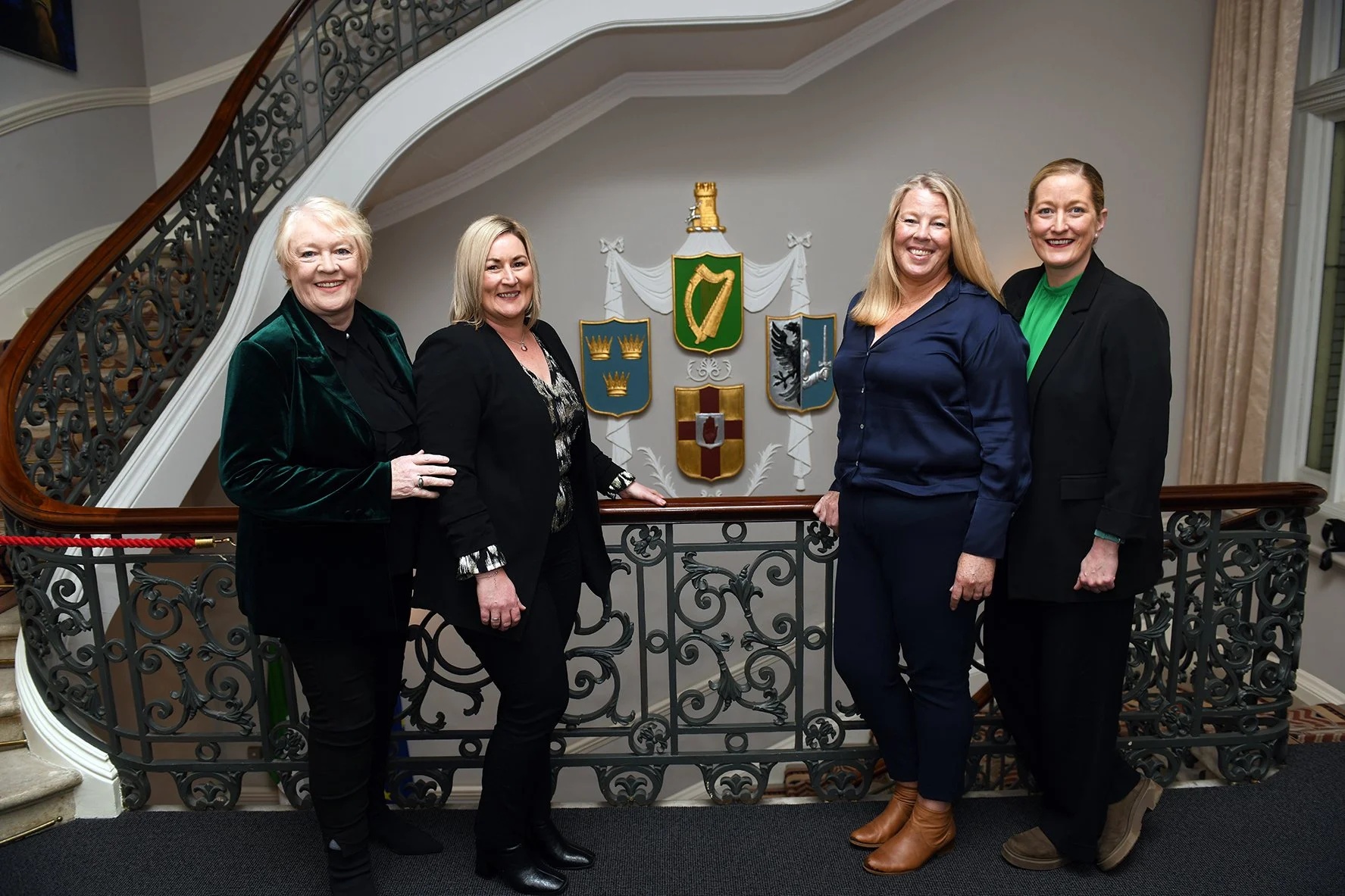
The work grew into AwakenClub, launched in 2021, and a set of programmes addressing different stages of company development. McGee now works alongside fellow co-founders Mary McKenna, Sinead Crowley and Denise McQuaid. Their responsibilities cover leadership, community and investor relationships, giving the operation several ways to respond to a founder’s needs.
“There is no border in business.”
Clare McGee
That is her concise explanation for working across the island. Serving two jurisdictions brings administrative complications, including conversations with two governments. A founder in Derry and one in Limerick may nevertheless recognise the same problem when trying to raise money. The organisation’s geography follows that shared experience.
AwakenHub describes itself as a registered social enterprise. Its community model makes room for founders across sectors and stages, including people who do not need outside investment. This distinction is useful: building a viable business and raising a funding round are related ambitions for some founders, but each deserves its own attention.
Then came the other side of the table
AwakenAngels followed in 2023. The founders had been hearing repeated accounts of difficulty accessing capital. They also wanted more women involved in deciding where investment went. The resulting syndicate brought founder support and investor participation into a closer relationship.
Its stated mission includes making investment more accessible through education and a community where experienced investors can support newcomers. It is women-led and welcomes male participants too. The focus is on backing women-founded businesses on the island of Ireland.
McGee’s responsibility as CEO includes operational strategy, work with portfolio companies and the commercial and strategic partnerships that extend the syndicate’s reach. There is continuity with her consulting years: the point of the connection is what a business can do with it afterwards.
By March 2026, she reported that more than 115 new investors had come through the accredited Investor Academy and that women made up 90% of the investor community. Investment tickets started at around £2,000. Education and a lower entry amount gave prospective participants a more approachable route into an unfamiliar activity.
More than 115 new investors had completed the Investor Academy. Figures reported by McGee at that date.
Those figures describe participation, rather than investment returns. They are revealing on their own terms: a community created to support women building companies was also bringing women into the process of backing them. The people around the table were changing.
A trophy, with the team attached
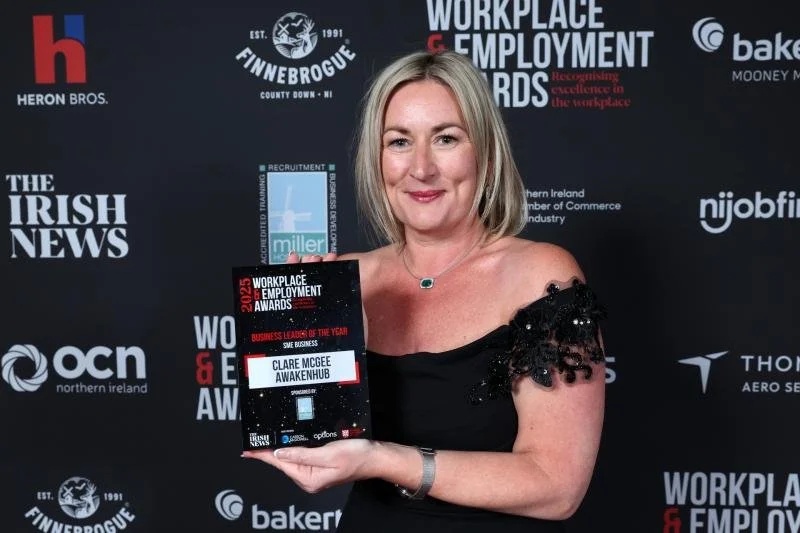
In 2016, McGee received Digital DNA’s Northern Ireland Business Personality of the Year award. In 2025, she was named Business Leader of the Year in the SME category at The Irish News Workplace and Employment Awards, held at Titanic Belfast.
Accepting the later award, she highlighted “the power of collective action”. It was a fitting phrase for a business built around colleagues, founders, investors and partners. The award had one person’s name on it; her explanation made the guest list rather longer.
The same June 2025 update recorded 143 women founders supported through SheGenerate across all 32 counties. By July 2026, AwakenHub reported that the programme had reached 167 founders. Set beside the investment work, these milestones show why McGee’s role stretches across several organisations: founders need different kinds of help at different moments.
From an Ohio visit to the next Dublin room
The Philadelphia encounter kept producing follow-up work. In July 2026, AwakenHub announced a Cleveland mission developed with Team NEO and the City of Mentor, scheduled for September. It also announced further San Francisco activity and a February 2027 New York and Boston mission. The April visit to Derry had become part of a wider exchange.
That expansion followed the June 2026 SheVentures summit at Lusty Beg Island in County Fermanagh, attended by more than 250 founders, investors and business leaders. McGee described delegates asking for money, customers and access to international networks. The next set of activities answered requests that were quite specific. A pleasant gathering still needed to lead somewhere.
By October 13, she was back at the programme level in Dublin. WeScale’s third cohort brought together 21 founders preparing to grow; SheGenerate’s sixth brought 25 at an earlier stage. The two groups began together at Clark Hill’s offices, before moving into work suited to their respective businesses.
McGee joined Denise McQuaid in taking early-stage founders through their value propositions. She also held a question-and-answer session with the scaling cohort. The agenda moved between customers, sales, AI and the evidence a growing business needs. Here was the less photographed part of opening doors: helping someone prepare for the conversation on the other side.
From a lunch in Philadelphia to a room in Dublin, McGee’s work has a recognisable rhythm. Meet someone. Find the practical connection. Follow it through. Then sit down with the next founder and ask who the customer is. The introduction earns its keep when there is something useful to say.