Steve Millaway had already made the journey that Northwest Florida keeps asking its ambitious young engineers to make. He had left. There were friends and family in Panama City, and beaches worth missing, but the private technology work he wanted was elsewhere. Arizona got the engineer. Florida kept the view.
Decades later, back home, he began working on a different proposition: perhaps the next person should have a choice. That question became TechFarms, the Panama City Beach incubator he founded in 2015. It has since led him into venture capital, drone development, fabrication and a former student-loan servicing building large enough to accommodate a commencement ceremony.
There is a pleasing stubbornness to this career. An electrical engineer spends years making things smaller, then comes home and starts acquiring room. Room for a prototype. Room for a company. Room for a graduate who would rather stay.
The long way back to the beach
Millaway’s first technical work was close to home. After high school, he became an engineering aide at Naval Support Activity Panama City, continuing there as a cooperative education student while attending the University of Florida. The degree was in electrical engineering. The next stop was Tucson.
At Burr-Brown Corporation, he spent 16 years designing semiconductor products, including the OPA111 operational amplifier. In 1994, he founded Gain Technology Corporation, designing integrated circuits for customers including Maxim, Raytheon and Intel. Standard Microsystems Corporation acquired Gain in 2002. Alongside it, he founded the Arizona internet provider Gain Communications, which merged with Dakota Internet Partners in 2006.
These were businesses concerned with making other people’s machines work. An amplifier, a communications connection, an interface inside a computer: useful engineering tends to disappear into the thing it enables. Users seldom pause at a USB port to inquire after its upbringing.
- Panama CityNavy engineering aide
- GainesvilleElectrical engineering
- TucsonChips and companies
- Back to the GulfTechFarms, 2015
Gain’s work on USB 2.0 is a particularly apt example. In 2001, the company and Mentor Graphics announced a reference solution combining Gain’s physical-layer transceiver with Mentor’s controller. The components had been tested in silicon and together on a board. Customers could examine a working arrangement before committing to integrating it into a larger chip.
The technical details belong to a different era of computing, but the commercial problem is familiar: make the next expensive step less uncertain. A design that works in isolation still has to work with somebody else’s design. A clever component needs a route into a product. Millaway’s later incubator would confront those same questions with considerably larger equipment.
An engineer notices the missing room
He returned to Panama City in 2007. Conversations with Gulf Coast State College’s then-president, Jim Kerley, drew him into plans for an advanced technology center. Millaway wanted a business incubator included. When that element was dropped, encouragement from others eventually persuaded him to start one himself.
The disappointment gave him a concrete assignment. TechFarms would provide somewhere to develop an idea and find people capable of challenging it. Its mission was regional from the outset: help Northwest Florida grow private technology businesses and the jobs that accompany them.
Today, the incubator’s practical inventory includes labs, a machine shop, manufacturing support, software development, meeting rooms and mentoring. The list also includes coffee. A place that invites entrepreneurs to stay late is wise to observe the basic diplomatic conventions.
The broader educational work continued. In 2018, Governor Rick Scott nominated Millaway to represent Florida at a White House STEM education summit scheduled for June 25-26. The invitation placed a local incubator founder in a discussion about the next federal five-year STEM strategy. His concern was the connection between technical education and employment.
In a 2019 letter supporting Walton County’s proposed Magnet Innovation Academy, he backed engineering, robotics and industry certification. In another letter the following year, he offered help introducing AMIkids Maritime Academy students to drone design, construction and testing. These were specific ways to bring students into contact with the electrical and mechanical work taking place around them. The classroom and the workshop could have a conversation.
A guitar pedal makes the argument
Landon McCoy gives the idea a human scale. An electrical engineering student who liked experimenting with electronics and software, he developed an app-connected guitar pedal. Stratus could put multiple effects into one device. Turning it into a company meant learning considerably more than how to make a guitar sound interesting.
McCoy found TechFarms through cold calls and some luck. Millaway became an investor and a guide through the startup process. For a student team, access to somebody who had already built and sold a technology business supplied a form of help that a parts catalog could not.
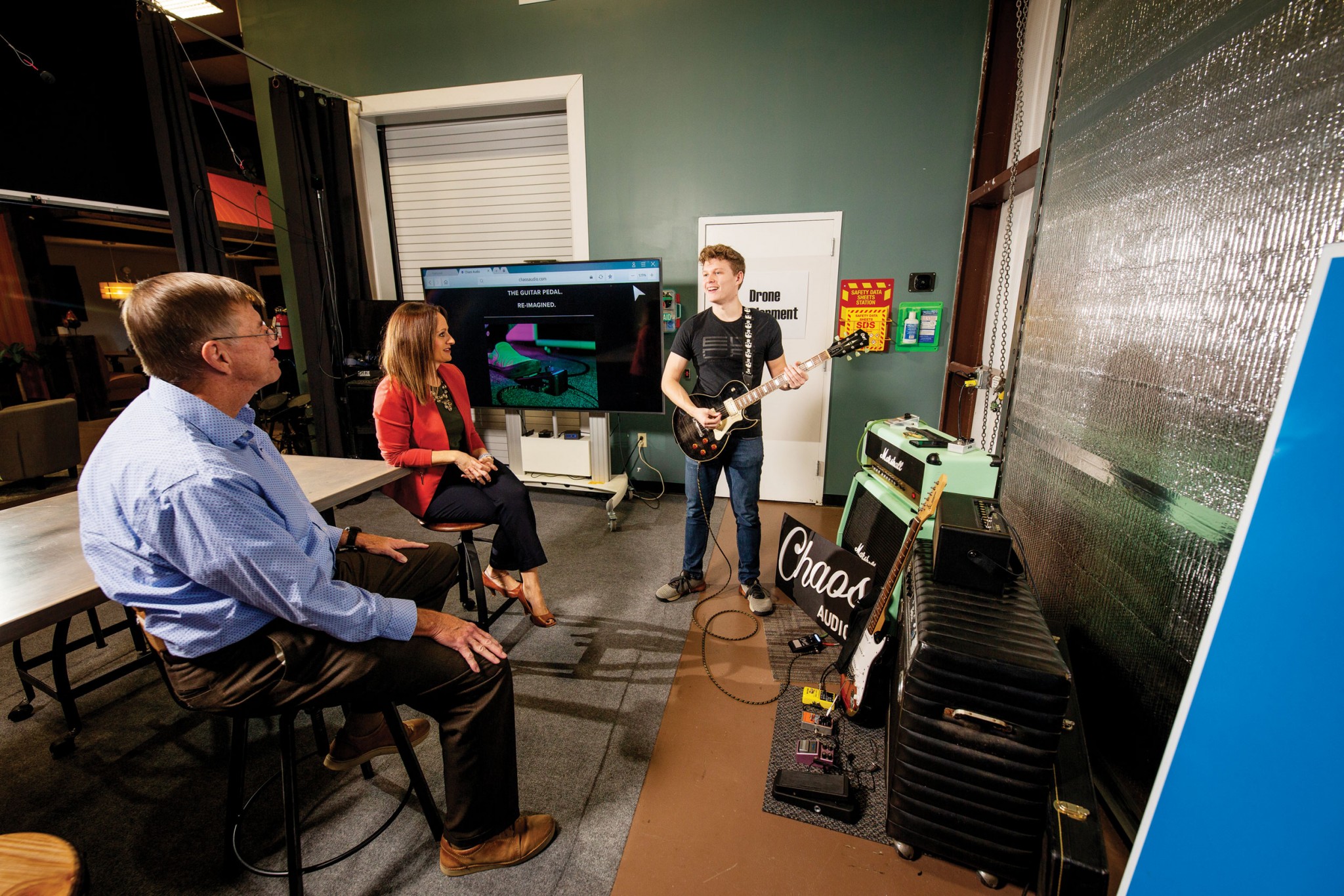
Chaos Audio also illustrates why an incubator needs patience. Stratus entered the music marketplace late in 2022. In November 2024, the company relaunched it alongside 39 effects plugins that could run on the pedal and on a Mac or PC. Feedback from musicians had helped shape improvements.
The interesting unit of progress here is the revision. A student’s project becomes a prototype, then a product, then a product that customers have opinions about. Some of those opinions require more engineering. The launch photograph catches only one moment in a much longer working relationship.
The next obstacle had a dollar sign
Space and advice could get founders started. They could also deliver a company neatly to its next problem: financing. By 2017, TechFarms Capital was setting out a regional investment strategy in a proposal to Triumph Gulf Coast. It described a shortage of early-stage capital and the departure of promising ventures for larger cities.
The proposal sought a durable mechanism for funding Northwest Florida businesses. It also explicitly acknowledged that angel investing carries risk and offers no guarantee of profits. The argument for helping local companies did not remove the obligation to assess them carefully.
In June 2025, TechFarms Capital announced its new name, GAIN Venture Capital, alongside a second fund initiative seeking $25 million in commitments. The target was a fundraising goal. The strategy emphasized hardware enabled by AI: sensors, robotics, drones and technologies with civilian and military applications.
The firm described the evidence it wanted to see: protectable intellectual property, a defined customer problem, a working prototype, a manufacturing route and early commercial interest. That is a demanding shopping list. It is also a recognizable continuation of Millaway’s engineering career. Before committing further, establish what works and what must happen next.
An editorial map of the facilities and investment approach Millaway has helped assemble.
More tools, more room
The fabrication side has been growing too. In January 2025, TechFarms outlined plans for ProtoTech, a prototyping and light-manufacturing division. Its intended customers included both first-time founders and experienced product developers. Machinists, welders, CAD designers and engineers would help take work through testing and validation toward limited production.
The plan extended beyond making a convincing first object. Manufacturing processes, packaging and distribution were part of the proposed service. A prototype can be a persuasive guest at a meeting; it still needs to survive the less flattering company of a production schedule.
Millaway also remains involved in making products himself. ArroTech lists him as CEO and co-founder alongside CTO and co-founder Tobias Leininger. Its GEON E61 combines a drone with metal detection, intended to locate landmines and unexploded ordnance. By March 2026, demonstration flights in Ukraine were being reported. By September, the system had reached the Round of 8 in the Coolest Thing Made in Florida competition. The work puts his interests in electronics, aircraft and practical applications into the same machine.
That March, GAIN VC was reported to have $10 million under management and investments in 20 companies. Millaway was looking another decade ahead, toward job creation and businesses that would remain rooted in the region. He was still measuring the project in years.
“We’re focused on stimulating organic growth.”
Steve Millaway, March 2026
A graduation in a former call center
The newest setting makes his intentions unusually visible. In 2024, Millaway acquired the former Sallie Mae servicing building in Lynn Haven. The Atlantis Center has 133,000 square feet and more than 80 offices. John Holdnak, the former Gulf Coast State College president who became TechFarms’ vice president of operations and innovation, has been helping develop it for businesses and events.
By April 2026, it had hosted proms for Bay High School and North Bay Haven High School. The details were cheerfully untechnical: parking close enough to retrieve a forgotten charger, room for a dance floor, a DJ positioned above it. A building earns its place through uses that seldom appear in an innovation strategy.
Then came FSU Panama City’s 2026 commencement. Around 2,500 people attended. Millaway admitted to some nerves beforehand; afterward, he was pleased by how little he would change. The team had also discovered that the building handled a large sound system well, opening possibilities for concerts. He wanted the university’s commencements there to become a tradition.
Consider the sequence. A young engineer once had to leave the coast to find the work he wanted. He returned, opened an incubator, helped establish a fund and bought a building with room for growing businesses. Now local graduates were crossing a stage inside it. Whether they can build their careers nearby remains the question that gives all those rooms their purpose.