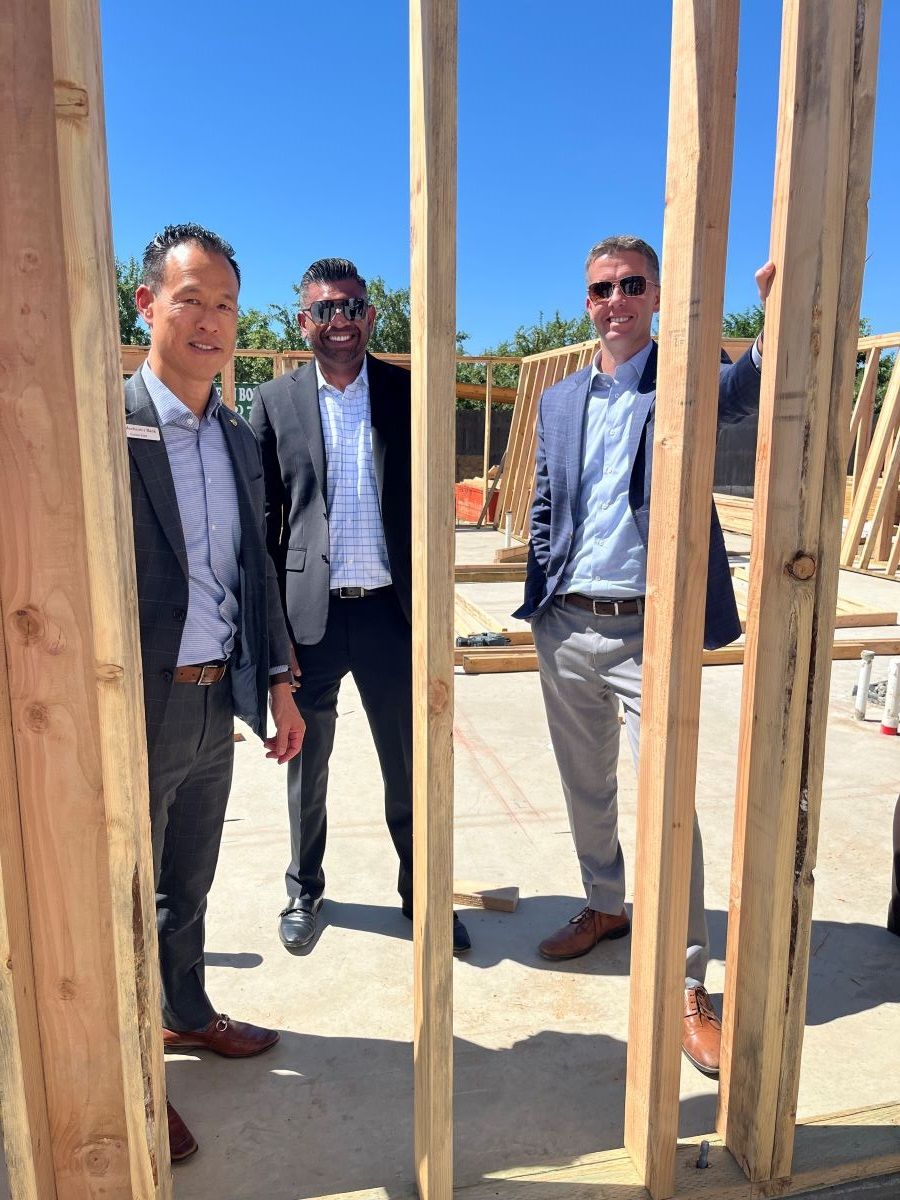
On June 11, 2025, C.J. Johnson visited a construction site in Planada, in California’s San Joaquin Valley. Self-Help Enterprises was celebrating its 300th home in the community. In a photograph from the visit, bankers in jackets stand between upright pieces of timber, looking rather less enclosed than bankers usually do. The walls still have some work ahead of them.
The occasion offers a useful way into Johnson’s career. He works with bank acquisitions, financial planning and the allocation of capital. Here was some of that work translated into a place where people could live. Mechanics Bank had expanded its equity-equivalent investment in Self-Help Enterprises to $2 million. Johnson had come with members of his management team to mark the housing milestone.
By then, he was also preparing to lead a much larger institution. Mechanics and HomeStreet had announced a merger that spring. One part of his working life involved joining banking businesses across the West Coast; another involved visiting the communities where credit becomes something more tangible than a line in a presentation. His public career is best understood by keeping both scales in view.
A degree with two conditions
Johnson attended the University of Michigan from 2001 to 2005 and earned a bachelor’s degree in economics with highest distinction and honors. He also received the Harold D. Osterweil Memorial Prize. The award recognizes academic achievement alongside social awareness. In the context of his later work, that pairing is an unusually apt detail: the economics mattered, and so did the people affected by it.
It would be too tidy to turn an undergraduate prize into a complete explanation of an executive’s subsequent choices. What it does establish is that the combination appeared early. Years before his chief executive appointment, Johnson had been recognized for more than his ability to do well in an economics classroom.
His first professional stop was Credit Suisse, where he worked in investment banking. He subsequently worked at Flexpoint Ford, a private equity firm focused on financial services. In 2010, he joined Santa Barbara Bank & Trust, serving as senior vice president and director of financial planning before the bank’s sale in December 2012. Those jobs put him on several sides of the same business: advising, investing and helping run a bank.
The analyst gets an operating job
There is a revealing episode in Johnson’s account of his early years with the Ford group. After joining in 2008, he worked on financial analysis and due diligence as the group pursued troubled banks. It bid on roughly 10 to 15 FDIC receivership transactions without winning one. A career in acquisitions can include a surprising amount of acquiring nothing.
In 2010, the group recapitalized Santa Barbara Bank & Trust, and Johnson moved there. The sequence matters: analysis led to an operating assignment. The investment team had to work inside the business it had backed. Buying an institution was the beginning of the job, with the slower work of managing it still to come.
That experience gives context to his later combination of responsibilities at Mechanics. Johnson became a partner at Ford Financial Fund, the bank’s majority owner, and served as Mechanics’ chief financial officer and on its executive committee. His work crossed the boundary between the investor’s interest in the institution and the executive’s responsibility for its daily operation.
He helped carry out the acquisition strategy behind Mechanics’ expansion from $3 billion in assets in 2015 to nearly $17 billion by January 2025. That growth belonged to a bank and a team, rather than to any one executive. Johnson’s place in it was nevertheless substantial enough that his eventual appointment represented continuity with the strategy already underway.
Eleven months with an extra word
Johnson began serving as interim president and chief executive in February 2024. Mechanics removed the interim designation on January 13, 2025. He had already spent almost a year doing the job before the title caught up. For an institution founded in 1905, eleven months might seem a modest wait; for the person carrying the responsibility, it was still eleven months.
His messages to customers during that period show the range of the assignment. In spring 2024, he emphasized a straightforward balance sheet and the importance of earning clients’ confidence. He also introduced the bank’s wealth management team under Kelly Johnston. Financial strength and the people delivering the service appeared together in his account of how the bank should work.
By the autumn, he was discussing investments in mortgage staff and technology. Faster remote applications and underwriting sat alongside an older example of convenience: a drive-through banking service introduced under E.M. Downer Jr. in 1948. Johnson enjoyed the historical detail enough to point out that the innovation had once been the talk of the town.
A drive-through window and an online mortgage application make an improbable couple. In his telling, they served the same enduring purpose: making a customer’s dealings with the bank easier. The technology changed; the practical question remained whether someone could get the banking service they needed without unnecessary difficulty.
A bigger map, and questions in the room
On March 31, 2025, Mechanics and HomeStreet announced their strategic merger. The proposed combination would retain the Mechanics name and Walnut Creek headquarters, with Mechanics’ officers leading the combined business. Johnson’s next assignment was taking shape in public: running an expanded bank while helping two workforces understand what joining together would mean.
At a May employee town hall, HomeStreet chief executive Mark Mason credited Johnson with suggesting the meeting. Johnson introduced the visiting Mechanics executives and made a small joke about finance chief Nathan Duda usually being on the golf course. He promptly acknowledged how much work Duda’s team faced as Mechanics prepared to become part of a public company. The joke came with an appreciation of the workload.
Employee meetings expose a different side of a transaction from the announcement. People have questions about products, responsibilities and how their working day will change. Showing up to answer those questions is part of the operating task. A combination that makes sense on a balance sheet still needs to make sense to the people expected to carry it out.
Interim bank CEO
Permanent appointment
HomeStreet merger closes
The merger closed on September 2, 2025. The combined institution had 166 branches across California, Washington, Oregon and Hawaii, with more than $22 billion in assets. Johnson also became president and chief executive of Mechanics Bancorp, the holding company renamed from HomeStreet, Inc. Those figures describe the business at closing, a dated milestone in a continuing operation.
The geography had changed considerably. A California bank now had a branch network extending into the Pacific Northwest and Hawaii. The Mechanics name remained, but the responsibility attached to it reached more employees, customers and communities. Keeping familiar service dependable across that expanded footprint became part of Johnson’s job.
A vacant house belongs in the financial picture
Johnson also chairs Richmond Housing Renovation, LLC, a nonprofit focused on vacant and blighted single-family housing in low-income Richmond neighborhoods. Mechanics financed the organization through a $3 million social impact bond. Here, his responsibility extends beyond attending an event: he holds a board leadership role in an organization addressing a specific local housing problem.
The contrast in scale is useful. A bank can measure its assets in billions while backing a housing initiative measured in individual properties. The smaller figure does not make the work incidental. It makes its purpose easier to picture. An abandoned house is a particular problem on a particular street; financing gives an organization a way to address it.
In April 2025, the National Diversity Coalition recognized Johnson with its Bob Gnaizda Giraffe Award. Former FDIC chair Sheila Bair presented it. The award honors willingness to stick one’s neck out for people who need support, giving the banking calendar a welcome encounter with zoology. Its significance here is the recognition of his work around access to financial services.
“Lifting up people in need is achieved through focus and hard work.”
C.J. Johnson, October 2025
That October, Mechanics expanded its Community Impact Goals with Rise Economy. The commitments included more than $3 million in annual direct donations, along with lending and investment initiatives. The plan ran through the end of 2026, with selected investment goals extending into 2028. These were commitments to be assessed over time, giving the partnership a timetable beyond the announcement.
Growth also means deciding what to sell
By July 2026, Johnson was reporting that the HomeStreet integration was substantially complete. Mechanics Bancorp’s second-quarter results included $57.7 million in net income and $21.2 billion in total assets at June 30. The company had also sold its Fannie Mae DUS business line. The work after the merger involved simplifying and integrating the institution as well as operating it.
A further step came on September 16, 2026, when Mechanics announced the sale of approximately $417 million in remaining performing indirect auto loans to Bank of America’s trading desk. About $13 million in runoff auto loans remained. Johnson described the sale as part of allocating capital to its best use, reducing risk and improving liquidity. Expansion was followed by decisions about what the bank should retain.
That is a fitting place to leave this chapter of his career. Johnson’s work encompasses buying, running, combining and reshaping banking businesses. It also includes a nonprofit board and visits to housing partners. In Planada, the photograph catches an executive between unfinished walls. The setting supplies a practical question for the financial work: what, eventually, gets built?