In 2010, Anthony Labozzetta traded a job at TD Bank for the chief executive’s chair at Sussex Bank, a troubled institution in northwestern New Jersey. The smaller bank came with a substantial collection of loans that were no longer behaving as loans should. For an executive seeking his first opportunity to run a bank, it was an invitation with rather demanding fine print.
He had worked at scale. He had also worked close to the top of a smaller institution. Sussex offered something different: responsibility for the whole thing. The move set up the question that has followed his career since. What makes a bank work when the balance sheet, the branch network and the people behind the counters all need attention at once?
Labozzetta’s answer has repeatedly returned to the behavior of employees. That can sound soft in a business with so many hard numbers. His career makes the connection more concrete. Loans get approved by people. Problems get reported by people. A decision made in one department lands, eventually, on somebody else’s desk. Culture acquires a financial consequence.
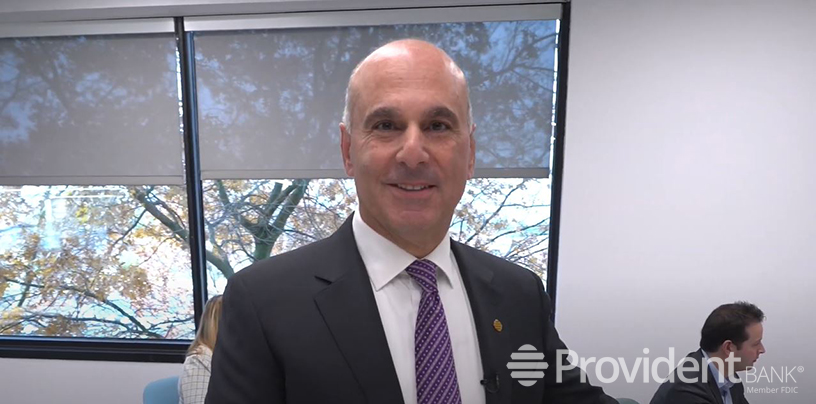
Today he leads Provident Bank and its publicly traded parent, Provident Financial Services. The institution is much larger than Sussex was. His recurring preoccupation is recognizably the same: how to get people working as one bank, even after several banks have become one.
An accountant gets the whole bank
Before banking, Labozzetta was a certified public accountant at Deloitte. A graduate of Wagner College, he moved into a career that would include senior executive vice president and chief operating officer at Interchange Financial Services, then executive roles at TD Banknorth and TD Bank. Those jobs supplied different views of the same business: accounting, operations and distribution.
At Interchange, he was close to the top job without quite reaching it. The company’s sale to TD changed the route. His time at TD gave him room to try retail banking ideas he had not been able to implement at Interchange. When Sussex came along, he brought experience from both a smaller organization and a much larger one.
That distinction matters to his later career. Bank mergers are often presented as maps: this territory joins that territory. For an operator, they are also combinations of habits. People bring their expectations about who decides, how quickly a problem travels upward and what a branch is supposed to do. A new sign over the door settles surprisingly few of those questions.
Sussex became his first opportunity to put the pieces together with the authority, and exposure, of the CEO’s office. A chief operating officer can improve a system. A chief executive must also persuade directors that the system is worth changing.
A branch could be a business outpost
The Sussex assignment eventually produced a rethink of the branch itself. In 2013, Labozzetta proposed a hub-and-spoke approach to expansion into more populous markets in New Jersey and New York. The unusual part was staffing: business development professionals would oversee that expansion, rather than relying on the traditional branch-manager model.
The board needed convincing. Edward Leppert, a director, described the proposal as a radical change. Labozzetta persisted. The newer locations operated more efficiently than traditional branches and showed potential for faster deposit growth. The idea used an existing banking concept, adjusted to the circumstances of a bank trying to move beyond its rural base.
In 2016, American Banker selected him as one of three Community Bankers of the Year. The company he kept on that list included Kevin Kim of Hope Bancorp and Mark Schroeder of German American Bank. It was recognition for a working banker’s kind of invention: changing how an ordinary institution conducts ordinary business.
There is a modest pleasure in this episode. Banking innovation did not require the invention of a new currency. It required asking who should run a branch, what that person should spend time doing and whether the institution’s familiar arrangements were still earning their keep.
Community Bankers of the Year selected by American Banker.
The troublesome loans were only the beginning
Looking back on Sussex in 2018, Labozzetta described weak communication, departmental silos and insufficient accountability. He connected those shortcomings to lending decisions and to problems that lingered after loans deteriorated. His diagnosis reached behind the bad assets to the behavior that had helped create them.
“But we had to deal with reality,” he said. Rather than simply disposing of troubled loans at steep discounts, the bank pursued workouts. That meant the awkward business of negotiating, restructuring and working through individual situations. A quick clearance might have been simpler, but it could also have damaged the bank’s capital.
He also wanted a particular relationship with the board: responsibility for running the business, paired with directors who could act as advisers and strategic sounding boards. The division of labor was part of the repair. Accountability needs someone who actually has the authority to act.
Sussex later became SB One Bank. Under Labozzetta, the organization completed two mergers and expanded to 18 locations across New Jersey and New York. The repaired bank had become a buyer. Soon its chief executive would experience the transaction from the other side.
“But we had to deal with reality.”
Anthony Labozzetta, on the Sussex turnaround, 2018
The acquired CEO takes the next chair
Provident’s acquisition of SB One brought Labozzetta into Provident in August 2020 as president and chief operating officer. He joined a bank whose history began in Jersey City in 1839. Institutional age supplied a considerable inheritance, along with the everyday obligation to make the inheritance useful to present customers.
Christopher Martin remained CEO before moving to executive chairman when Labozzetta became chief executive on January 1, 2022. The succession gave the incoming leader time inside the organization before taking the top role. Martin publicly emphasized his advocacy for the employee and customer experience.
Labozzetta’s stated ambition included giving employees a fulfilling experience and developing deeper customer relationships. Shareholder value belonged in the same sentence. In his formulation, these were connected responsibilities rather than separate audiences to be addressed on separate occasions.
By December 2022, he was discussing succession planning and trust on Steve Adubato’s Lessons in Leadership. The subject suited someone who had crossed so many organizational boundaries. A bank can arrange a succession on paper. The people who remain must still believe in the person who arrives.
- 2010Leaves TD for Sussex Bank’s CEO role
- 2020SB One joins Provident; becomes president and COO
- 2022Becomes Provident’s CEO
- 2024Leads Provident through the Lakeland combination
The arithmetic of a larger neighborhood
The Lakeland combination, completed in May 2024, changed the size of Labozzetta’s assignment again. At closing, the combined company had approximately $24.5 billion in pro forma assets and a network of 140 branches in New Jersey and parts of New York and Pennsylvania. Those are figures from the transaction, a snapshot of the bank he was being asked to lead.
The leadership team drew people from both organizations. Lakeland’s former CEO, Thomas Shara, became executive vice chairman. Wealth management through Beacon Trust and insurance through Provident Protection Plus sat alongside the expanded banking business. The customer could bring more kinds of financial questions to the same group.
On television in an interview aired in February 2025, Labozzetta explained the customer proposition in practical terms. Additional scale could support spending on technology, digital access and data capabilities. He also defended the continuing availability of branches for customers who wanted to walk in and speak with someone.
That is a useful way to understand the institution’s “super community bank” description. The phrase combines two ambitions that can pull in different directions: a broader range of capabilities and a familiar relationship. The mobile phone and the branch have to coexist. Customers are unlikely to reorganize their preferences merely to make a merger easier.
A transaction-day snapshot, not a current branch count.
When the old badges stop mattering
At a staff summit in spring 2025, Labozzetta noticed he could no longer distinguish the former Provident employees from the former Lakeland employees. For him, that was a sign the combination was becoming a single organization. Integration had become visible in a room full of people.
He also acknowledged the limits of a CEO’s view as an institution grows. A small bank’s leader can see much further into its operations. A larger bank needs stronger processes, broader expertise and more delegated authority. His argument was practical: decisions that once reached his desk could not all keep arriving there.
The point gives his emphasis on culture some weight. Empowerment needs agreed rules, or it becomes a collection of private interpretations. Consistency needs capable people, or it becomes a manual nobody knows how to apply. His task is to put those two requirements together without slowing every customer interaction to a committee’s pace.
There was a tangible community dimension, too. Provident Bank and its foundation contributed more than $2.8 million to nonprofit organizations during 2024. In September that year, the bank’s Community Partnership Program awarded $88,000 to nine New Jersey nonprofits working in areas including financial literacy, economic empowerment and housing support.
The next test is already on the desk
Growth continues to bring management decisions. Adriano Duarte became chief financial officer effective July 1, 2026, reporting to Labozzetta. Duarte had also arrived through SB One. Labozzetta’s endorsement stressed financial expertise and a collaborative leadership style, a pairing that fits the way he talks about the business.
For the second quarter of 2026, Provident reported net earnings of $78 million, or $0.60 per diluted share. First-half earnings per share rose 17% from a year earlier. Labozzetta pointed to commercial lending, margin expansion and contributions from fee-based businesses. Culture still has to show up in results; the financial statements do not award points for good intentions.
In September 2026, he was declared elected to the Federal Home Loan Bank of New York’s board, with a one-year term beginning January 1, 2027. The role extends his responsibilities into a wholesale banking institution whose mission includes liquidity for housing and local community development.
His public agenda remains close to the customer’s practical choices. When Provident released a higher-education survey that September, he emphasized helping families understand the options and consequences of paying for education. The question was familiar in a different setting: what does a financial decision make possible, and who will help someone work through it?
The former accountant has spent much of his career making institutions larger. The more revealing work happens inside them: deciding who gets authority, how colleagues cooperate and whether a customer can still reach someone who understands the problem. Those questions were waiting at Sussex. They have followed him to Provident, and they have acquired rather more desks.