A bank vault is a wonderfully theatrical object. It has weight, polish and a door fit for a submarine. Yet the modern banker’s real burden is mostly invisible: a promise recorded in a ledger, governed by rules, tested by panic and renewed each time a client decides not to move the money elsewhere. Kevin King came to that burden by way of the law. Before the corner office, he occupied the chair reserved for the person paid to notice the clause everyone else hopes is boilerplate.
King is chairman and chief executive of Saint Louis Bank, a commercial institution with one office in St. Louis and another across the Mississippi in Edwardsville, Illinois. The footprint is modest enough to describe before an elevator reaches the third floor. The balance sheet is not. At June 30, 2026, the bank reported about $1.11 billion in assets, $995 million in deposits and $909 million in loans. Those numbers belong to an institution with two locations and roughly five dozen employees, a ratio that makes each decision feel less like an abstraction and more like furniture in the room.
First, read every clause
King’s public biography is spare, which may be apt for a general counsel. It records experience in banking, commercial transactions, corporate and general business law, real estate and regulation. He worked for three years in the Missouri Attorney General’s office. He then spent years as general counsel at Pulaski Bank, a local institution that was eventually sold to an out-of-state bank. In 2018, he arrived at Saint Louis Bank to do the same job.
There is a useful tension in that progression. Lawyers are trained to imagine how arrangements fail. Bankers are expected to finance how plans succeed. The two habits can annoy each other at a conference table, but they are close relatives. Both depend on evidence. Both price uncertainty. Both eventually reduce a grand ambition to dates, signatures and an answer to the impolite question: what happens if this goes wrong?
A glimpse of King’s earlier work appeared in 2011, when Pulaski Bank owned a foreclosed retail development called Sappington Square. As the bank’s attorney, he spoke about filling vacant lots and using a development agreement to attract tenants. It was hardly glamorous work. Empty parcels, loan defaults and municipal incentives seldom are. But it located him exactly where local banking becomes tangible, with a lender trying to turn a troubled property back into a working piece of a neighborhood.
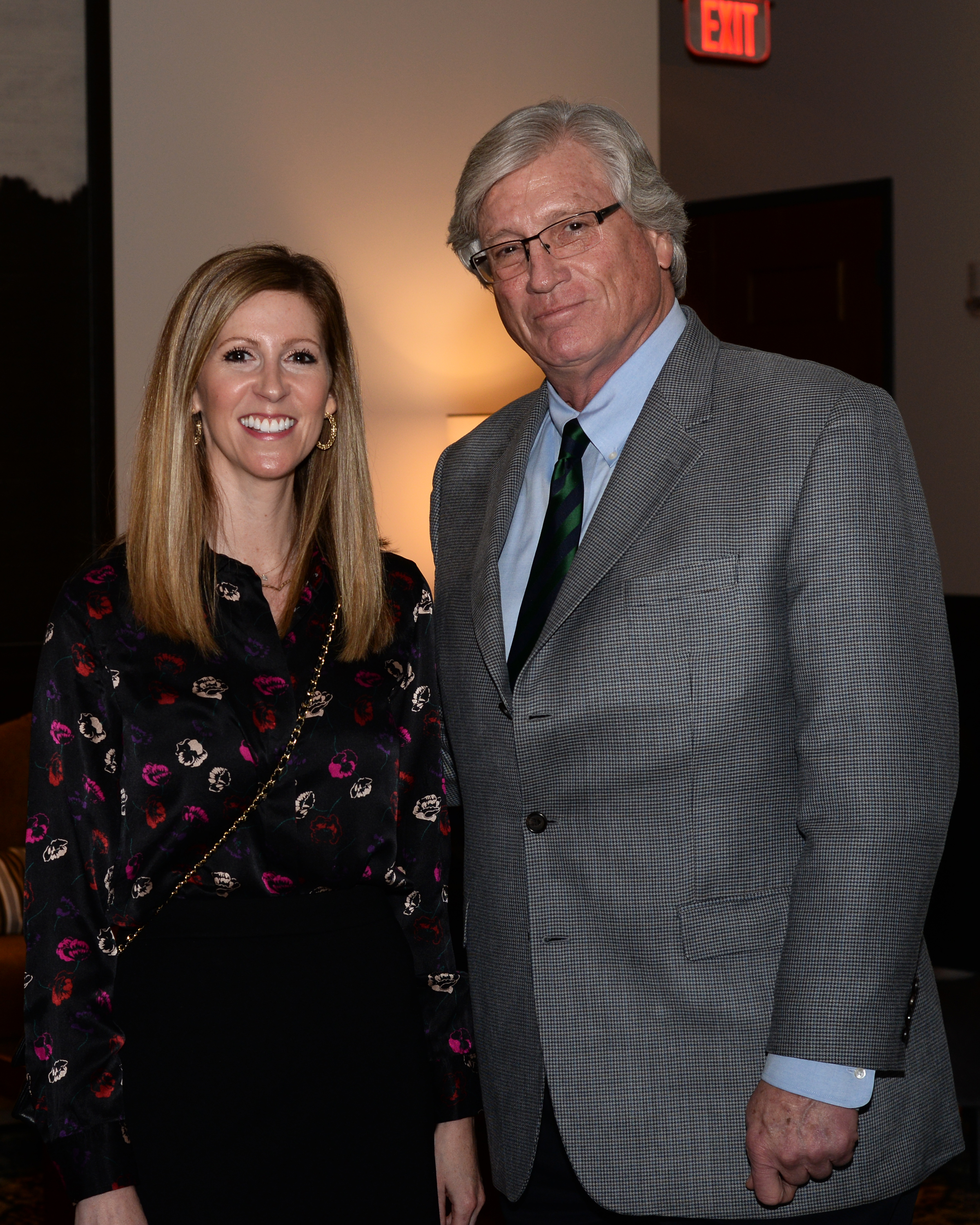
The photograph catches another part of the local claim. In 2020, the bank gathered supporters of LaunchCode at the Last Hotel, backing an organization that creates alternative routes into technology careers. King appears in the event record among bankers, civic figures and guests. Two years later, a public filing listed him as secretary-treasurer of the Saint Louis Bank Foundation. Neither appearance supplies a grand theory of citizenship, and neither needs one. A community institution is often measured through repetitions: whose event it hosts, which room it enters, what work its officers accept after the meeting ends.
This also helps explain why geography matters even when banking arrives through a phone. Commercial customers do not merely borrow money. They hire people, lease buildings, collect taxes, pave streets and make payroll. A lender’s consequences travel through the same map. King’s public career has stayed unusually close to that map, from a distressed shopping center in south St. Louis County to a bank whose second office looks across the river toward its first.
The promotion that changed the signature line
On August 17, 2023, Saint Louis Bank’s board reduced its membership from thirteen directors to nine and ended the employment of its chief executive. The same day, directors unanimously appointed King president and CEO. He had been the bank’s general counsel for five years and already sat on both the bank board and the board of its holding company. An abrupt transition is never an elegant piece of theater. It is, however, a moment when familiarity with governance, documents and institutional history becomes unusually valuable.
King inherited a bank that defined itself through relationships and commercial lending. The phrase “relationship banking” is in danger of becoming the financial equivalent of “farm to table,” pleasant, ubiquitous and occasionally hard to audit. At Saint Louis Bank, the physical facts sharpen it. A two-office institution cannot win a contest of ubiquity. It must know which clients it wants, solve specific problems for them and remain close enough to recognize the difference between a temporary difficulty and a deteriorating credit.
Legal and regulatory work, followed by years as general counsel at Pulaski Bank.
Joins Saint Louis Bank as general counsel.
The board appoints him president and chief executive.
Continues as CEO and becomes holding-company chairman as Brian Bjorkman takes the bank president role.
Explains the mechanics of reciprocal deposits in a national policy discussion for community bankers.
By early 2025, the division of labor changed again. Veteran banker Brian Bjorkman became president while King remained CEO and took the chairmanship of the holding company. The arrangement placed daily bank presidency with Bjorkman and the chief executive and board responsibilities with King. It also completed King’s short climb in title and long apprenticeship in institutional risk.
A concentrated balance sheet
Quarter-end figures, June 30, 2026. Bars are scaled against total assets.How to make “local” work at scale
King’s clearest public explanation of the bank’s model came in September 2026, during a conversation about reciprocal deposits. The term is graceless, even by banking standards, but the idea is neat. A customer places a large sum with one community bank. The money is divided into amounts within insurance limits and placed through a network of participating institutions. Matching deposits flow back. The customer keeps one primary relationship and receives access to aggregate federal deposit insurance far beyond the standard limit.
For Saint Louis Bank, this is not a clever accessory. King said about half of its deposits are public funds. Municipalities and other public bodies commonly require their balances to be insured or otherwise secured. Commercial clients also keep operating accounts that can exceed ordinary insurance limits before lunch. A branch-light bank needs those deposits to fund loans, but it cannot offer a nervous treasurer the soothing scale of a national giant. Reciprocal deposits turn technical infrastructure into reassurance.
The need became vivid after Silicon Valley Bank failed in 2023. Corporate finance teams rediscovered, with the zeal of people who had just located the fire exit, that deposit insurance has limits. King described moving commercial customers with large operating balances into sweep arrangements. Safety became part of the sale. The point was not to ask a client to ignore concentration risk for the sake of local loyalty. It was to remove the forced choice.
This is where King’s legal temperament and executive job finally overlap. A contract is a machine for preserving trust after memory and mood have left the room. Reciprocal deposits do something similar. They take the warm language of relationship banking and give it cold machinery: allocation rules, insurance coverage, network accounting and a single statement for the client. Romance, meet operations.
The usefulness of a narrow field
Community banks occupy an odd position in American commerce. They are praised for local knowledge while competing against institutions that can spend more on software, marketing and rates before breakfast. Their advantage cannot simply be friendliness. A cheerful greeting has never rescued a weak credit file. The advantage is compressed distance: fewer layers between a borrower’s circumstance and the person authorized to understand it.
Saint Louis Bank’s numbers illustrate both the appeal and the pressure. Loans represent a large share of assets, and commercial lending is its declared specialization. Deposits are therefore not idle trophies; they are the raw material for credit. Every large public account protected through a deposit network can support business lending close to home. Every loan still carries the possibility that local knowledge becomes local overconfidence. The chief executive’s task is to enjoy the first fact without forgetting the second.
King has not built a public persona out of slogans or frequent interviews. His visible record is largely institutional: board actions, bank biographies, legal matters, a foundation filing and, recently, a technical conversation among bankers. It leaves little material for mythology and plenty for a more useful portrait. He is an operator whose career moved steadily toward the place where advice becomes accountability.
The vault, in the end, remains the handsome prop. King’s actual craft is the arrangement of promises around it. A city wants its funds protected. A business wants its cash available. A bank wants deposits that can finance loans. A regulator wants the risks named correctly. The lawyer in King can read each obligation. The CEO has to make them coexist.
That coexistence is the quiet art in the headline. It has no dramatic door and makes no satisfying clang. Done well, it looks almost uneventful: the payroll clears, the loan closes, the municipality sleeps, and the money stays near enough to remember where it came from.