In 2002, Jeff Hawkins could see an opening in somebody else’s bank merger. Larger institutions were buying local banks around the Twin Cities. Customers would eventually feel the change in who made decisions, he thought, especially customers running businesses. Hawkins was then president of Anchor Bank in West St. Paul. A competitor’s new sign could become his invitation to a conversation.
Fifteen years later, Anchor itself joined a larger institution. Hawkins stayed to help lead Old National Bank’s Minnesota region. The banker who had explained the opportunities created by consolidation now had to work on the other side of it: helping a local banking team carry its relationships into a different organization.
That reversal gives his career its interesting question. What, exactly, makes an institution local? Its ownership? Its address? The person who remembers your business? Hawkins’s work moves among those answers. It also reaches beyond banking, into the less glossy machinery of Minnesota civic life: fair boards, fundraising committees and youth auctions. A corporate name can change in a weekend. A committee appointment tends to require rather more evenings.
The customer notices who decides
Hawkins’s early banking responsibilities were practical ones. By November 1987, he had joined Town & Country Bank in Newport as vice president and senior loan officer, responsible for credit administration and business development. He had previously been a vice president at First Bank. His University of Minnesota bachelor’s degree combined a concentration in business and agriculture, two subjects that would continue to appear, in different proportions, throughout his working life.
He arrived at Anchor in May 1995 as its West St. Paul charter president. At the time, the organization had five bank charters and about $250 million in assets. That was a particular scale of responsibility: a local presidency within a collection of banks, before the later regional title and the larger corporate map.
By 2002, he was describing consolidation in terms of its consequences for commercial customers. “Whenever a large institution takes over a community-based bank, some changes in decision-making will follow,” he said. His argument depended on something more specific than affection for small banks. Decisions could move, and a customer might prefer a lender whose decisions remained closer.
There is a useful absence of romance in that observation. Hawkins saw a business opportunity. Community banking still had to compete for customers, make loans and earn money. Local knowledge mattered because it might make the service more useful. Being nearby was a start; being able to act was the point.
When growth meant making another loan
The financial crisis supplied a harder test than a marketing conversation. In January 2009, Hawkins was Anchor Bancorp’s chief operating officer, overseeing its branches. The organization had 17 Twin Cities locations and $1.3 billion in assets. While the banking industry was struggling, Anchor was still lending and reporting a profit.
from a year earlier
through October
of September
Historical company figures. These describe Anchor’s position at the time, rather than Hawkins’s individual performance.
Its loan portfolio had increased by $101 million from a year earlier. Capital had risen by $11.2 million. Those figures describe the bank, with all the people and decisions behind it. They also locate Hawkins’s operational role in a period when the ability to keep extending credit was a meaningful distinction.
Banking profiles often hurry toward the next acquisition. This interval deserves a pause. Seventeen locations, growing loans, positive earnings and capital behind the business: here was a local institution continuing to do the work its customers needed. The story was less cinematic than the national financial drama, which was rather the attraction.
The promise inside a new sign
Expansion came with a very concrete geography. Anchor completed its purchase of Voyager Bank in April 2015, adding locations in Eden Prairie, Minnetonka, Shakopee and Mankato. The acquisition extended a bank concentrated in the eastern Twin Cities toward the southwest and brought its total to 20 locations.
The operational timetable was equally concrete. Voyager branches were scheduled to close for conversion over the June 6-7 weekend and reopen on June 8 under Anchor. A transaction that occupies lawyers and executives for months eventually becomes a Monday morning for customers.
Hawkins’s emphasis was on retaining Voyager employees, while giving customers access to a larger lending capacity and more investment expertise. The intended bargain was understandable: keep the people customers knew, add what the larger bank could provide. The difficulty, of course, lives in carrying out both halves at once.
His interests also extended to the people running those customer businesses. In 2015, he served on the selection committee for Minnesota’s Family Business Awards alongside advisers, an academic and other business leaders. The committee considered companies facing questions about family relationships, succession and the next generation. It was a different view of continuity: how a business keeps going when the people in charge eventually change.
Then it was Anchor’s turn
Old National completed its combination with Anchor on November 1, 2017. Hawkins remained with the organization as Minnesota region CEO. Arleen Sullivan, Jim Collins and Margaret Murphy were also part of the Minnesota leadership group continuing through the transition.
For the new parent, Minnesota offered an opportunity to lend to small and midsize companies in a market with large established competitors. Its 2017 annual report recorded $35.2 million of Minnesota loan growth between November 1 and year-end, and 11.4 percent commercial loan growth for the Minnesota team across the full year.
Again, these were team and company results. Hawkins’s place in the episode was as an experienced local executive helping carry the organization through a change in ownership and onward toward a branch and systems conversion. The customer questions he had identified in 2002 now belonged on his own desk.
“The strong reputation that Anchor Bank developed in the community”
Jeff Hawkins, reflecting on his banking career in December 2018
His retirement announcement arrived in December 2018, with his departure planned for January 2019 after 38 years in banking. He said he wanted more time with family. Looking back, he emphasized Anchor’s standing in its communities and the people who had represented it. The balance sheet had supplied the scale of the business. His farewell supplied a different measure.
A second boardroom, with a fair outside
Hawkins’s civic commitments were already well established before that farewell. His volunteer history lists work with the Dakota County 4-H Auction Committee beginning in 2000 and the Minnesota State Fair Auction Committee beginning in 2003. The State Fair Foundation’s 2017 annual report names him as treasurer.
In January 2018, he was elected to the Minnesota State Agricultural Society’s board of managers, filling the remaining year of the second district term previously held by Paul Merkins. The geography remained familiar: Hawkins represented the district as a resident of Inver Grove Heights.
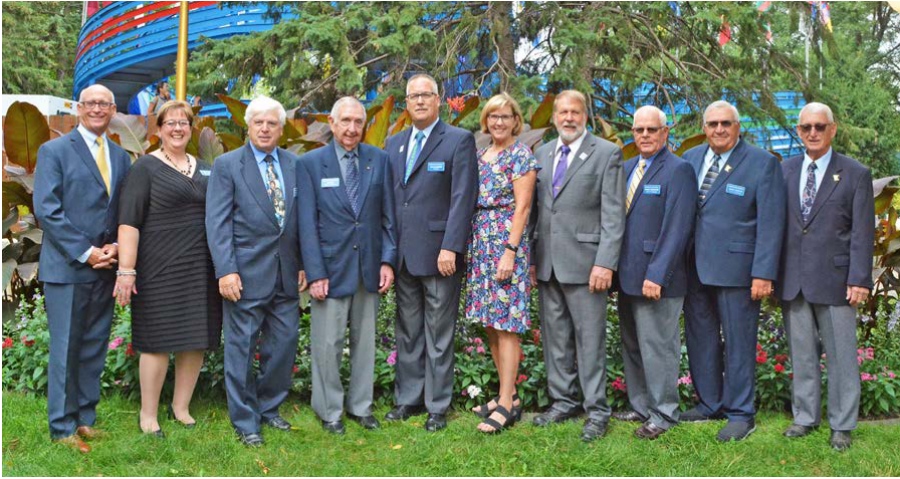
The fair’s board has ten members, nine representing regional districts and a president serving at large. Its remit includes the fairgrounds as well as the annual event. The arrangement puts an agricultural and civic institution in the hands of people selected through a society whose delegates represent county fairs and statewide organizations.
For visitors, the fair is a day out. For its governors, it is also buildings, contracts, maintenance and money. The 322-acre grounds require attention after the crowds leave. A banker can find plenty to recognize in an institution that must preserve assets, finance improvements and keep the experience worth paying for. The refreshments are more entertaining than those at most finance meetings.
- 1995Joins Anchor as West St. Paul charter president.
- 2000Begins listed service with Dakota County’s 4-H auction committee.
- 2017Anchor joins Old National; Hawkins continues in Minnesota leadership.
- 2018Joins the State Fair board of managers.
- 2025Re-elected as the fair board’s second district representative.
Keeping room for the next generation
The overlap between his two working worlds extends to younger people. In May 2015, Hawkins spoke to the Apple Valley Chamber of Commerce’s NextLeaders group at a coffee gathering hosted by Anchor. He shared lessons about business and personal life with emerging business leaders.
His name now appears on the campaign committee for the State Fair 4-H Building project. The fair and Minnesota 4-H are working on a $35 million campaign to renovate the building and expand statewide programming. The campaign is a joint fundraising effort of the State Fair Foundation and the University of Minnesota Foundation.
It is a collective undertaking, with Hawkins one member of a committee. Still, the connection is particular: the university where he studied, an agricultural youth organization he has supported, and a fair he helps govern meet in the same project. His business-and-agriculture education has acquired a rather literal architectural setting.
He also serves on the Catholic Community Foundation of Minnesota’s board, where his professional description identifies him as Anchor Bank Minnesota’s retired president and chief operating officer. Banking retirement left room for other institutions to make use of that experience.
In January 2025, Hawkins was re-elected to a three-year term representing the fair board’s second district. By then, the banking retirement was six years behind him. The continuing appointments give his story an ending that is still open: a career associated with changing bank names, followed by work helping familiar Minnesota institutions remain useful to the people coming next.