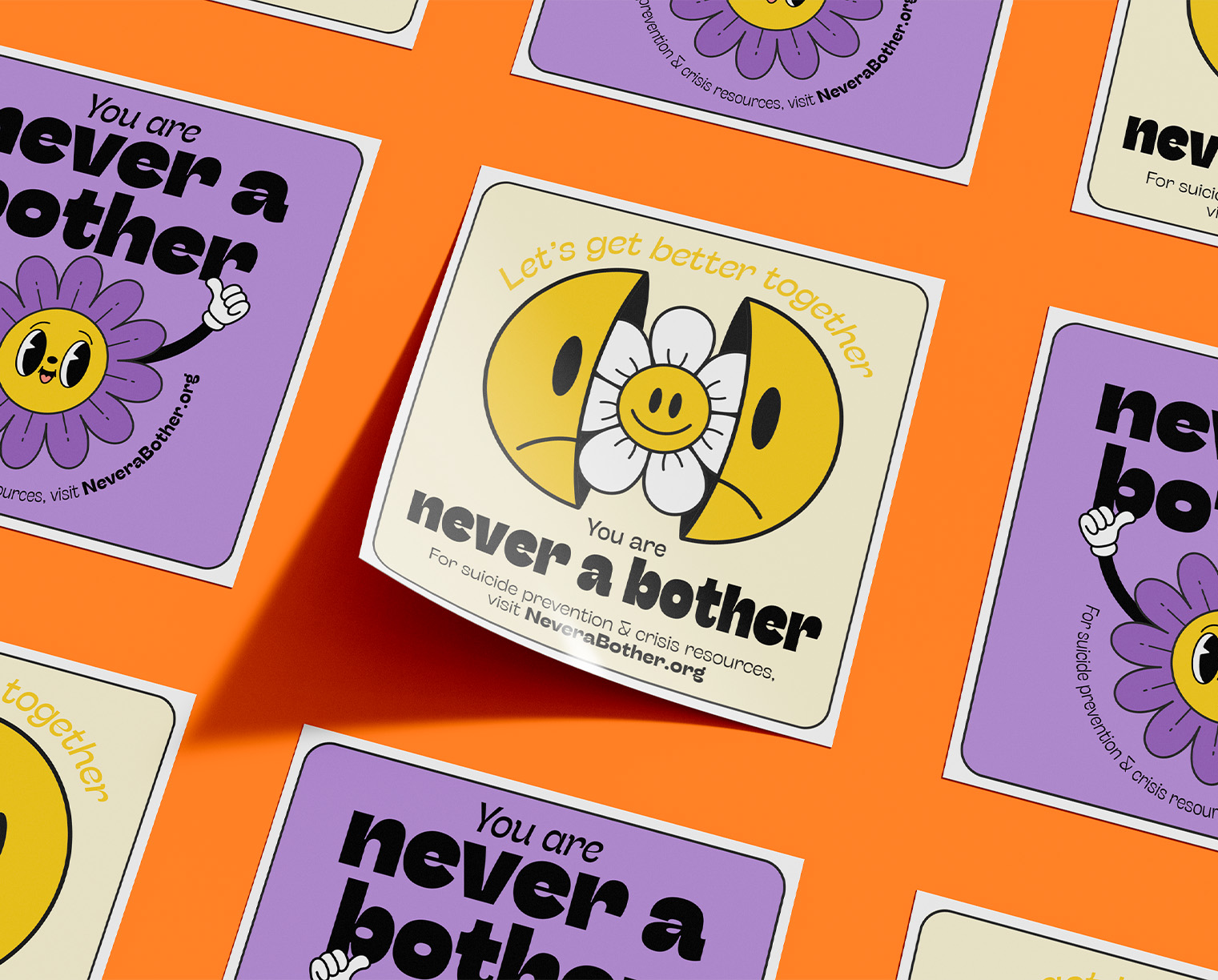
The flowers have faces. Some look happy; others look as though the day has asked rather too much of them. Across the stickers runs a small assurance: you are never a bother. This is the visual world of a California suicide prevention campaign, an assignment with considerably more at stake than getting someone to remember a brand of cereal.
The agency behind it, Civilian, did something worth examining before it made the stickers. It brought young people into the decisions. Paid youth advisors helped shape research, messaging, and design for Never a Bother. The people who would receive the message also helped make it. That arrangement is the most interesting thing about this San Diego company.
First, give the audience a say
A public agency can know exactly what it wants people to do and still misunderstand why they hesitate. A website may explain a service perfectly. The person who needs it may be wondering whether their problem deserves anyone’s time. Those are different communication problems, and they call for different sentences.
Civilian’s award entry describes listening that surfaced themes of validation, trust, and safety. Its creative used expressive, retro-style flower characters rather than stock photography. The tone makes sense in that context: the campaign offers reassurance before asking for action.
By September 2024, Civilian reported nearly 450 million paid and organic impressions and 1.1 million website sessions. Those figures describe distribution and use. An impression is an opportunity to encounter something; a session is a visit. Neither is a count of people whose health improved. Keeping those distinctions intact makes the work easier to assess.
Paid + organic impressions
1.1mWebsite sessions. Different units, different questions.
The young people kept naming Megan
The choice of messenger offers a more revealing measure of participation. In its account of the partnership, Civilian says young collaborators kept returning to Megan Thee Stallion as someone they trusted and related to. Their preference became part of the campaign’s direction.
The partnership launched on World Mental Health Day, October 10, 2024. A Billboard conversation provided material for shorter social clips, with distribution across the campaign’s web, advertising, and social channels. Civilian later reported more than 40,000 new website visitors from the earned-media push.
The lesson is pleasantly concrete. Ask the audience whose voice carries weight, then let the answer influence the media plan. A celebrity’s follower count tells a buyer how large a doorway might be. The audience can help explain whether anyone wants to walk through it.
The name arrived after the change
Civilian began in 1999 as AdEase, founded by Stacey Nelson Smith. Its early business included small retail clients. Over time, the work moved toward government and community organizations. The 2015 rename acknowledged a shift already underway.
“This is a case of brand identification catching up to agency identity.”
Stacey Nelson Smith, announcing the rename in 2015
That sequence matters. A purpose statement can be composed in an afternoon. A client list takes longer. Civilian’s rebrand announcement describes a gradual evolution rather than a dramatic conversion. The company did not need a newly invented origin myth; it needed a name that fitted the work.
Today its service range is recognizably that of a full-service agency: audience research, brand strategy, design, websites, video, media buying, public relations, and community engagement. Its market position comes from combining those capabilities around social issues. A public-sector client can hire help with the argument, the creative, and the machinery that gets both in front of people.
Clients are buying professional services, with scope set around an assignment or contract. Civilian shares territory with social-impact specialists such as HelpGood and integrated agencies such as The Martin Group, which also publishes PaintCare work. Its distinctive evidence is the depth of its California public-sector portfolio and the documented role of community participants in making campaigns.
The $40 million needs a label
The economics require a little care. California’s Children and Youth Behavioral Health Initiative lists $40 million for its youth suicide prevention media and outreach workstream. That allocation covers a broader effort involving the campaign and local projects. It should not be read as Civilian’s fee or company revenue.
The state’s timeline shows the infrastructure around the advertisements: a media vendor selected in February 2023, community and tribal funding awards that August, a baseline survey that autumn, and launch in spring 2024. It records the campaign and grantee projects ending in May 2025 and an evaluation report submitted in June.
This is a useful corrective to the idea that a public campaign is mainly a clever line plus a media budget. There are partners to recruit, audiences to consult, materials to develop, and outcomes to evaluate. An agency participates in a system that has many owners.
A basketball court belongs in the media plan
Live Beyond, developed for the Office of the California Surgeon General, shows the same approach in another setting. The brief concerned adverse childhood experiences. Civilian worked with ACEs Aware advisory groups and Native youth ambassadors, and listening sessions influenced the campaign’s concept.
Distribution extended into the 2024 Drew League basketball season and gaming partnerships, including Valkyrae and Refinery29’s Twitch programming. The campaign website brought the resources together. Civilian’s case study reports more than 876,000 website visits in the first five months, with 22% of users visiting the Spanish-language site.
These choices suggest an agency thinking about the setting of a conversation as well as its wording. A government office, a basketball league, and a gaming stream can carry related information while having very different relationships with an audience. Choosing between them is strategic work.
PaintCare offers a less emotionally charged example. Civilian’s multistate campaign promoted buying the right amount of paint, using leftovers, and disposing of the remainder properly. It paired English- and Spanish-language media with promotion of local drop-off events. The last detail is essential: a message about recycling becomes more useful when there is somewhere to take the can.
Participation has to survive the schedule
Civilian’s practical advice is more instructive than its slogans. In a 2025 reflection on youth collaboration, staff describe advisors helping name campaigns in English and Spanish, shaping websites, and presenting at partner meetings. They recommend fair compensation and flexibility around how people participate.
For another organization, the copyable move is to assign real decisions before recruiting participants. Can they change the name? Challenge the imagery? Recommend a messenger? If every important choice has already been signed off, the invitation offers little room to influence the work. Meaningful participation needs both time in the schedule and someone willing to revise the brief.
The same logic sets a boundary on what advertising can accomplish. A campaign needs a usable next step. A recycling message depends on collection infrastructure; a resource campaign depends on resources people can access. This is an implication of the model, not a claim that a particular Civilian campaign failed.
The next brief concerns the workplace
Inside the company, the stated culture includes a Purpose Committee, a belonging committee, and a Fun Committee. There are also dogs and kombucha. The more formal credential is its B Lab listing, which dates certification to October 2018 and records a 98.9 impact score. That assesses the business; campaign effectiveness remains a separate question.
In July 2026, Civilian announced a 48-month Department of Industrial Relations contract for media work covering heat illness, wildfire smoke, wage theft, and women in construction. The agency identifies farmworkers, warehouse employees, and domestic workers among the audiences it intends to reach.
It is a fitting extension of the company’s work. A protection can exist on paper and remain distant from the person it is supposed to protect. Civilian sells the research, creative work, and distribution meant to close that distance. Its most useful habit is asking the people on the receiving end what would help a message get through.