The school bus is a remarkably efficient piece of machinery. It collects children by the dozen, travels a repeated route, and lets a single adult do the driving. The marketing problem looked equally tidy: persuade teenagers that riding one is safe. Then TMNcorp put teenagers and parents in focus groups, and the tidy problem fell apart.
The teens were not the deciders. Parents were. A playful pitch amused them but did not move them. A more forceful pitch felt dark and preachy. Safety statistics held their attention, yet prompted another inconvenience: could these numbers be trusted? The first audience was wrong, the tonal choices were wrong, and the strongest evidence carried a credibility tax.
This is the least glamorous and most useful thing a communications agency can discover. TMNcorp, formally The Media Network, Inc., has made a business of discovering it early. Founder Nhora Barrera started the company in 1999 to bring health and wellness information to communities that had little access to it. From Silver Spring, Maryland, the firm grew into a woman- and minority-owned agency serving government departments, health organizations, universities, nonprofits, research groups, and private companies.
The failure was the finding
TMNcorp and the National Highway Traffic Safety Administration rebuilt the school-bus campaign around parental choice. The line became “My choice... their ride.” Five infographics gave the safety evidence a visible structure. The work was also made accessible under Section 508 standards. Instead of asking young people to reconsider the bus, the campaign gave adults a reason to choose it.
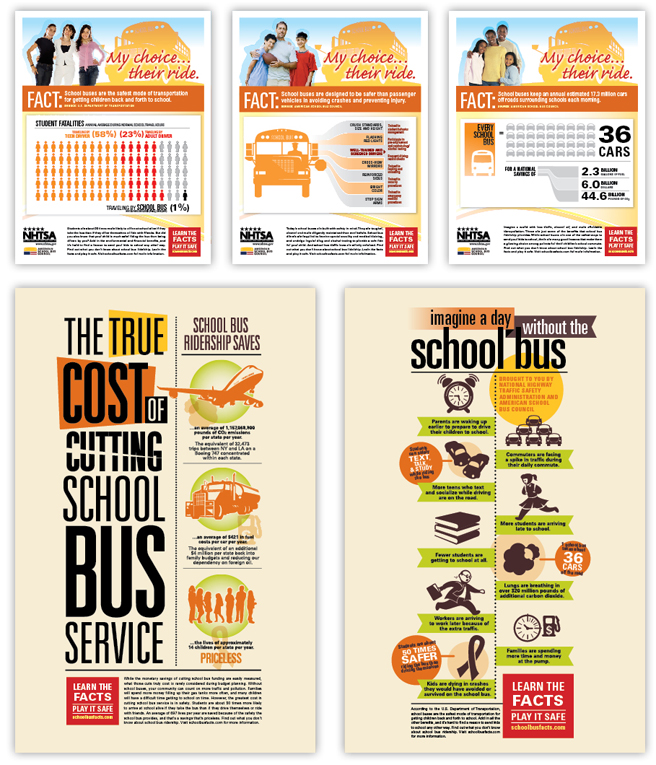
What failed first? Assumption. What changed the agency's mind? People in a room disagreeing with the creative premise. This sounds obvious until one notices how much marketing is designed to avoid precisely that encounter. Slides are kinder than strangers. A slogan in a conference room does not interrupt, squint, or call the supporting statistic suspicious.
“A campaign can't modify behavior unless those crafting the message understand the issues involved from the audience's perspective.”TMNcorp's statement of method
Three verbs, in the correct order
TMNcorp calls its model understand, adapt, connect. The order is the product. Understand means focus groups, interviews, segmentation, and the unhurried work of learning how an audience sees a problem. Adapt means shaping language and form around culture, experience, family, faith, ambition, and doubt. Connect means selecting media, community partners, events, and places where the message has a chance of being encountered.
Understand
Find the decision-maker, the barrier, and the believable evidence.
Adapt
Build language and creative around context, not a dictionary.
Connect
Use the channels, partners, and moments the audience already trusts.
That sequence separates cultural adaptation from translation. A translated sentence can be grammatically impeccable and socially inert. TMNcorp's work for the Centers for Disease Control and Prevention on folic-acid use among Spanish-speaking Hispanic women began by assessing existing materials and conducting exploratory focus groups across three audience segments. The resulting materials were tested again. The company reported a statistically relevant increase in knowledge and intent to take folic acid, with few revision requests from distributors.
For the Centers for Medicare & Medicaid Services, interviews with health professionals informed a multilingual mobile application that presented Medicare terminology in written and spoken English and Spanish. The surrounding campaign included e-books, podcasts, banners, newsletters, social content, and an online community. This is not a menu assembled for its own sake. One insight moves through several formats because a provider explaining a benefit, a patient hearing a term, and a caregiver looking it up are different moments.
Impressions are loud. Decisions are better.
The agency's public case studies offer the usual large numbers, but the more interesting figures describe consequences. A campaign encouraging Hispanic families in the Washington area to visit Baltimore generated five million impressions in two months. For the launch of Ana G. Méndez University System's dual-language program and local campus, TMNcorp combined Spanish television and radio, print, digital placements, bus shelters, recruitment kits, and a ribbon cutting. It reported more than 16 million impressions and enrollment 26 percent above the client's goal.
A NHTSA child-passenger-safety effort shows the distribution machinery. Spanish-language posters and a recommendation flyer framed caregivers as protectors of a child's future milestones. TMNcorp contacted Hispanic media, bloggers, and community organizations. In a matter of weeks, the agency reported 2.8 million impressions in 28 Hispanic media outlets; Telemundo and Univision carried stories; 17 blogs published material; and 33 social users shared it with more than 226,000 followers.
These are not consumer products with a checkout button. The product is more often an informed action: secure the car seat, consider the school bus, understand a Medicare benefit, take folic acid, enroll in a program. That puts TMNcorp in a particular part of the market, between a research consultancy, a multicultural agency, a public-relations shop, a creative studio, and a media buyer. The company sells projects and contracts rather than subscriptions. Its services run from strategy and evaluation to branding, digital and broadcast production, media relations, community outreach, translation, events, and placement.
What the work costs
Project-level prices are rarely published. One Maryland procurement makes the scale visible without pretending the ceiling was the final invoice. A competitive Department of Housing and Community Development contract began with up to $600,000 for three years of agency services plus a $2.4 million media budget. A two-year option raised the total ceilings to $1 million for services and $4 million for media. The media money was identified as pass-through spending. Montgomery County separately recorded TMNcorp among vendors on a $714,285 marketing-services award in 2022.
Total not-to-exceed ceiling after extension: $1M in services plus $4M in pass-through media. A ceiling is capacity, not proof that every dollar was spent.
The distinction matters. Buying an audience and understanding one are separate costs. TMNcorp's pitch is that the second makes the first less wasteful. Its named clients span CDC, CMS, FDA, NIH, EPA, NHTSA, the Census Bureau, Montgomery County, Visit Baltimore, the Corporation for Public Broadcasting, research contractors, universities, and communications firms. Competitors can be other public-sector agencies, specialist translators, research consultancies, or an internal team assembling those capabilities vendor by vendor.
The discipline is the deliverable
The part worth copying is small enough to fit on an index card. First, write down who you think the audience is and who has the power to act. Second, test several tones, including the clever one everyone in the room loves. Third, ask which claim was believed, not merely remembered. Fourth, adapt the message before choosing channels. Finally, connect through trusted people and places, then measure a behavior closer to the goal than raw reach.
This method needs conditions that are easy to name and hard to maintain. The client must allow research to overturn the brief. The schedule must leave time to revise. The audience sample must resemble the people expected to act. The agency needs access to credible community partners and evidence. Without those conditions, “cultural adaptation” can shrink into decoration, and a focus group can become theater performed after the decision has already been made.
TMNcorp's public portfolio is strongest where the subject is consequential and the audience is not generic: health, safety, education, the environment, public services. In those settings, the message before the message is respect. The parents in the school-bus room were not obstacles to a clever campaign. They were the people the campaign had failed to understand. Once that became clear, the work could begin.
Keep going
Visit the company, browse its campaign archive, follow its public profiles, or watch the school-bus animations connected to the featured work.