Chris Kempczinski picked up a burger, took a bite and gave the internet something to chew on. In early 2026, the McDonald’s chief executive recorded himself trying the Big Arch. He called it a “product.” The bite was modest. The response was not. Rival restaurant executives joined the fun with taste tests of their own. For a few days, a routine piece of corporate promotion became a public examination of how a hamburger ought to be eaten.
It was a peculiar examination for someone whose working life has revolved around understanding what people buy. Kempczinski had sold the idea of soap, beverages and packaged food before taking charge of the Golden Arches. He knew the language of consumer preference. Here, the audience wanted a less grammatical endorsement. A mouthful would apparently have done.
The episode is a useful place to begin because it makes the central difficulty of his job visible. McDonald’s is a business of operating systems, investment returns and brand management. Customers meet it through a bag, a counter, a price and a few minutes of their day. Its chief executive has to move between those worlds. Occasionally, he must do so while holding a very large burger.
Before the arches, a checkerboard lawn
Long before the burger video, there was a lawn in suburban Cincinnati. Growing up, Kempczinski was expected to mow it every weekend. His father wanted a particular checkerboard pattern. If the pattern was wrong, the work had to be done again. He later recalled the chore as an early lesson in standards: completing an assignment and completing it properly were separate achievements.
His father’s exacting approach supplies one of the more revealing details in his account of himself. He describes a childhood obligation that became a management habit, and admits he appreciated its purpose rather more in retrospect. The garden had, in effect, acquired a quality assurance department. Its youngest employee had limited appeal rights.
“You are what you settle for.”
Chris Kempczinski / 2023
He graduated from Indian Hill High School in 1987, then Duke University in 1991. A restaurant job had already given him a different education. At 16, he washed dishes. Looking back on those early jobs, he has stressed learning how to deal with customers and read people. The title at the top of a career history can obscure the useful, unglamorous work at the bottom.
His adult career began in brand management at Procter & Gamble. Harvard Business School followed, with an MBA in 1997, then a spell at Boston Consulting Group. These are familiar stops on an executive résumé, but their sequence matters. He learned to think about consumer products, stepped outside the operating company to advise businesses, and then returned to work where people had to choose something from a shelf or a menu.
An education in things people buy
At PepsiCo, which he joined in 2000, he worked in strategy and later beverage marketing. The American Advertising Federation inducted him into its Hall of Achievement in 2008, listing him as a vice president responsible for marketing noncarbonated beverages. His professional formation was already about a practical puzzle: how to make a familiar purchase feel worth choosing again.
Kraft broadened his responsibilities. He led its U.S. grocery business, became president of Kraft Canada and later took responsibility for international business and growth initiatives. The progression moved him across categories and borders. A product that works in one market needs more than a translated advertisement to work somewhere else. Distribution, local preferences and the people running the business all enter the calculation.
He joined McDonald’s in 2015 to lead strategy, business development and innovation. In January 2017, he became president of McDonald’s USA, responsible for roughly 14,000 restaurants. That was a substantial change in the unit of attention. Packaged goods reach shoppers through retailers. A restaurant company must also arrange the encounter itself, from the ordering process to the handover.
In November 2019, he succeeded Steve Easterbrook as president and CEO. McDonald’s had dismissed Easterbrook for violating company policy through a relationship with an employee. Kempczinski therefore inherited a question about conduct alongside the commercial agenda. In describing his early priorities, he emphasized listening and renewing the company’s values. The manner of the succession gave those words a specific obligation.
A global plan meets a local counter
Kempczinski’s account of McDonald’s gives local ownership a central place. Explaining the company to David Rubenstein, he connected the brand’s durability to franchising, consistent production and involvement in local communities. Those elements belong together. The arches promise something recognizable; the owner and restaurant team have to deliver it in a particular neighborhood, on a particular shift.
That makes the job more negotiated than the neat lines of an organization chart suggest. The company sets direction, but restaurants depend on franchisees committing money, managers organizing work and crew members doing it. A new initiative must make sense to people who experience its cost before they see its promised benefit. Enthusiasm at headquarters is helpful. It does not fill the order.
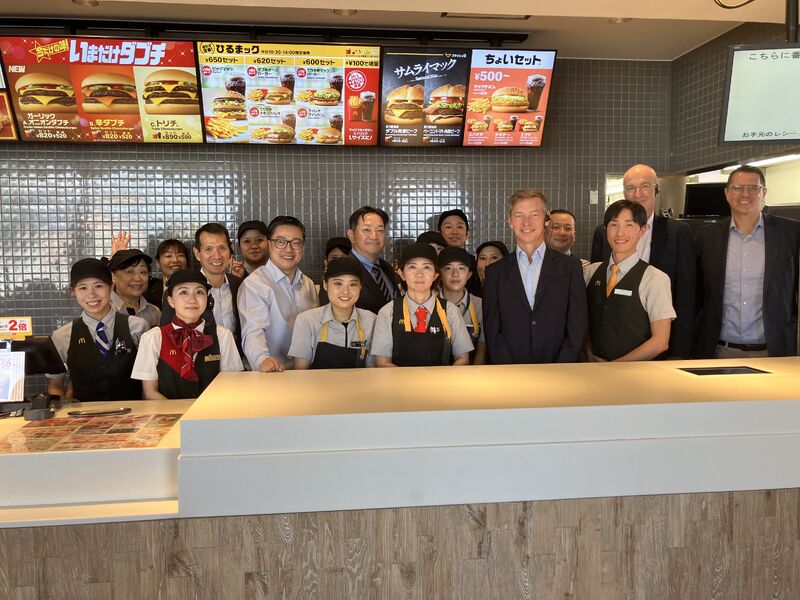
A visit to Japan, shared publicly by fellow executive Jo Sempels, offers a glimpse of this side of the work. Kempczinski met the local team, led by Thomas Ko, in a market whose menu includes the Samurai Mac. The photograph puts the executives behind the counter with restaurant employees. Local adaptation is easy to praise from a distance. Here it has faces, menu boards and a place to stand.
His 2020 growth strategy, Accelerating the Arches, put familiar advantages to work through marketing, core menu items and the ways customers order and collect food. Digital ordering, delivery and drive-thru made an established restaurant network available in different ways. The attraction was partly convenience. The harder work was making the channels fit the restaurant, where the orders eventually arrive together.
He has also argued for reducing complexity. A menu or process can acquire extra steps one reasonable decision at a time. Removing them can improve service and restaurant economics together. That is a less glamorous form of innovation than unveiling a new sandwich, though a customer waiting for lunch may find it considerably more persuasive.
The customer keeps the casting vote
For all his brand training, Kempczinski can be strikingly literal about demand. Asked about menu choices, he returns to what customers purchase. His old Pepsi connections have occasionally raised the question of putting their drinks into McDonald’s. His answer to Rubenstein was that changing customer preference would be the way to do it. Friendship gets a hearing. The order gets the decision.
That approach sits beside an interest in culture. He discussed campaigns involving Travis Scott and J Balvin as examples of meeting customers through their interests, and described marketing as a continuing exchange rather than a campaign sent out for a year. Once customers participate, a company has to accept some uncertainty about the reply. In 2026, he received an unusually vivid demonstration himself.
The Big Arch clip became an invitation for rivals and strangers to perform their own versions. In a later interview, he joked that his mother’s instruction against talking with his mouth full had contributed to the small bite. It was an appropriately domestic explanation for an episode surrounded by corporate analysis. There are situations in which good table manners are a marketing disadvantage.
His public visibility has brought more serious scrutiny, too. In November 2021, he apologized for a text to Chicago Mayor Lori Lightfoot that blamed parents following the shooting deaths of two children. The message prompted protests and criticism. He acknowledged that the remarks were wrong and that his perspective needed broadening. It remains a material part of his public record, especially beside his stated emphasis on listening.
What comes after acceleration?
By 2024, the board had added the chairmanship to his responsibilities. Outside McDonald’s, he had also returned to P&G as a director, joining its board in 2021. His connections now span the company where he learned brand management and the restaurant system he leads. He is also a trustee of Ronald McDonald House Charities. Chicago is home, with his wife and two children.
The immediate commercial picture is more complicated than the scale of the brand might suggest. McDonald’s reported global comparable sales growth of 1.3 percent for the second quarter of 2026, with the U.S. up 0.8 percent. U.S. comparable guest counts declined. Higher sales and more visits are different achievements; the distinction matters when repeat custom is the objective.
Sales rose. U.S. guest counts fell.
In August, the company appointed Skye Anderson president of McDonald’s USA. Kempczinski framed the move around improving execution in its largest market. Anderson brought more than 26 years at McDonald’s. The choice put an experienced insider into the American job he himself had held before becoming chief executive.
His next strategic chapter, McDonald’s > NEXT, was introduced in June 2026 and detailed for investors in September. It addresses food, customer relationships, restaurant operations and people. The ambition includes making hospitality count as more of the ordering journey becomes automated. Fewer conversations with employees make the remaining encounters carry more weight. An efficient transaction can still leave someone feeling overlooked.
The September plan included approximately $8.5 billion in partnering support through 2036, combining rent relief and capital support for modernization and operational improvements. Those are announced plans. Their value will depend on what restaurants deliver. For Kempczinski, the familiar challenge persists: persuade a large system to make changes that customers experience as something straightforward.
He began with brands that people put in shopping baskets. He now leads one they walk into, drive through and discuss with remarkable confidence. The checkerboard lawn has become a much larger assignment. Every restaurant must get its own pattern right. The customer is unlikely to admire the planning from Chicago. Lunch arrives, the bag opens, and the inspection begins.